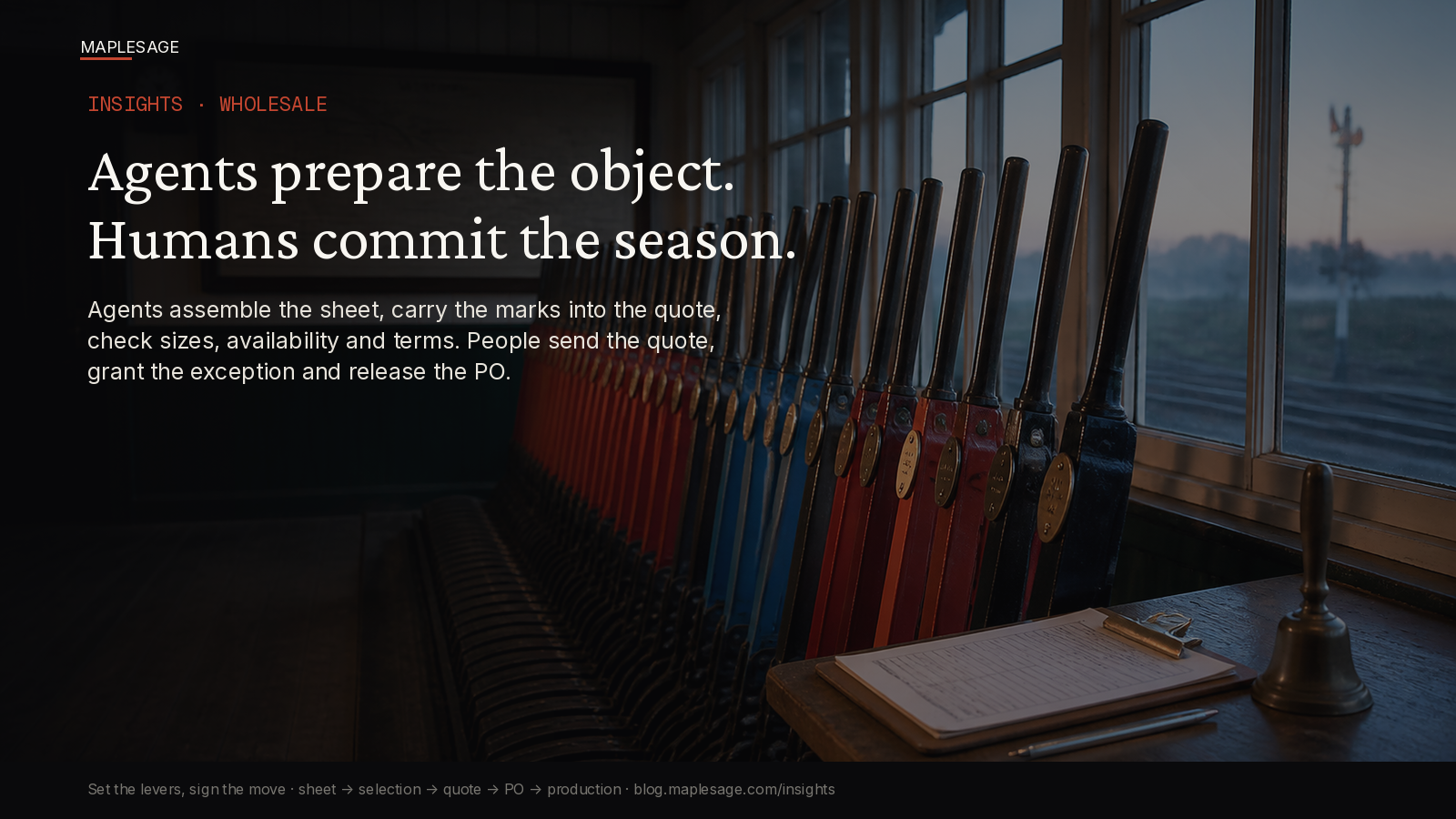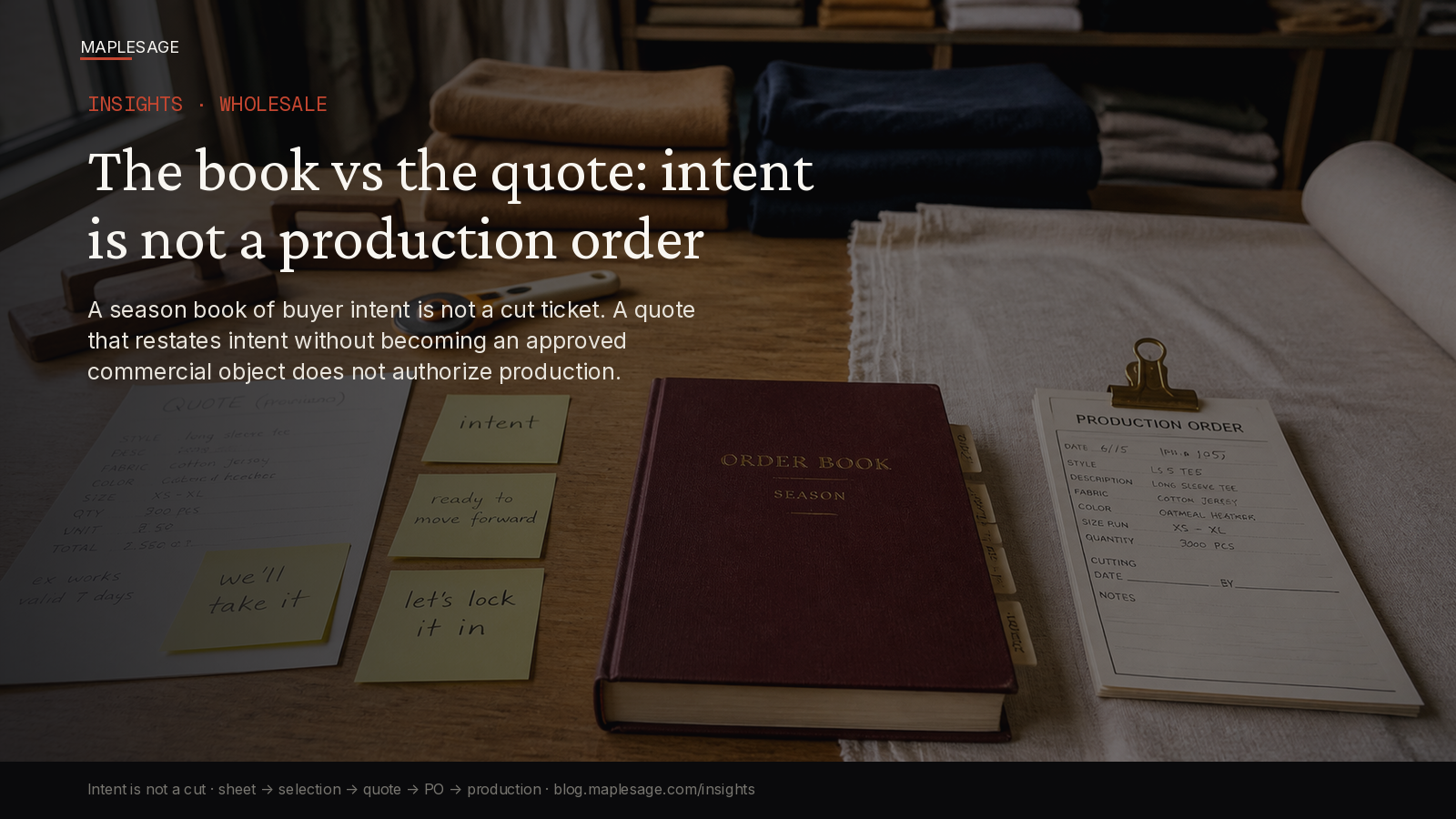
The sticky says “we’ll take it.” The cut ticket says when fabric leaves the roll. Those are not the same object.
Every wholesale season produces a pile of things people call “the book.” The buyer’s provisional buy. The rep’s notes from the appointment. The “we’ll take it” sticky on a style card. The spreadsheet that finance uses to guess how much fabric to order. None of those is a production order. Treating them as if they were is how mid-market AFL brands cut units nobody approved, miss units somebody did, and spend half the season arguing about what was actually committed.
This follow-up sits on the spine: showroom → account-aware line sheet → quote → size/assortment → approved PO → production. Day 13 said cut commitments without a canonical quote are folklore. Day 15 said “looks good” in email is not approval. Day 27 said selection has to become a quote without losing units. Day 29 said agents prepare the object and humans commit. This one draws the line the industry keeps blurring: the book is intent. The quote is a commercial proposal. Only an approved PO is a production order.
Three different objects
| Object | What it is | What it authorizes |
|---|---|---|
| The book / intent | What the buyer said they’d take, what the rep wrote down, the provisional buy for the account or the door | Nothing. It is a forecast and a conversation, not a cut. |
| The quote | A commercial proposal: styles, colourways, size runs, prices, dating, terms — one object the buyer can accept or revise | Negotiation. It is ready to be approved, not ready to cut. |
| The PO / production order | The approved commercial object released to production: same lines, same units, same terms, with a named approval | The cut. Fabric, capacity and delivery windows move on this, not on intent. |
When teams use “the book” to mean all three, they lose the ability to say which lines are provisional, which are proposed and which are committed. Production hears “the book is strong” and starts allocating. Finance hears “we booked it” and expects revenue. The buyer still thinks she was expressing interest.
Related: Cut Commitments Without a Canonical Quote Are Folklore. From Selection to Quote Without Losing Units. Why “Looks Good” in Email Is Not Approval.
How intent gets mistaken for a cut
The confusion is structural, not careless:
- The appointment creates a feeling of commitment. The buyer marked styles, talked units, nodded at a colourway. The room felt like a close. The sticky feels like a contract.
- The rep’s notes become the season narrative. “She’s taking the oatmeal tee across 40 doors” starts as a memory and ends as a fabric order, without a quote the buyer ever saw.
- Finance needs a number before the quote is ready. Greige, yarn and capacity deadlines arrive earlier than commercial approval. Someone fills the gap with the book.
- The word “booked” does double duty. In wholesale it can mean “on the provisional buy” or “on the PO.” Teams that don’t separate those meanings cut on the first and report the second.
- A quote that only restates intent looks finished. If the “quote” is a reprint of the sticky notes with prices typed in, it has the shape of a commercial object without the work: size curves, ATP, dating, MOQ, credit, door mix. It invites approval of something that was never built.
The result is familiar. Production cuts what the book promised. The buyer revises. The PO that finally lands doesn’t match the cut. Somebody eats the difference.
What belongs on the record
Intent can stay. It just has to stay labelled as intent.
- On the account’s sheet: provisional marks, colourway interest, door-level notes — clearly marked as not approved
- On the draft quote: every style, colourway and size run carried from the room, with prices, dating and terms applied, and every gap flagged (ATP short, MOQ break, credit hold)
- On the sent quote: a version the buyer can accept or revise, with a revision history
- On the approved PO: the same lines the quote held when it was approved, unit for unit, with a named person and a timestamp
- Off the record for the cut: sticky notes, WhatsApp “we’ll take it,” verbal nods, and any spreadsheet that only restates those
If a line can’t be traced from the buyer’s mark → the quote → the approved PO, it is not a production order. It is folklore wearing a season label.
Related: WhatsApp Exceptions That Never Reach the PO. Agents Prepare the Object. Humans Commit the Season.. Why Another CRM Won’t Hold Your Wholesale Book.
What it costs to cut on intent
Treat the book as a production order and the cost shows up in five places:
- The overcut cost. Fabric and capacity leave on lines the buyer never approved. The surplus becomes markdown or dead stock.
- The undercut cost. Intent that never became a quote never reached production. The account wanted the goods; the goods weren’t cut.
- The revision cost. When the real PO arrives, it doesn’t match the cut. Somebody rebuilds allocations by hand, and the delivery window slips.
- The trust cost. Buyers learn that “we’ll take it” somehow became a factory order. They stop marking freely in the room. Reps lose the signal the season needs.
- The audit cost. Finance asks who authorized the cut. “It was in the book” is not an answer. Neither is a sticky.
None of this is fixed by a better CRM contact card or a nicer showroom. It is fixed by keeping intent, quote and PO as different states of one commercial object.
Full spine: The Wholesale Season Breaks When the Sheet Stops Being the System.
What a clean handoff looks like
- Intent lives on the sheet as provisional. The buyer’s marks are captured, not retyped into a new file, and they stay labelled until a quote is built
- The quote is built from the marks, not from memory. Size curves, ATP, dating, MOQ and credit are applied before anyone calls it ready to send
- Sending the quote is a named step. Not a reply-all, not a PDF dropped in a thread without a version
- Approval is acceptance of that quote (or a dated revision of it). “Looks good” in email is not enough; the record needs who and when
- The PO is the approved quote, released. Same lines, same units, same terms — into production
- Production only moves on the PO. Greige and capacity planning can use intent as a forecast. The cut uses the approved object
The book can be thick. The sticky notes can be honest. Neither one clips to the fabric.
ICP framing
For mid-market AFL brands selling to retailers (roughly $10M to $250M wholesale), confusing the book with the PO affects:
- how much fabric and capacity get committed before a buyer has approved a quote
- how often the PO that lands matches what production already cut
- whether reps can defend what they “booked” when finance or the factory asks for proof
- whether buyers still mark freely in the room, or stop because intent somehow became a cut
It isn’t an argument against provisional buys, season planning or early fabric cover. Those are forecasts. Forecasts are not cut tickets.
Heads of wholesale feel it when production asks “is this booked?” and nobody can say whether that means intent, quote or PO.
Product proof note: the Retail-OS wholesale path
MapleSage Retail-OS keeps the season as one commercial object: the account’s sheet holds provisional marks as intent; the quote is built from those marks with sizes, availability and terms applied; approval is a named step; the PO released to production is the approved quote, unit for unit. Intent stays visible. It does not authorize the cut.
See the buyer path: b2b.maplesage.com. Wholesale surface: www.maplesage.com/retail/wholesale/. Talk: go.maplesage.net.
What we won’t pitch
- Treating sticky notes or provisional buys as production orders
- A CRM that stores “the book” as contacts and calls that a wholesale system
- Product UI screenshots as the hero for a commercial argument
Next step
Pull last season’s ten largest cuts. For each one, find the document that authorized fabric to leave the roll. Label it: intent, quote, or approved PO. Count how many cuts moved on intent alone, how many on a quote nobody can prove was approved, and how many on a named PO. The first two columns are where the season leaks.