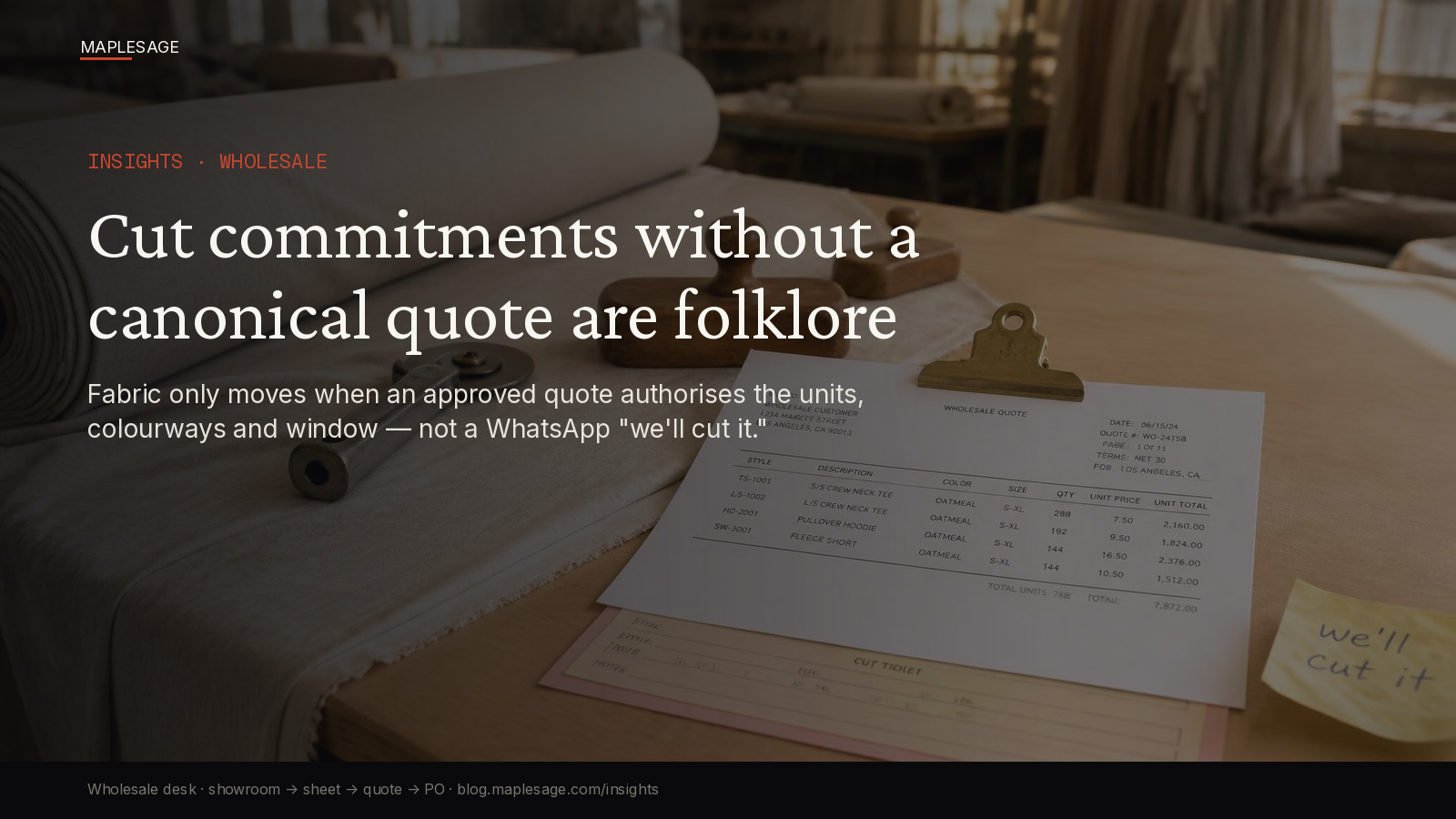
If the cut doesn’t point at an approved quote, it isn’t a commitment. It’s folklore with a ticket number.
Every wholesale season has the same quiet failure. A buyer says they sold the style. A rep texts the mill “we’re cutting it.” A planner opens a cut ticket off that message. Fabric moves. Labour books. The season clock starts — and nobody can point at a single approved quote that says which units, which colourways, which window, for which account.
Then the PO arrives with different units. Or the colourway list on the cut doesn’t match the sheet. Or the window on the mill ticket is three weeks earlier than the dating on the quote. The cut that felt like progress becomes an argument with three different “versions of the truth,” none of them the commercial object.
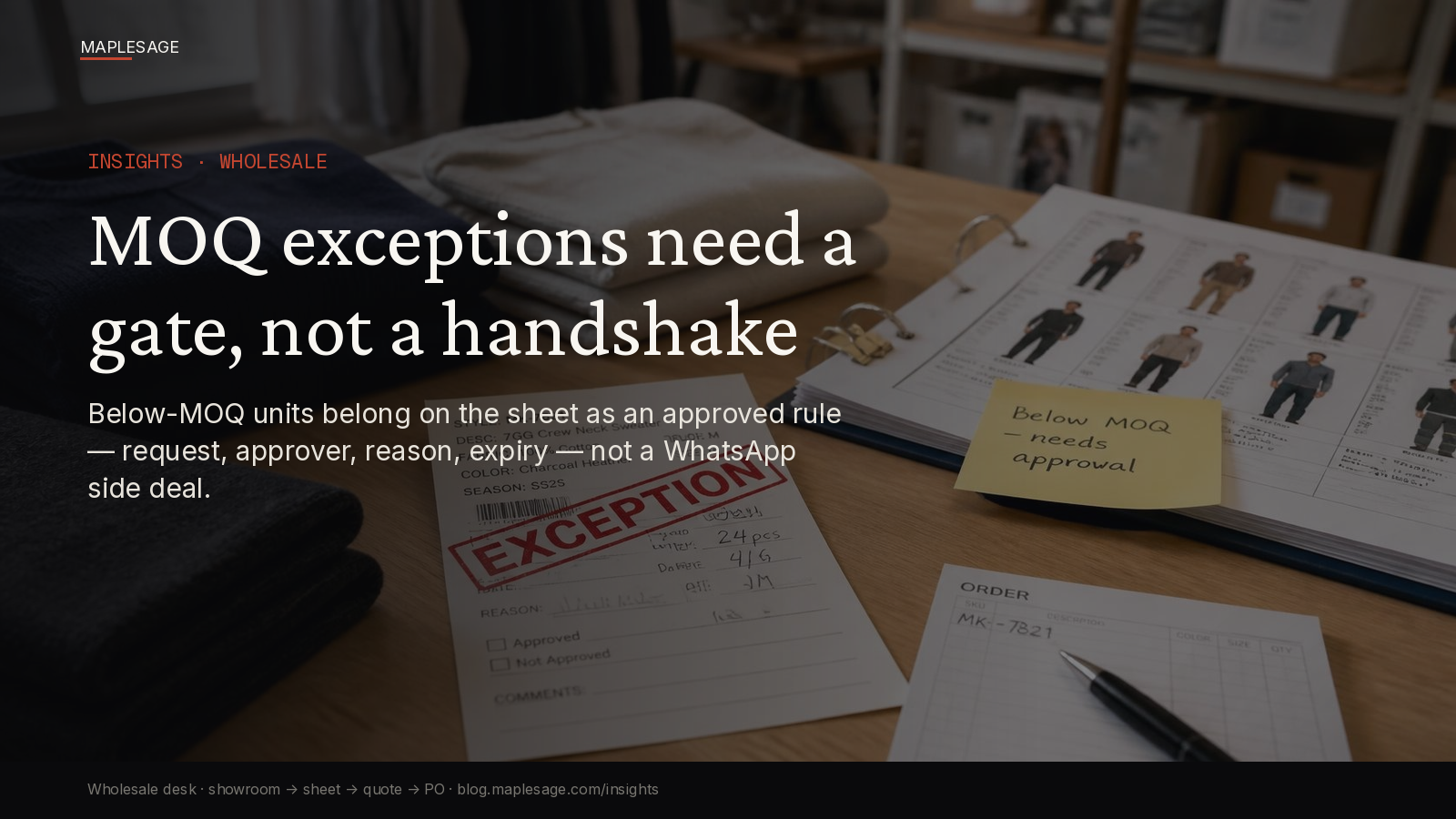
This follow-up sits on the spine: showroom → account-aware line sheet → quote → size/assortment → approved PO. Day 4 made the PO the end of a commercial object. Day 11 put the buyer’s marks on the sheet so the rep doesn’t re-enter them. Day 12 gated MOQ exceptions. This one is about the next irreversible step: the cut must be gated by the canonical quote, not by a side commitment.
The misuse
Cut and mill commitments get treated as operational urgency. Somebody sold something; start the fabric before the paperwork catches up.
In wholesale, a cut is a commercial decision that already carries:
- Which account and door the units belong to
- Which styles, colourways and size curves the mill should cut
- Which ship window or drop the fabric is meant for
- Which approved quote (and PO, when it exists) is the source of those numbers
- Who authorised the start when the PO isn’t clear yet
When those live in a WhatsApp “we’ll cut it,” the quote still looks clean, the sheet still looks current, and the mill is already running on folklore. The only people who know why those units are on the table are the two who sent the message — and by the time finance or planning need the record, the chat is buried and the fabric is already cut.
Nobody meant to invent a second source of truth. The commitment just never sat on the object the cut ticket is supposed to read.
Folklore cut vs quote-gated cut
| Moment | Folklore cut | Quote-gated cut |
|---|---|---|
| Trigger | Verbal / WhatsApp / email “we sold X” | Cut requested against an approved quote ID |
| Units | From memory or a side note | From the quote lines as approved |
| Colourways | Often paraphrased or partial | Exact colourway list on the quote |
| Window | “ASAP” or a date in the chat | Ship window / drop on the quote |
| Account | Implied from the conversation | Named account (and door, when required) on the quote |
| On the cut ticket | Ticket number, no commercial pointer | Ticket carries quote ID (and PO when clear) |
| Change control | New chat revises the cut mid-table | Quote amendment required before re-cut |
| Overcut / undercut | Discovered when the PO or ASN arrives | Caught because cut quantity must match quote |
| Audit | “We agreed to cut it” | Which quote authorised which units, when |
The folklore desk asks: who said we were cutting this? The gate desk doesn’t have to ask, because the cut ticket points at the same quote the buyer and finance already approved.
Why the folklore cut is too expensive
A “we’ll cut it” text looks like speed. It is where three of the season’s loudest costs start:
- The mismatch cost. Units, colourways and windows from a chat diverge from the quote. The mill cuts what was said; the PO clears what was approved. Somebody eats the difference — usually in dead fabric or a rush re-cut.
- The overcut / undercut cost. Without a canonical quantity, planners round up “to be safe” or cut short because somebody remembered a smaller number. Either way, the account gets the wrong depth, and the next door ask repeats the chaos.
- The ownership cost. When the cut goes wrong, there is no commercial object to open. The debate becomes whose message was latest — not which approved quote the mill was supposed to follow.
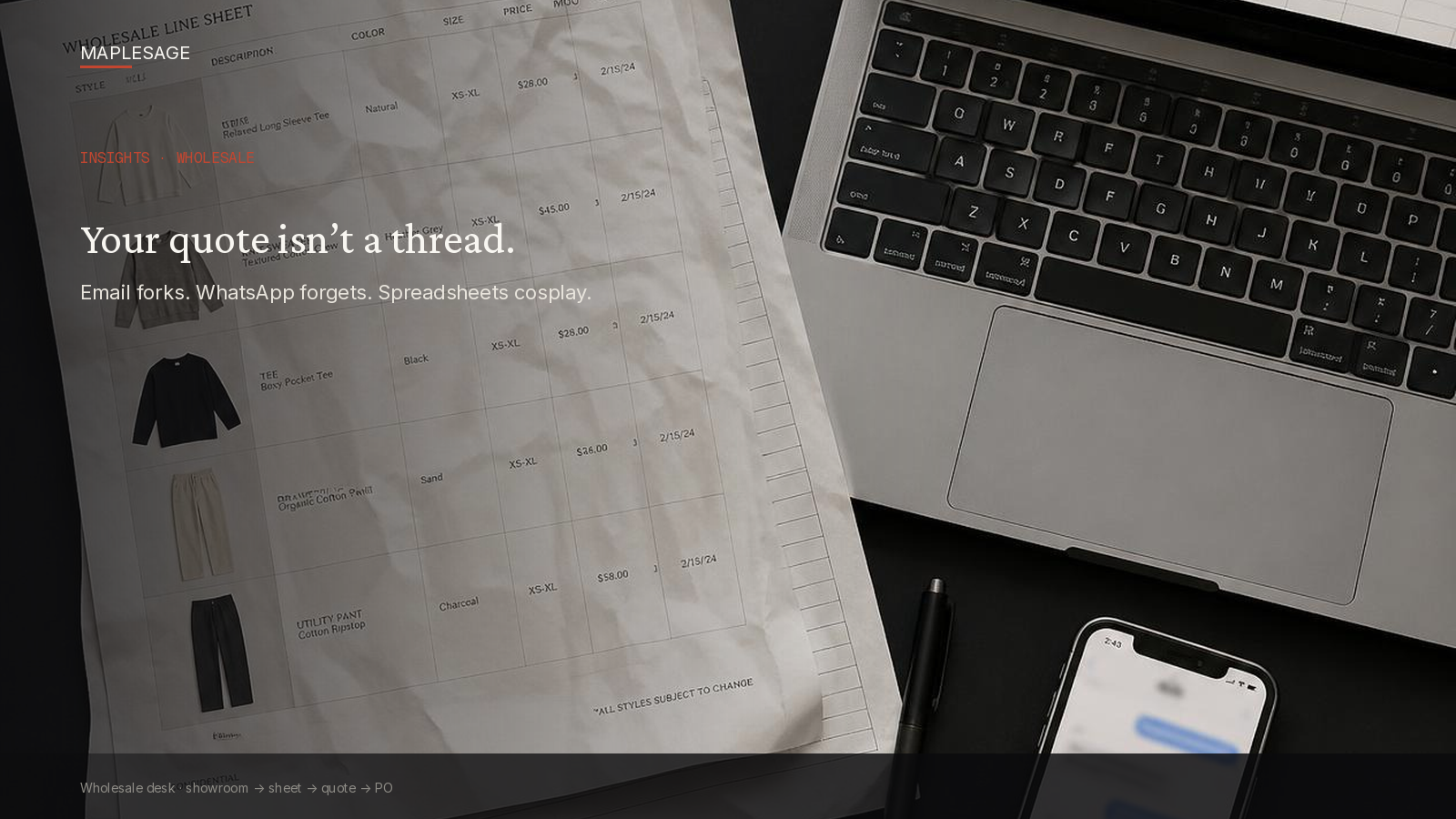
Related: Your Quote Isn’t a Thread. The PO Is Not a Form. ATP on the Buy. MOQ Exceptions Need a Gate, Not a Handshake. The Rep Shouldn’t Re-Enter What the Buyer Already Marked. Account History Is Assortment Logic. Full spine: The Wholesale Season Breaks When the Sheet Stops Being the System.
What the gate must carry
A cut only belongs on the mill floor if it carries enough for planning and finance to trust it:
- Canonical quote ID: the cut ticket points at one approved quote — not a chat thread
- Line fidelity: units, colourways, size curves and windows match the quote lines exactly
- Account / door scope: who the cut is for is on the ticket, not implied
- Authority when PO isn’t clear: named approver and reason if the cut starts before PO — still against the quote, not instead of it
- Change control: any unit/colourway/window change amends the quote (or issues a new one) before the re-cut
- Hard stop: no cut ticket without a quote pointer; no silent “we’ll fix the paperwork later”
- Visible status: planners and finance can open the quote and see the cut commitment that followed from it
When those live on the commercial object, the cut is a governed start. When they live in WhatsApp, it’s folklore with a ticket number.
ICP framing
For mid-market AFL brands selling to retailers (roughly $10M to $250M wholesale), whether cuts are quote-gated or folklore-triggered is an input to:
- how often mill tickets disagree with the approved quote
- how much fabric is overcut or undercut against the real buy
- how hard it is to explain a wrong colourway run when the only “approval” was a chat
- how fast urgency becomes a second operating system beside the sheet and quote
It isn’t a stricter mill SOP PDF, a longer email CC list before every cut, or a shared drive of “cut commitment” spreadsheets that nobody updates after market week.
Heads of wholesale feel it when planning asks which quote authorised last week’s cut — and the only answer is a search through chat.
Product proof note: the Retail-OS wholesale path
MapleSage Retail-OS keeps the cut on the same account-aware commercial object as the sheet and quote: approved quote as source of truth, line fidelity into the cut ticket, visible status for planning and finance, and no mill start that can’t point at the canonical quote. The side commitment becomes a governed gate, not folklore.
See the buyer path: b2b.maplesage.com. Wholesale surface: www.maplesage.com/retail/wholesale/. Talk: go.maplesage.net.
What we won’t pitch
- “AI that reads your cut WhatsApps into the ERP” as a fix for ungated mill starts
- A longer cut-commitment policy PDF that still leaves the trigger in the chat
- Competitor cut-ticket or PLM screenshots as the hero
Next step
If your cut tickets still open because somebody said “we’ll cut it” in a chat, stop treating that as a commitment process. Put the quote ID, line fidelity and change control on the ticket — so fabric only moves when the canonical quote has actually authorised it.