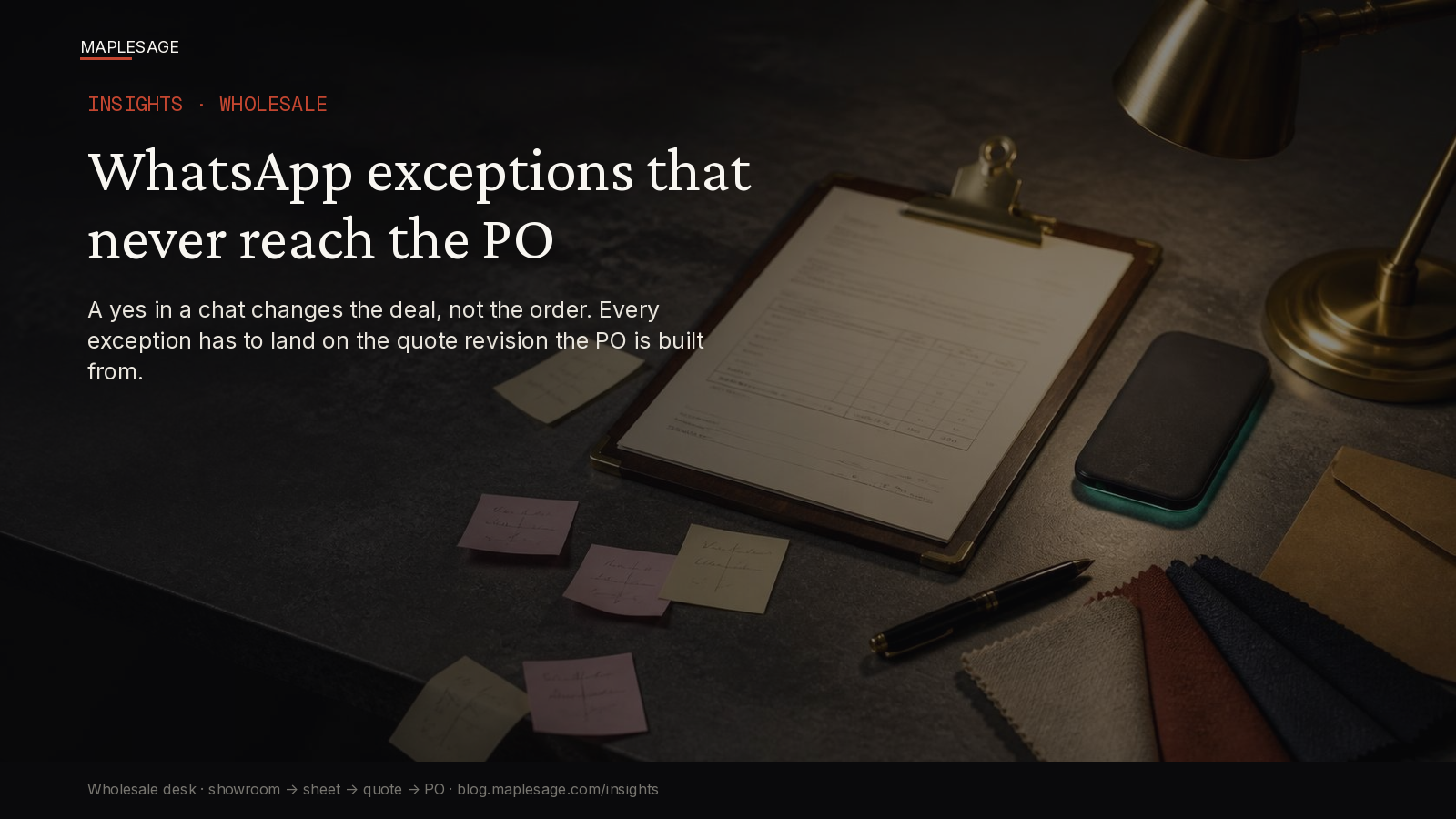
The yes was real. It just never made it onto the paper anyone ships from.
It’s 9:40 at night, two days after market. The buyer messages the rep: can the knit cardigans ship two weeks later, can the rust colourway swap to navy on doors 3 to 5, and can they keep the 8% they talked about at the table. The rep replies “done, no problem” with a thumbs up. Everyone goes to sleep happy.
The PO is generated the next morning from the quote. The quote still has the original ship window, the rust colourway and the standard price. The warehouse picks rust. Finance invoices at list. The buyer receives the wrong colour early, at the wrong price, and forwards a screenshot of the chat.
This follow-up sits on the spine: showroom → account-aware line sheet → quote → size/assortment → approved PO. Day 1 said the quote isn’t a thread. Day 12 said MOQ waivers need a gate. Day 15 said “looks good” isn’t approval. This one names the general leak behind all of them: an exception agreed in a chat that never reaches the commercial object never reaches the PO.
The misuse
Chat is where wholesale actually negotiates. It’s fast, it’s personal, and buyers like it. The misuse isn’t using WhatsApp. It’s treating the chat as the record.
The exceptions that most often live only in chat:
- Price: an extra discount, a matched price, a free-freight promise, a one-off allowance
- Dates: a later ship window, an earlier cancel date, a split delivery across drops
- Assortment: a colourway swap, a substitution for a short style, a style added after the sheet closed
- Quantity and size: a below-MOQ line, a changed size run, units moved between doors
- Terms: extra dating, a different payment term, a returns or markdown allowance
- Logistics: a different ship-to, a packing or labelling request, a routing guide exception
Each one changes what the brand has committed to. None of them changes the quote unless someone goes back and edits it, by hand, from memory, later.
Exception in chat vs exception on the commercial object
| Moment | Exception lives in WhatsApp | Exception lands on the quote |
|---|---|---|
| Agreed | “Done, no problem” in a chat | Change requested on the quote line or header it affects |
| Who knows | The rep and the buyer | Rep, buyer and every team that reads the quote |
| Approval | Implied by the rep’s reply | Routed to whoever owns that kind of exception |
| Record | Screenshots on two phones | New quote revision with who, what, when and why |
| PO | Generated from the quote without the change | Generated from the revision that includes the change |
| Warehouse | Picks the original colour and window | Picks what was actually agreed |
| Finance | Invoices list price and standard terms | Invoices the agreed price, terms and dating |
| Dispute | “We agreed on WhatsApp” | The revision shows what was agreed and approved |
The chat desk asks: did the rep say yes? The commercial-object desk asks: is the yes on the revision the PO will be built from, and did the right person approve it?
Why chat-only exceptions are too expensive
A thumbs up costs nothing to send. It carries four costs that arrive later:
- The mismatch cost. The PO, the pick, the invoice and the buyer’s expectation now describe four different orders. Every mismatch becomes a credit note, a re-ship, a return or a phone call.
- The approval cost. The rep agreed something they may not have been allowed to agree. Discounts, dating and below-MOQ lines usually belong to someone else, who finds out when the margin report or the cutting plan doesn’t add up.
- The memory cost. Exceptions are re-keyed from chat into the quote, or into the ERP after the PO, by whoever remembers. When the rep is travelling, on leave or gone, the exception goes with them.
- The visibility cost. Because the real terms are spread across private chats, the head of wholesale can’t see how much was given away in a season, to which accounts, or by whom, until the invoices and returns show it.
Related: Your Quote Isn’t a Thread. Door Terms Belong on the Sheet. When Finance Discovers Dating Late. MOQ Exceptions Need a Gate. Why “Looks Good” in Email Is Not Approval. The PO Is Not a Form. Full spine: The Wholesale Season Breaks When the Sheet Stops Being the System.
What has to be true for an exception to reach the PO
Banning WhatsApp won’t work, and it isn’t the point. The point is that the chat is where the request starts, not where it ends:
- One place exceptions land: every price, date, assortment, quantity, term or logistics change is recorded on the quote line or header it affects
- Exception types named: discount, ship window, cancel date, substitution, size change, below-MOQ, dating, ship-to, each with its own field, not a free-text note
- Owners per type: the rep can agree some changes; discounts past a threshold, extra dating and below-MOQ lines route to the person who owns them
- A new revision, not an edit: each agreed exception creates a revision with who requested it, who approved it, when and why
- The buyer sees the same revision: the buyer confirms the revision, not a chat message, so both sides hold the same version
- The PO comes from the approved revision: nothing agreed after the last approved revision reaches the warehouse or finance until it’s on a new one
- Late exceptions visible: a change asked for after the PO opens as a change against that PO, not a quiet edit in the ERP
When exceptions land on the commercial object, the chat stays fast and the PO stays true. When they don’t, the brand ships one order and the buyer remembers another.
ICP framing
For mid-market AFL brands selling to retailers (roughly $10M to $250M wholesale), where exceptions land is an input to:
- how many credit notes, re-ships and invoice disputes each season produces
- how much discount, dating and below-MOQ volume was given away without the owner’s approval
- how much the order depends on one rep’s phone and memory
- whether wholesale leadership can see the season’s real terms before the invoices and returns arrive
It isn’t a chat ban, a shared “exceptions” spreadsheet that nobody updates after market week, or a tool that copies chat messages into the ERP after the PO has shipped.
Heads of wholesale feel it when an account disputes an invoice with a screenshot, and the screenshot is right.
Product proof note: the Retail-OS wholesale path
MapleSage Retail-OS keeps the line sheet, the quote and the PO as one account-aware commercial object. Exceptions such as price, ship window, substitution, size, MOQ and dating are requested on the line they change, routed to their owner, and saved as a new revision that the buyer confirms; the approved revision converts to the PO.
See the buyer path: b2b.maplesage.com. Wholesale surface: www.maplesage.com/retail/wholesale/. Talk: go.maplesage.net.
What we won’t pitch
- “Stop using WhatsApp” as a wholesale process
- AI that reads chats and edits the PO without an approval
- Chat-app or competitor screenshots as the hero
Next step
Take ten POs from last season that ended in a credit note, a re-ship or an invoice dispute. For each, find where the change was first agreed: on the quote, in email, or in a chat. Count how many were agreed in a chat and never reached a quote revision. That count is the work your PO is leaving to memory.