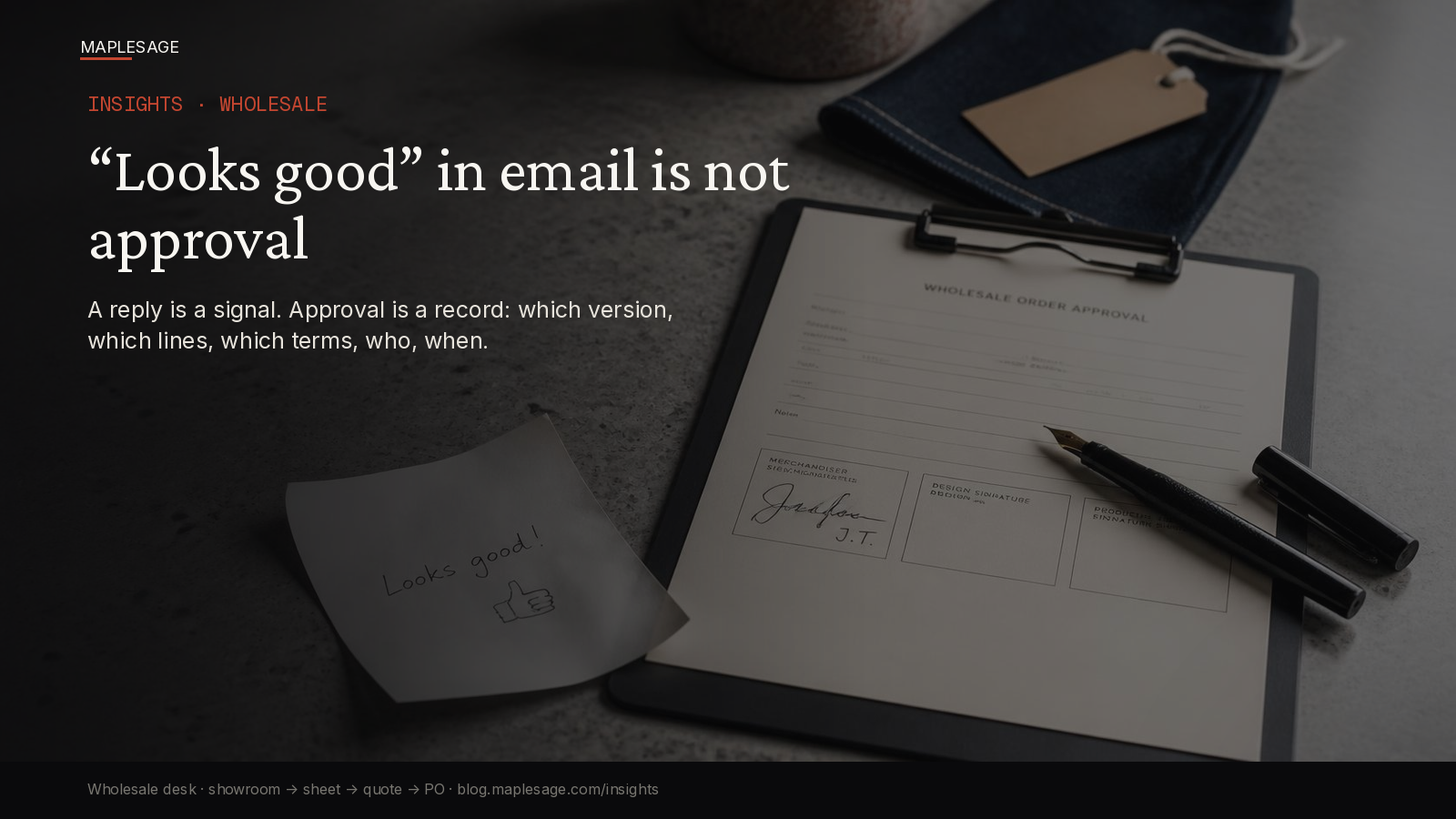
“Looks good” is a feeling. Approval is a record: who, which version, which lines, which terms, when.
Every wholesale team has this thread. The rep sends the buyer a revised quote on Tuesday night. The buyer replies “looks good 👍” from a phone on Wednesday morning. The rep forwards it to customer service with “approved, please enter.” The order goes in. Planning books the units against the windows.
Three weeks later the buyer disputes the price on two styles, says the size curve was never agreed and points out that the reply was to the Monday version, not the Tuesday one. Finance asks who approved the extended dating. Nobody can say, because the only proof is two words in an inbox, attached to a thread that has four PDFs in it.
This follow-up sits on the spine: showroom → account-aware line sheet → quote → size/assortment → approved PO. Day 1 said the quote isn’t a thread. Day 4 made the PO the end of a commercial object. Day 12 put a gate on MOQ exceptions. This one is about the word every PO depends on and almost nobody records properly: approved. An email reply is a signal. It isn’t approval.
The misuse
Email sign-off gets treated as approval because it’s fast and everyone already does it. The buyer said yes in writing; what more do you need?
In wholesale, approval has to answer specific questions. A real approval on a wholesale order already carries:
- Which version: the exact quote revision being agreed, not “the latest attachment”
- Which lines: the styles, colourways, size curves and units in scope, including what was dropped
- Which terms: door pricing, breaks, dating, deposit and ship windows that apply
- Who: a named approver with the authority to commit the account (buyer, and on your side finance or the wholesale lead where the deal needs it)
- When: a timestamp tied to that version, so later edits are visibly new and need their own approval
“Looks good” answers none of them. It replies to a thread, not a version. It doesn’t say which attachment was opened. It doesn’t distinguish “the styles look good” from “I commit to these units at these terms.” And it often comes from someone who can say yes to the assortment but not to the money.
Nobody is acting in bad faith. The reply felt like a yes to the rep, and it felt like “I glanced at it” to the buyer. The problem is that the PO got built on the rep’s reading.
Email sign-off vs approval on the quote
| Moment | “Looks good” in email | Approval on the quote |
|---|---|---|
| Version | Reply to a thread with several attachments | Approval pinned to one quote revision |
| Scope | Unclear: styles, units, terms or all three? | Lines, curves, units and terms listed in what was approved |
| Authority | Whoever replied first | Named approver(s) per the account’s approval rule |
| Terms | Dating and deposit “as discussed” | Terms on the quote, approved with it |
| Later edits | New attachment, same thread, assumed still approved | Any edit creates a new revision that needs approval again |
| Order entry | CS re-keys from the email and the PDF it thinks was meant | PO converts from the approved revision; nothing to interpret |
| Disputes | Inbox archaeology across four PDFs | One record: who approved which version, when |
| Finance view | “Did anyone approve this dating?” | Approval and terms visible before the PO is accepted |
The email desk asks: what did they actually say yes to? The quote desk doesn’t have to, because the yes is attached to the thing it agreed.
Why email approval is too expensive
Treating a reply as approval looks efficient. It quietly carries three costs:
- The dispute cost. When the invoice or the delivery doesn’t match what the buyer thinks they agreed, the only evidence is a thread. Credits, chargebacks and re-ships get negotiated from memory, and the brand usually concedes.
- The re-keying cost. Customer service has to work out which attachment the “looks good” referred to, then enter it by hand. Every interpretation is a chance to put the wrong curve, window or price on the PO.
- The control cost. Finance and the wholesale lead can’t see what was approved until it’s already an order. Extended dating, below-MOQ lines and off-list breaks slip through because the approval never passed through anyone who could say no.
Related: Your Quote Isn’t a Thread. The PO Is Not a Form. When Finance Discovers Dating Late, the Season Already Lost. MOQ Exceptions Need a Gate, Not a Handshake. The Rep Shouldn’t Re-Enter What the Buyer Already Marked. B2B Portals Don’t Fix Fragmented Quotes. Full spine: The Wholesale Season Breaks When the Sheet Stops Being the System.
What has to be true for a yes to count
Approval only does its job when it lives on the same object the PO is built from:
- Approve a revision, not a thread: every quote has a version, and an approval points at exactly one
- Show the scope at the moment of approval: lines, curves, units, windows and terms visible on the thing being approved, not in an attachment
- Named approvers by rule: the account’s buyer approves the buy; finance or the wholesale lead approves terms, dating or exceptions that need them
- Edits reopen approval: change a unit, a curve or a term and the revision moves, with history; the old yes doesn’t carry over
- Exceptions route, not ride along: below-MOQ, off-list price or extended dating goes to its approver before the quote can be accepted
- The approved revision becomes the PO: no re-keying from email, no guessing which PDF was meant
- Email becomes a notification: the reply can still say “looks good”; the system just links it to an approval step that records the real thing
When those live on the quote, the buyer’s yes is unambiguous and the brand can stand behind it. When they don’t, every order rests on someone’s reading of an inbox.
ICP framing
For mid-market AFL brands selling to retailers (roughly $10M to $250M wholesale), whether approval lives on the quote or in a reply is an input to:
- how many disputes, credits and chargebacks trace back to “that’s not what we agreed”
- how often customer service enters a PO from the wrong attachment
- how much off-list pricing, extended dating or below-MOQ business reaches the PO without finance seeing it
- how long it takes to answer “who approved this?” when a retailer escalates
It isn’t a new e-signature tool bolted onto the PDF, a stricter email policy or another “please confirm by reply” template that still leaves the approval in the inbox.
Heads of wholesale feel it when the season review turns up a dispute log full of email screenshots and nobody can show which version was agreed.
Product proof note: the Retail-OS wholesale path
MapleSage Retail-OS keeps the quote as one account-aware commercial object from the showroom to the PO, with versions, named approvers and governed exceptions on the quote itself. The buyer approves a specific revision; finance and the wholesale lead see the terms before acceptance; the approved revision converts to the PO.
See the buyer path: b2b.maplesage.com. Wholesale surface: www.maplesage.com/retail/wholesale/. Talk: go.maplesage.net.
What we won’t pitch
- “Just ask buyers to reply APPROVED in caps” as an approval process
- An e-signature on a PDF that’s already out of date by the next revision
- Inbox or competitor approval-screen screenshots as the hero
Next step
If your POs are entered from “looks good” replies, pull the last five disputed orders and check which version the reply actually referred to. Then put the version, scope, approver and timestamp on the quote, and let the email just tell people it happened.