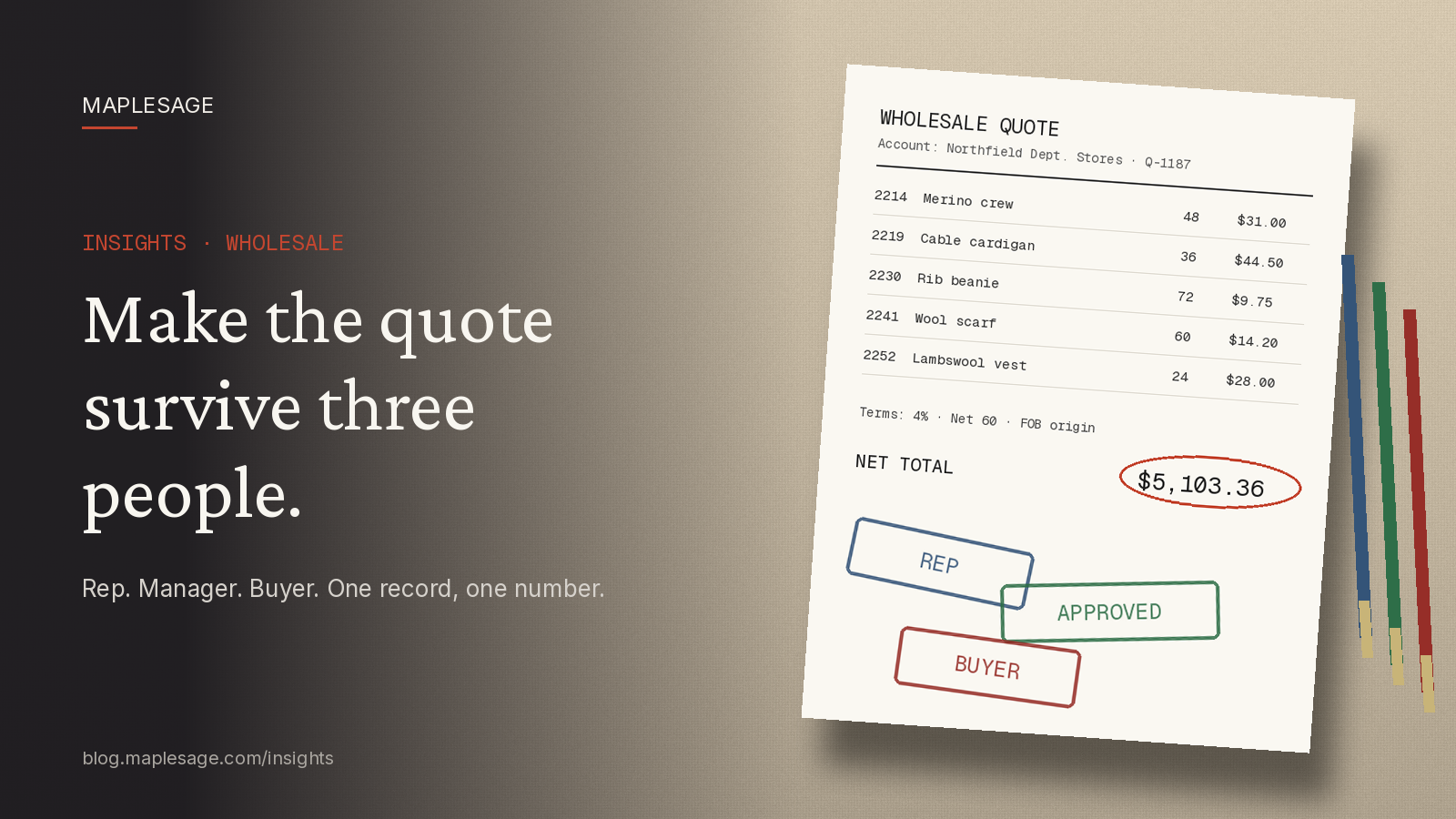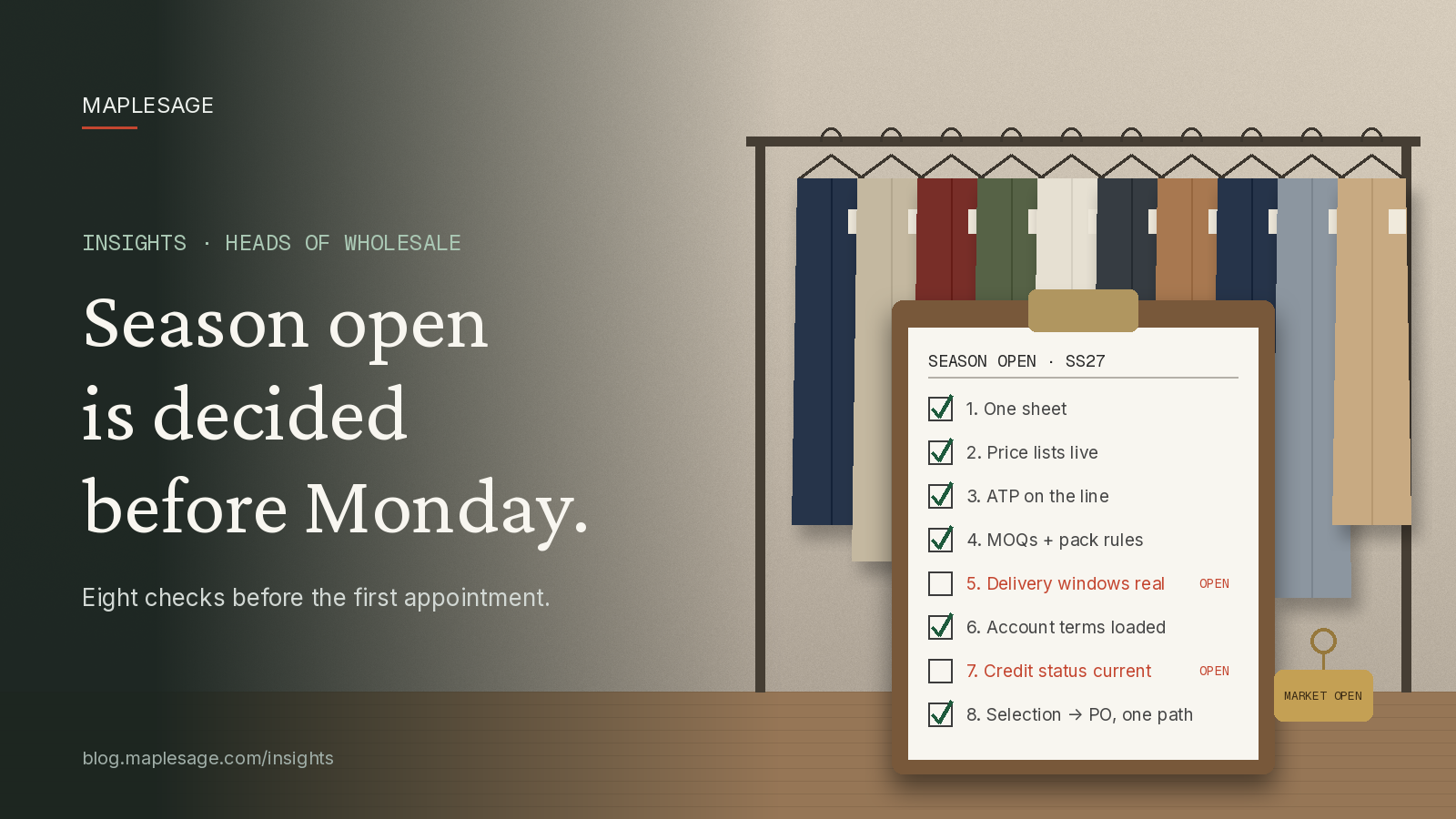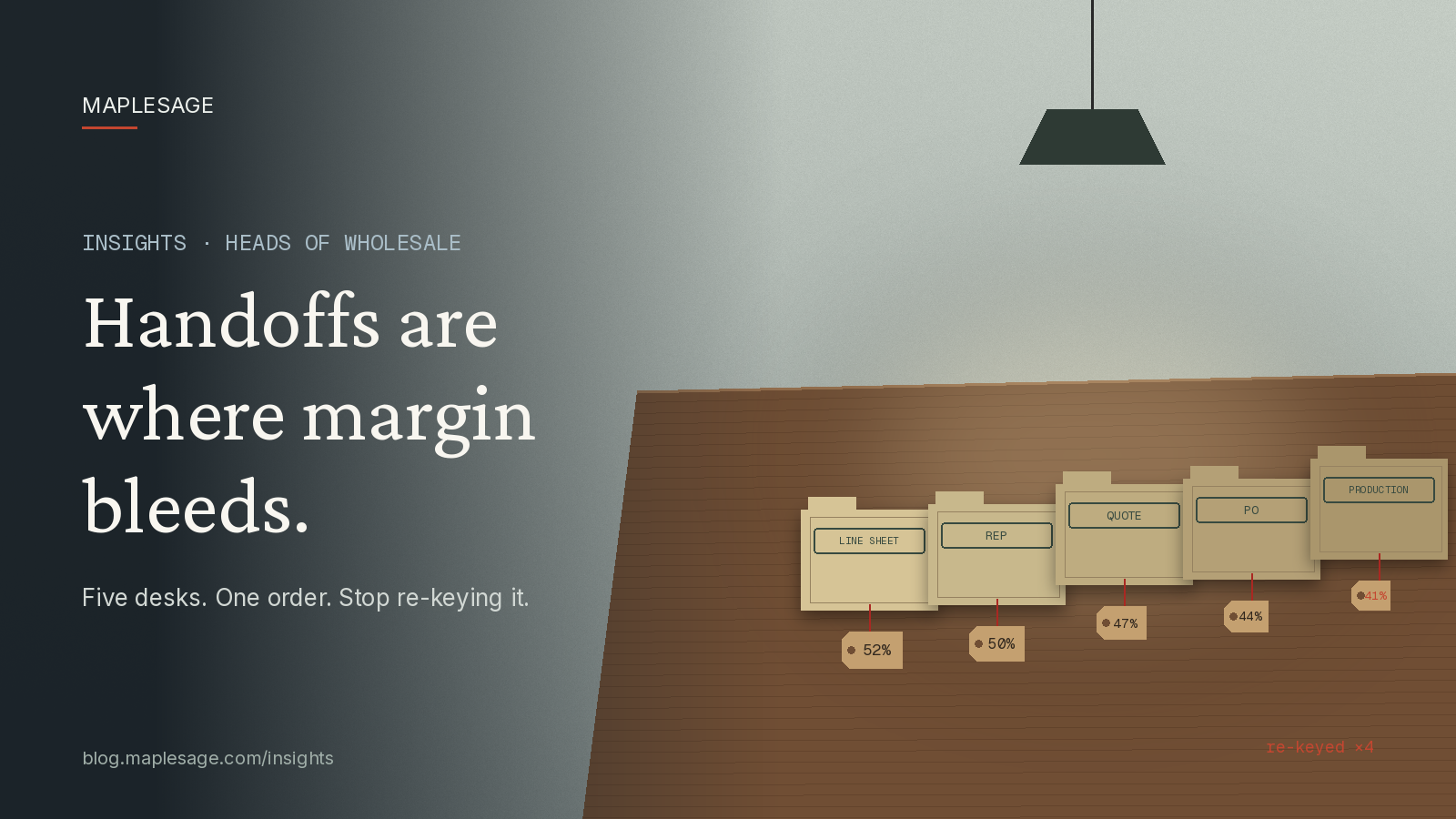
Same order, five desks. The margin tag gets smaller every time it changes hands.
Nobody on a wholesale team decides to give away margin. The costing was right. The price list was right. The buyer agreed the number. And still, when the season closes, realised margin on the big accounts is three to eight points below what was planned.
Look for where it went and you rarely find one bad decision. You find a dozen small ones, each made at the moment an order changed hands.
Why handoffs leak
Every handoff is a re-entry. Someone reads a number from one place and types it into another: a line sheet into a deck, a deck into an email, an email into a quote, a quote into the ERP, the ERP into a factory sheet. Every re-entry is a chance to round, drop a condition, use an old file or approve something informally “just this once.”
Each slip is small. Across hundreds of orders and five or six handoffs per order, it compounds.
The five handoffs to map
1. Sheet to rep. The line sheet leaves merchandising and lands with reps as a PDF or a spreadsheet copy. From then on, every price or availability change has to chase every copy. Leak: reps selling at last week’s price or offering styles that were already dropped.
2. Rep to buyer. The rep builds a selection in the room, on a tablet, in a notebook or on WhatsApp. Leak: discounts, free freight and extended dating agreed verbally to close the appointment, with no record attached to the order.
3. Buyer to quote. The selection becomes a quote someone keys up later. Leak: pack rules and MOQs ignored, lines rounded, special terms left out because they were “in the email.”
4. Quote to PO. The approved quote becomes a PO in the ERP or order system, typed again. Leak: price or quantity changes after approval that nobody reconciles against what the buyer actually signed.
5. PO to production. The PO becomes production demand on a factory sheet. Leak: delivery windows promised that production never confirmed, so the brand pays for air freight or eats a cancellation.
What it looks like on the P&L
It rarely shows up as a line called “handoff loss.” It hides in:
- Markdown and allowance money paid to cover price errors.
- Chargebacks for wrong units, late shipments and routing misses.
- Air freight to save a delivery window that was never real.
- Cancellations when the buyer’s plan and your PO no longer match.
Add those for your top ten accounts and compare them to planned margin. That gap is the cost of your handoffs.
How to stop the bleed
Pass the object, not a copy. The selection, the quote and the PO should be the same order record moving forward, not a new document typed at each desk.
Attach terms to the account. Discounts, dating, routing and chargeback rules live on the account and travel with every order, not in a rep’s inbox.
Make exceptions visible. Any price, MOQ or window exception is requested and approved on the order itself, with a name and a reason.
Reconcile at one point. Before the PO goes to production, compare it line by line with what the buyer approved. Differences stop the order, not the season.
A one-week test
Pick ten orders from last season’s top five accounts. For each one, trace it from line sheet to factory PO and count:
- How many times was a price or quantity typed by hand?
- How many terms were agreed outside the order record?
- How many lines changed between the buyer’s approval and the PO?
If the average order was re-keyed more than twice, your margin problem is a handoff problem.
The short version
Wholesale margin does not leak in the costing meeting. It leaks every time an order changes hands and someone retypes it. Map the five handoffs, pass one order object instead of copies, and keep exceptions on the record.
MapleSage Retail-OS keeps the wholesale spine in one place: sheet → selection → quote → PO → production. More Insights at blog.maplesage.com.