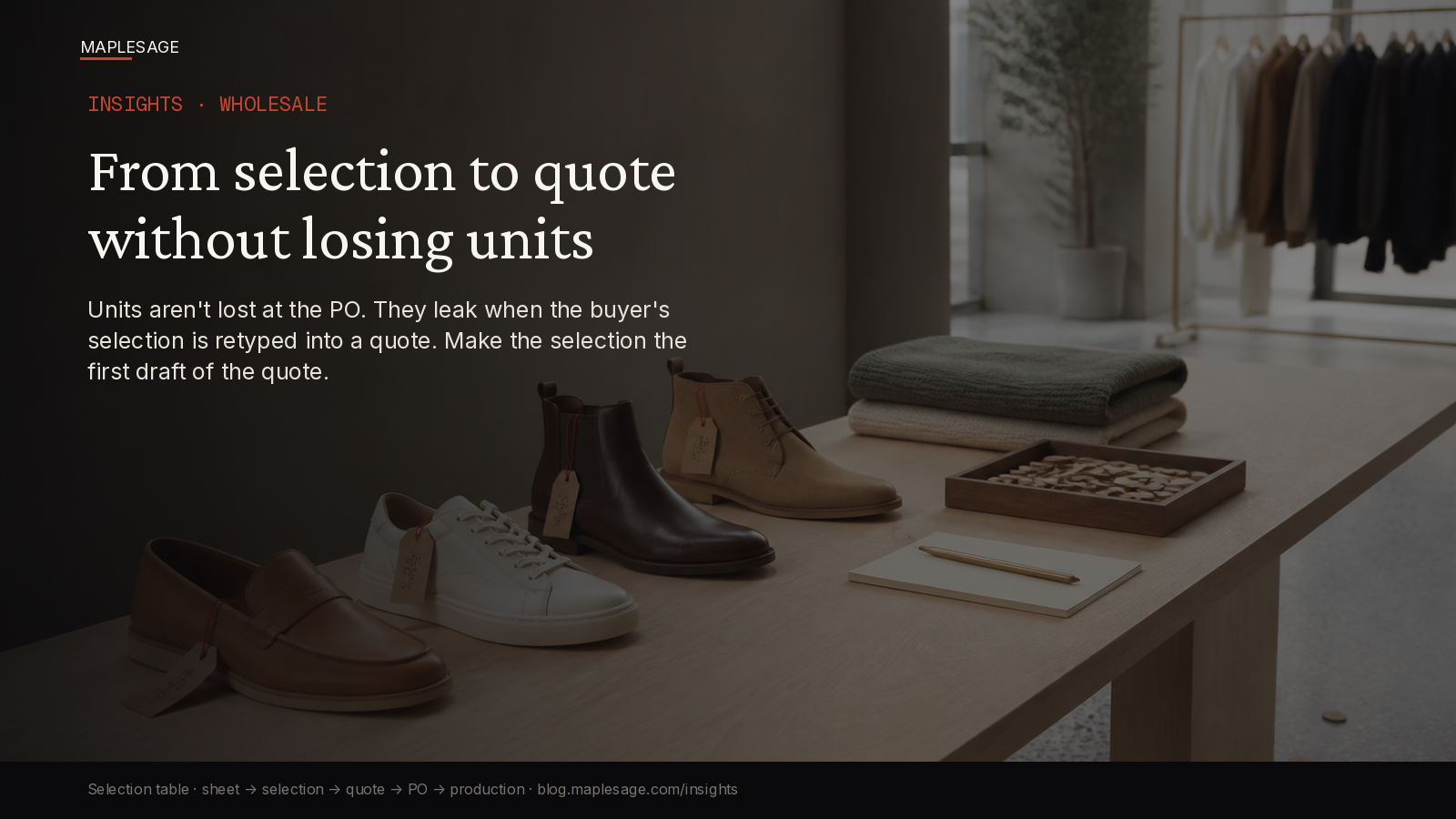
Every token on the table is a unit the buyer chose. The ones on the floor are the ones the quote won’t have.
The appointment goes well. The buyer works through the line for two hours, marks the styles she wants, adds two colourways she didn’t plan for and asks for the boot in a deeper size run for her flagship. She leaves saying the quote should be easy, because she’s already chosen everything.
Three days later the quote arrives. Four styles are missing. One of the extra colourways is there, the other isn’t. The boot has the standard size run. The rep built the quote from his notes, a photo of the buyer’s marked sheet and his memory of the conversation, between two other appointments. The buyer now has to check every line against what she chose, and she finds the gaps by remembering them too.
Nothing was wrong with the selection. The units were lost in the copy.
This follow-up sits on the spine: showroom → account-aware line sheet → quote → size/assortment → approved PO → production. Day 11 said the rep shouldn’t re-enter what the buyer already marked. Day 26 put exclusivity on the sheet. This one is about the step in between that most brands treat as admin: turning a selection into a quote. If the selection has to be retyped to become a quote, some of it won’t make it.
The misuse
In the room, the buyer is building an order. She picks styles, colourways, quantities, size runs and doors, and she says out loud what she wants changed. For her, that is the order. For the brand, in most mid-market wholesale teams, it’s raw material that someone has to turn into a quote later.
The handoff usually looks like this:
- The selection lives in several places: a marked-up PDF, a photo of a printed sheet, the rep’s notes, a few messages sent during the appointment
- The quote is built from scratch: someone opens a spreadsheet or the ERP and keys each line again, working from whichever of those sources they have
- Changes made in the room get dropped: an added colourway, a deeper size run or a swapped door is said once and written down nowhere the quote builder looks
- Quantities drift: “about the same as last season” becomes a number someone guesses, or the default pack, not what the buyer meant
- The buyer re-checks everything: because the quote doesn’t match what she chose, she has to compare it line by line, and her corrections start another round
Each of these is a small loss. Together they decide whether the quote arrives as a confirmation of what the buyer chose or as a new document she has to argue with.
Retyped vs carried forward
| Question | Selection retyped into a quote | Selection carried into the quote |
|---|---|---|
| What does the quote start from? | A blank spreadsheet and the rep’s notes | The buyer’s selection, line for line |
| Where do changes made in the room go? | Into notes, if someone writes them down | Onto the selection as they’re made, so they’re already in the quote |
| How long until the buyer sees a quote? | Days, depending on the rep’s week | As soon as the rep has reviewed the selection |
| What does the buyer check? | Every line, against her memory | Only what changed since she chose it, and why |
| What happens to a missing line? | Nobody knows it’s missing until she notices | It can’t go missing, because nothing was copied |
| What can management see? | Quotes, but not what was chosen in the room | The selection, the quote and the difference between them |
The retyping model asks: did we manage to copy down everything the buyer chose? The carried-forward model asks: what has changed between what she chose and what we’re offering, and does she agree?
Why units lost in the handoff cost more than they look
A missing line on a quote looks like a typo. It behaves like a lost sale:
- The missed-units cost. If the buyer doesn’t notice a style is missing, it never reaches the PO. The brand loses units she wanted and planned to buy.
- The revision cost. If she does notice, the quote goes back and forth. Each round takes days, and each one is another chance for something else to change.
- The timing cost. While the quote is being corrected, her open-to-buy is being spent elsewhere and production slots are being given to other orders.
- The size-run cost. A size run that falls back to the default looks complete. It ships the wrong mix to the wrong doors, and the cost shows up as markdowns and returns later in the season.
- The trust cost. A buyer who has to re-check every quote assumes every quote needs checking. Next season she spends the appointment protecting herself instead of buying.
Related: The Rep Shouldn’t Re-Enter What the Buyer Already Marked. Your Quote Isn’t a Thread. Size Curves on the Wholesale Sheet. ATP on the Buy: Why Availability After the Quote Is Too Late. The PO Is Not a Form. Full spine: The Wholesale Season Breaks When the Sheet Stops Being the System.
What a selection that becomes the quote looks like
The rep still runs the appointment and still reviews the order before it goes out. The difference is that nothing has to be typed twice:
- The buyer marks the account’s own sheet: styles, colourways, quantities, size runs and doors are chosen on the line sheet built for that account, not on a generic PDF
- Changes are made on the selection: when the buyer adds a colourway or asks for a deeper run, it goes onto the same record during the appointment, not into a notebook
- The quote is the selection, reviewed: the rep opens what the buyer chose, applies terms, availability and minimums, and sends it, without rebuilding a single line
- Differences are visible: if a style isn’t available or a quantity has to change, the quote shows what was chosen, what’s being offered and why
- Revisions keep their history: each round of changes is a revision of the same quote, so the buyer and the rep can see what moved and who agreed it
- The approved quote becomes the PO: the same lines carry forward to production, so the units the buyer chose in the room are the units the factory sees
When the selection is the first draft of the quote, the buyer’s two hours in the room are kept. When it isn’t, they’re summarised.
ICP framing
For mid-market AFL brands selling to retailers (roughly $10M to $250M wholesale), how a selection becomes a quote is an input to:
- how many chosen units never reach the PO
- how many days pass between the appointment and a quote the buyer can approve
- how many revision rounds each order needs before it’s confirmed
- how much of a rep’s week goes on retyping instead of selling
It isn’t a pricing engine, a replacement for the rep’s judgement or a way to send quotes nobody has reviewed.
Heads of wholesale feel it when a buyer forwards the quote back with a list of everything she chose that isn’t on it.
Product proof note: the Retail-OS wholesale path
MapleSage Retail-OS keeps the wholesale order as one object from the account’s line sheet through quote revisions to the approved PO. What the buyer marks on her sheet is the starting point of the quote, changes made in the room stay on the same record, and each revision keeps its history, so the rep reviews the order instead of rebuilding it.
See the buyer path: b2b.maplesage.com. Wholesale surface: www.maplesage.com/retail/wholesale/. Talk: go.maplesage.net.
What we won’t pitch
- Quotes sent without a rep reviewing them
- AI that decides what the buyer should have chosen
- ERP or spreadsheet screenshots as the hero
Next step
Take five orders from last season’s appointments. For each one, put the buyer’s marked selection next to the first quote that went out. Count the lines that went missing, the colourways that changed, the size runs that fell back to the default and the days between the two. Each of those is a unit the buyer chose that the brand had to win twice.