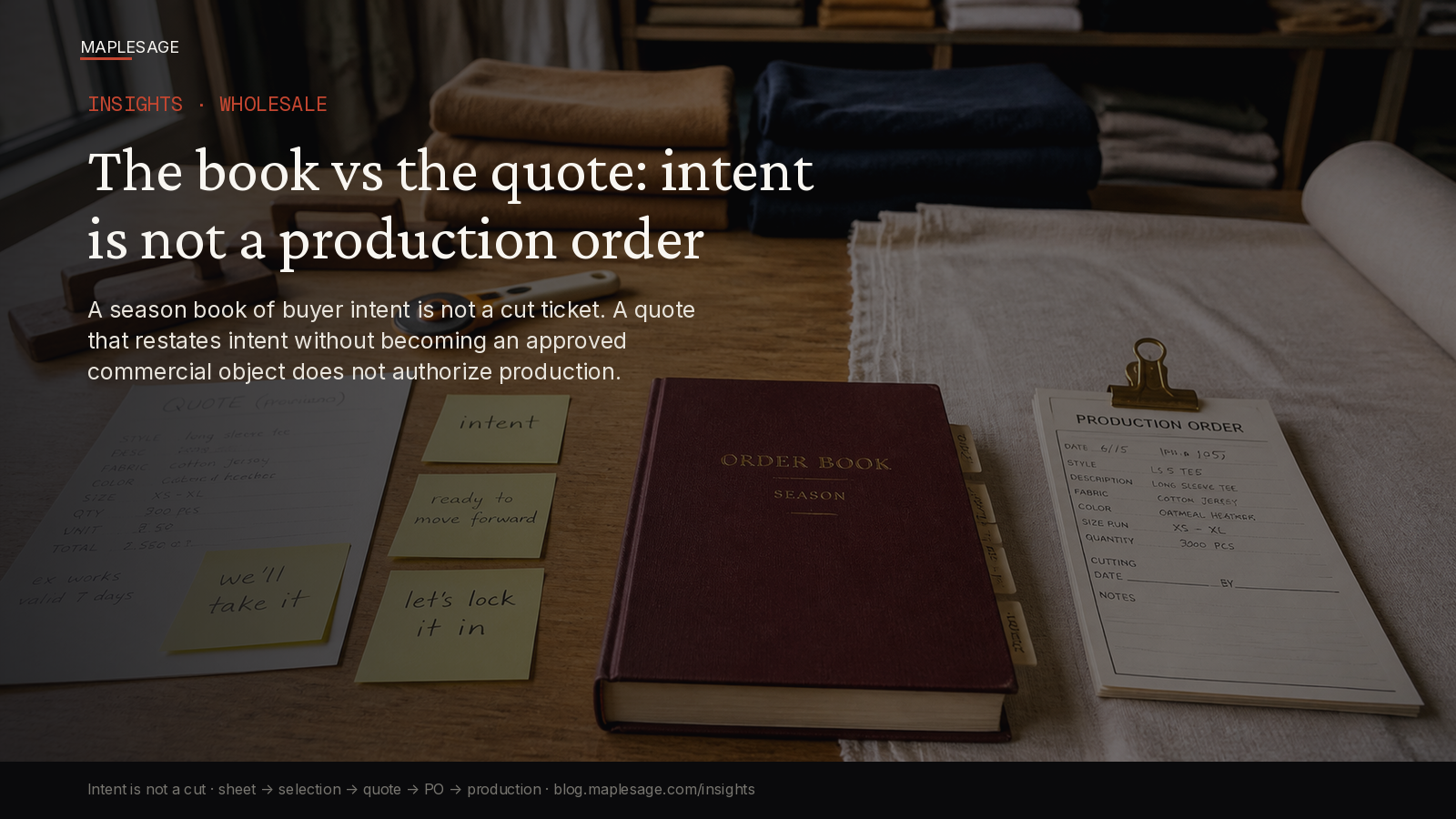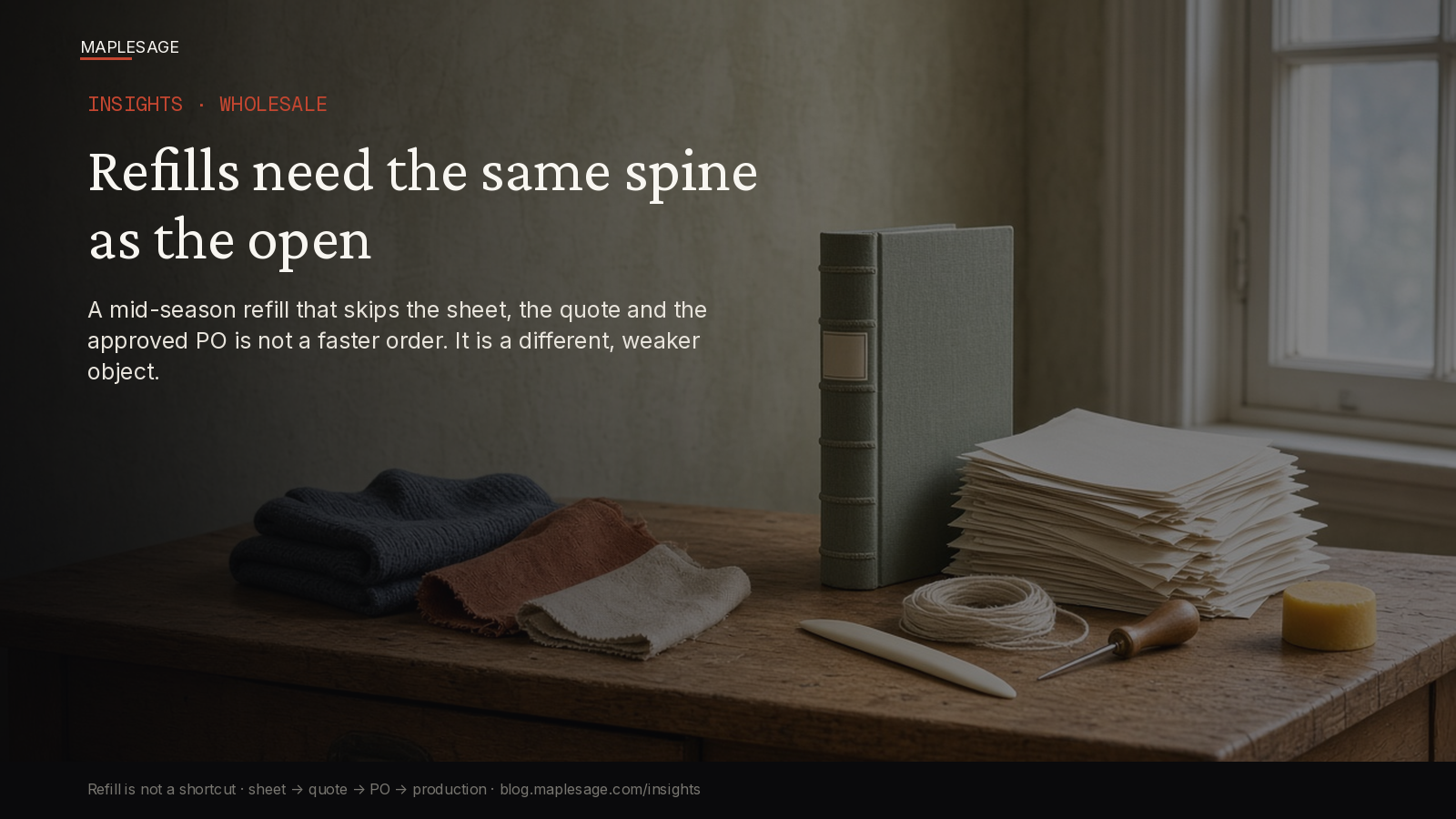
The open arrived as a bound commercial object. The refill arrived as loose pages. Same account. Different spine.
The opening buy usually gets a process. The buyer marked the sheet. Someone built a quote with sizes, doors, dating and terms. Someone approved it. A PO went to production. Then, six weeks later, the same account texts “send me more of the navy crew — same as the open.” Ops treats it as a warehouse pull. Merch copies last time’s units from memory. Nobody rebuilds the quote. That is how a refill becomes a different, weaker object than the order that taught you the account.
This follow-up sits on the spine: showroom → account-aware line sheet → quote → size/assortment → approved PO → production. Day 10 said account history is assortment logic — use it before the room. Day 16 said size mix has to be by door, not an average. Day 18 said WhatsApp exceptions that never reach the PO are how the book leaks. Day 22 said credit holds belong upstream of the cut. Day 25 said delivery windows are commercial terms too. Day 30 said intent is not a production order. This one is the next leak: a refill is not a shortcut. It needs the same spine as the open.
What the open actually was
The opening order was not “the first shipment.” It was a complete commercial object:
| On the open | What it carried |
|---|---|
| The sheet | Account-aware styles, colourways, door notes and the buyer’s marks |
| The quote | Size runs, prices, dating, MOQ, ATP and terms the buyer could accept or revise |
| The approval | A named person and a timestamp on that quote (or a dated revision of it) |
| The PO | The approved quote released to production, unit for unit |
That object is why the open usually lands closer to what the buyer meant. It is also why teams feel licensed to skip the work the second time. “We already know this account” is treated as a substitute for rebuilding the object. It is not. The account is the same. The commercial facts are not.
Related: The Book vs the Quote: Intent Is Not a Production Order. Account History Is Assortment Logic — Use It Before the Room. The PO Is Not a Form — It’s the End of a Commercial Object.
How the refill gets stripped
The stripping is structural, not careless:
- The open already “proved” the account. Credit was checked, doors were assigned, sizes were argued over. The refill arrives as if those answers are still current.
- “Same as last time” feels complete. It names a style and implies every term that rode with it: size curve, door mix, dating, price, MOQ. None of those are actually restated, so none of them can be checked.
- Urgency rewards the shortcut. The door is out of the navy crew. The buyer wants goods next week. Building a quote looks like delay. A warehouse pull looks like service.
- WhatsApp becomes the order form. “Just send more” never reaches the sheet, so it never becomes a quote, so it never becomes a PO. It becomes a verbal allocation that production or the warehouse tries to honour.
- Ops rekeys from memory or from the last invoice. The refill is typed into a new document that only resembles the open. What sold through, what is available now and what the account can still take are not on it.
The result is familiar. The refill ships the open’s leftover curve into the doors that already sold through. Or it ships a colourway you no longer have. Or it ships into an account that is already over its credit. The buyer asked for more of what worked. What arrived was a weaker copy of what you already knew.
Related: WhatsApp Exceptions That Never Reach the PO. ATP on the Buy: Why Availability After the Quote Is Too Late.
What changed since the open
A refill that reprints the open is already wrong, because the facts moved:
- Size mix. The open’s curve was a plan. Sell-through is the evidence. The refill should ask which sizes left the floor and which sat — by door, not as an account average.
- Door mix. Flagship, outlet and resort did not sell the same way. Sending “more of the same” to every door repeats the miss.
- Availability. What you could promise at the open is not what you can promise now. ATP belongs on the refill quote, not after the warehouse has already pulled.
- Credit. The open is still shipping, or already invoiced and not yet paid. The refill adds exposure. A credit hold that was clear in February may not be clear in April.
- Dating and the delivery window. A refill that inherits the open’s window arrives after the door needed it, or lands on top of goods the account has not paid for.
- MOQ and price. The refill quantity may break the open’s MOQ, or sit under a price that has since changed. Neither should be inherited silently.
- Colourway and capacity. The style they want more of is often the one you are shortest on. That is a quote conversation, not a pick-ticket surprise.
Account history belongs here — as input to the refill quote, not as a reason to skip it.
Related: Size Mix by Door: Flagship, Urban vs Outlet vs Resort. Credit Holds Belong Upstream of the Cut. Delivery Windows Are Commercial Terms Too. MOQ Exceptions Need a Gate, Not a Handshake.
What belongs on a refill
A refill is another pass down the same spine. It is allowed to be faster. It is not allowed to be thinner.
- On the account’s sheet: the refill request, tied to the same account and doors, with sell-through notes from the open — clearly a new mark, not a scribble in a thread
- On the draft quote: styles, colourways and size runs built from what actually sold and what is available now, with prices, dating, MOQ and credit applied again
- On the sent quote: a version the buyer can accept or revise, with a revision history that points back to the open without copying it blindly
- On the approved PO: the same lines the refill quote held when it was approved, unit for unit, with a named person and a timestamp
- Off the record for the warehouse and the cut: “same as the open,” “just send more,” a forwarded invoice, and any pick ticket that was not released from an approved PO
If a refill line cannot be traced from the request → a quote that used current sizes, ATP and terms → an approved PO, it is not a refill of the open. It is a new leak wearing a familiar style number.
Related: From Selection to Quote Without Losing Units. Cut Commitments Without a Canonical Quote Are Folklore.
What it costs to refill without a spine
Treat the refill as a warehouse favour and the cost shows up in five places:
- The wrong-mix cost. You refill the open’s curve, not the curve that sold. Markdowns repeat on the sizes that already sat; stockouts repeat on the sizes that already left.
- The ATP cost. The warehouse pulls what it can see. The quote never said what you could honestly promise. The account gets a partial, a substitute or a late apology.
- The credit cost. Goods leave to an account that could not take more exposure. Collections and holds arrive after the cartons do.
- The window cost. A refill that inherits the open’s dating misses the door’s actual need, or stacks on unpaid goods.
- The trust cost. The buyer asked for more of what worked. What arrived was a weaker copy. The next refill goes to a competitor who can confirm sizes, dates and availability before they ship.
None of this is fixed by answering WhatsApp faster. It is fixed by keeping the refill on the same spine as the open: one sheet, one quote, one named approval, one PO.
Full spine: The Wholesale Season Breaks When the Sheet Stops Being the System.
What a clean refill looks like
- The request lands on the sheet, not only in a thread. “More of the navy crew” becomes a mark on the account, with the doors that need it
- Sell-through from the open informs the quote. Sizes and doors that moved get weight; sizes and doors that sat do not get a blind reprint
- ATP, credit, dating, MOQ and price are applied again. Inherited terms are labelled as inherited, not assumed
- Sending the refill quote is a named step. Faster than the open, because the object already exists — not skipped because the object already exists
- Approval is acceptance of that refill quote (or a dated revision of it). “Yes, same as last time” in a chat is not enough unless it points at the quote they were shown
- The PO is the approved refill quote, released. The warehouse and the cut move on this, not on the chat
The open can stay the reference. It cannot stay the document.
ICP framing
For mid-market AFL brands selling to retailers (roughly $10M to $250M wholesale), stripping the spine off a refill affects:
- whether the second write matches what actually sold, or reprints the guess you made at the open
- whether availability and credit are honest at the moment of the refill, not at the moment of the first appointment
- how often “just send more” becomes a carton the account cannot take, or a miss the door will not forgive
- whether buyers keep asking you for refills, or go to someone who can confirm the object before it ships
It isn’t an argument against moving faster the second time. Speed is the reward for having a living sheet. It is not a reason to leave the sheet.
Heads of wholesale feel it when a refill that should have been the easy order becomes the one finance, the warehouse and the buyer all dispute.
Product proof note: the Retail-OS wholesale path
MapleSage Retail-OS keeps the season as one commercial object: the account’s sheet still holds the open, the sell-through and the refill request in the same place; the refill quote is built from those marks with current sizes, availability and terms applied; approval is a named step; the PO released to the warehouse or to production is the approved refill quote, unit for unit. The open remains the reference. It does not silently become the refill.
See the buyer path: b2b.maplesage.com. Wholesale surface: www.maplesage.com/retail/wholesale/. Talk: go.maplesage.net.
What we won’t pitch
- Treating “same as the open” or “just send more” as a production or warehouse order
- A CRM that stores the original PO as a contact note and calls a refill done
- Product UI screenshots as the hero for a commercial argument
Next step
Pull last season’s ten largest refills. For each one, find the document that authorized goods to leave. Label it: chat or memory, a reprinted open, or an approved refill quote with current sizes, ATP and terms. Count how many refills moved on the first two columns. Those are the orders that should have been as tight as the open, and were not.