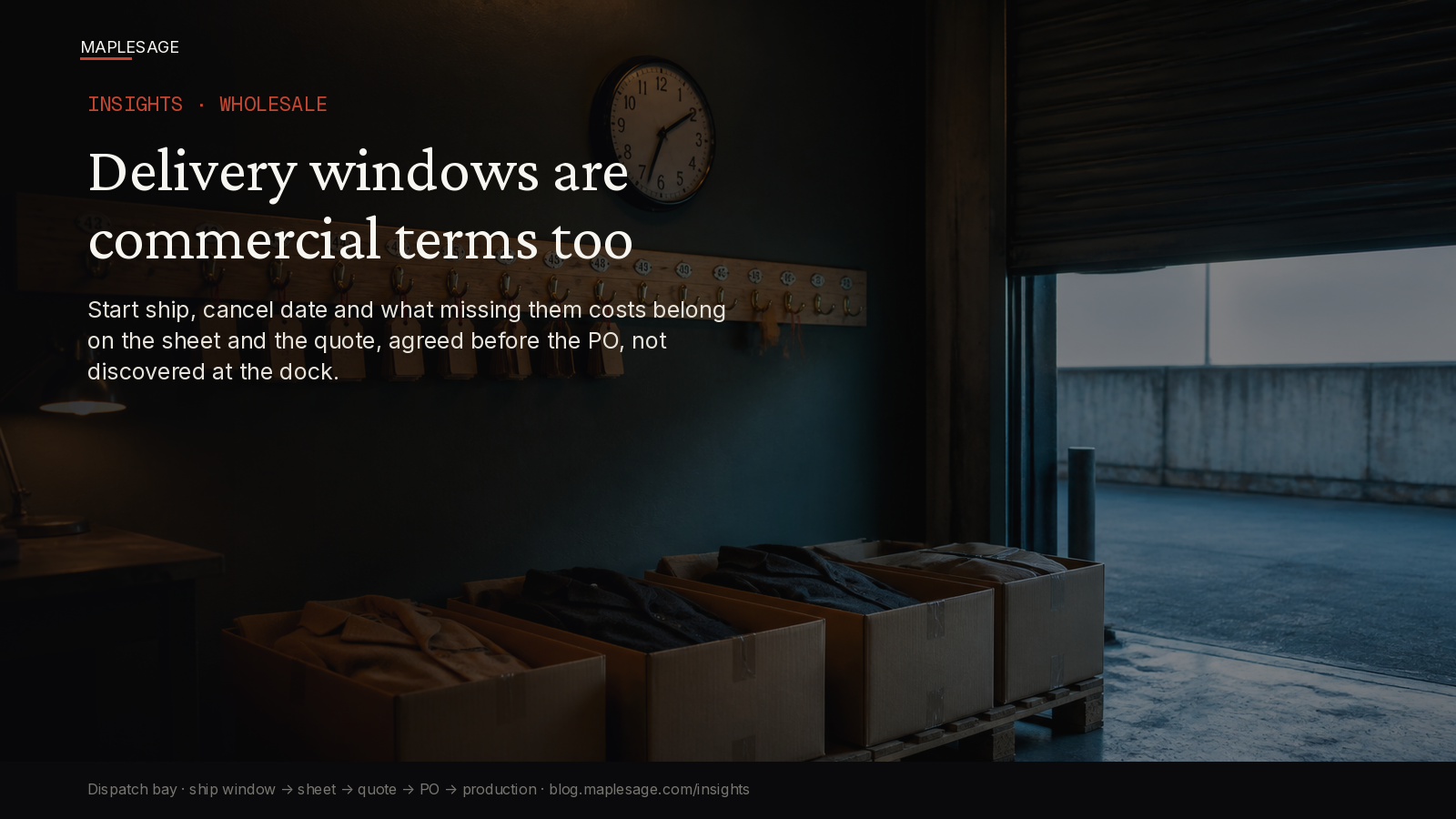
The cartons are packed. Whether they’re on time depends on a window nobody priced.
The order is right. Styles, colours, sizes and doors all match what the buyer approved, the price holds and credit is clear. Production finishes, the cartons are packed and the goods leave the warehouse.
Nine days later the retailer’s distribution centre turns half the shipment away. The cancel date on the buyer’s PO was two weeks earlier than the window the rep agreed in the room. The rest is accepted with a chargeback for arriving outside the window, and the buyer asks for a markdown allowance on the late styles because they’ve missed the floor set. Nobody on the brand side had the retailer’s dates on the order. They had “ships in September.”
Nothing was wrong with the order except when it was due. That turned out to be a commercial term.
This follow-up sits on the spine: showroom → account-aware line sheet → quote → size/assortment → approved PO → production. Day 22 moved credit upstream of the cut. Day 23 put the buyer’s budget on the sheet. This one is about the term most brands leave to operations: the delivery window. Agree it on the sheet and the quote, or it gets renegotiated at the dock.
The misuse
A wholesale delivery window has a start ship date, a cancel date and consequences if either is missed. The retailer plans its floor sets, its open-to-buy and its staffing around those dates. To the buyer, the window is part of what they’re buying.
In most mid-market brands, the window is treated as a logistics detail:
- The sheet shows a delivery month: “September” or “Delivery 2”, not a start ship and cancel date per style or per door
- The room promises dates verbally: the rep agrees “first week of the month” to win a style back into the order; the quote never changes
- The PO brings its own dates: the retailer’s PO arrives with its cancel date and its routing guide, and nobody checks it against what was agreed
- Early is treated as safe: goods shipped before the start date are held, refused or charged back, just like late ones
- Consequences live in the vendor manual: chargebacks, cancellations and markdown allowances for missed windows sit in a document the rep has never read
The result is an order where everything was agreed except the date it had to arrive, and that’s the one term the retailer enforces automatically.
Logistics detail vs commercial term
| Question | Logistics detail | Commercial term on the sheet |
|---|---|---|
| What does the sheet show? | A delivery month or drop | Start ship and cancel date per style, by door cluster where they differ |
| Who agrees the window? | Operations, after the PO | The rep and buyer, in the room, on the quote |
| What happens when a style moves? | The rep says yes in a message | The quote revision carries the new window |
| How is the retailer’s PO checked? | It isn’t, until goods ship | Dates are matched to the approved quote before acceptance |
| What does production plan to? | A month | The earliest start ship and the hardest cancel date |
| What does finance see? | Chargebacks after the fact | The deductions each window carries, before the order is accepted |
The logistics model asks: when can we ship it? The commercial model asks: when has the buyer agreed to take it, and what does missing that cost?
Why a window off the sheet is too expensive
An order with the wrong window looks fine until the goods move. Then the cost arrives all at once:
- The cancellation cost. Goods that miss the cancel date can be refused outright. The brand has finished stock with no buyer, in the middle of the season.
- The chargeback cost. Shipments outside the window, or not routed to the retailer’s terms, come back as deductions on the invoice. Finance finds them weeks later and can’t trace them to a decision.
- The markdown cost. Late goods miss the floor set. The buyer asks for an allowance to sell them, so the margin agreed in the room shrinks after delivery.
- The production cost. The factory planned to a month, not to a cancel date. The styles with the tightest windows weren’t cut first, because nobody knew they were tight.
- The relationship cost. The buyer remembers the empty floor set, not the reason. Next season the account asks for earlier windows, harder penalties or a smaller order.
Related: The PO Is Not a Form. Door Terms Belong on the Sheet. ATP on the Buy. WhatsApp Exceptions That Never Reach the PO. How Mid-Market AFL Loses the Season Between Room and Factory. Full spine: The Wholesale Season Breaks When the Sheet Stops Being the System.
What a window on the sheet looks like
The buyer still sets their floor dates. The sheet just stops showing a month and starts carrying the term:
- Windows are dates, not drops: each style carries a start ship and a cancel date, and door clusters that set their floors at different times get their own
- Availability is checked against the window: the dates offered in the room are the dates production and stock can actually meet, not the dates that win the style
- Changes are revisions: when a style moves to a later window in the room or in a message, the quote revision carries the new dates and the buyer approves them
- The retailer’s PO is matched: start ship, cancel date and routing on the incoming PO are checked against the approved quote, and differences are resolved before the order is accepted
- Consequences are visible: the account’s chargeback, cancellation and allowance terms for missed windows sit with the order, so the rep and finance know what each date is worth
- Production plans to the hardest date: the cut and ship sequence follows cancel dates, so the tightest windows are made first
When the window is on the sheet, the buyer and the brand agree the date the same way they agree the price. When it isn’t, the retailer’s system decides it for them.
ICP framing
For mid-market AFL brands selling to retailers (roughly $10M to $250M wholesale), whether the delivery window is a term or a detail is an input to:
- how much finished stock is refused or cancelled for missing a date
- how much of the invoice disappears into window and routing chargebacks
- how often a margin agreed in the room is given back as a markdown allowance
- whether production sequences the cut to the dates that actually bind
It isn’t a transport management system, a replacement for the retailer’s routing guide or a promise that goods will never be late.
Heads of wholesale feel it when a correct order, shipped in full, still comes back as a deduction.
Product proof note: the Retail-OS wholesale path
MapleSage Retail-OS keeps the wholesale order as one object from the account’s line sheet through quote revisions to the approved PO. Delivery windows travel with the order as terms, so a date changed in the room becomes a revision the buyer approves, and the rep, finance and the people planning production all work from the same dates instead of rebuilding them after the appointment.
See the buyer path: b2b.maplesage.com. Wholesale surface: www.maplesage.com/retail/wholesale/. Talk: go.maplesage.net.
What we won’t pitch
- Replacing your 3PL, your transport management system or the retailer’s routing guide
- AI that promises delivery dates the factory can’t meet
- Carrier-portal or competitor screenshots as the hero
Next step
Pull last season’s chargebacks, cancellations and markdown allowances from your five largest retail accounts. For each one, find the order and compare the window the rep agreed, the dates on the quote and the start ship and cancel dates on the retailer’s PO. If the three don’t match, the window was never a term. It was a guess that the retailer’s system enforced.