The room was perfect. The thread to the order book was cut before anyone wrote a line.
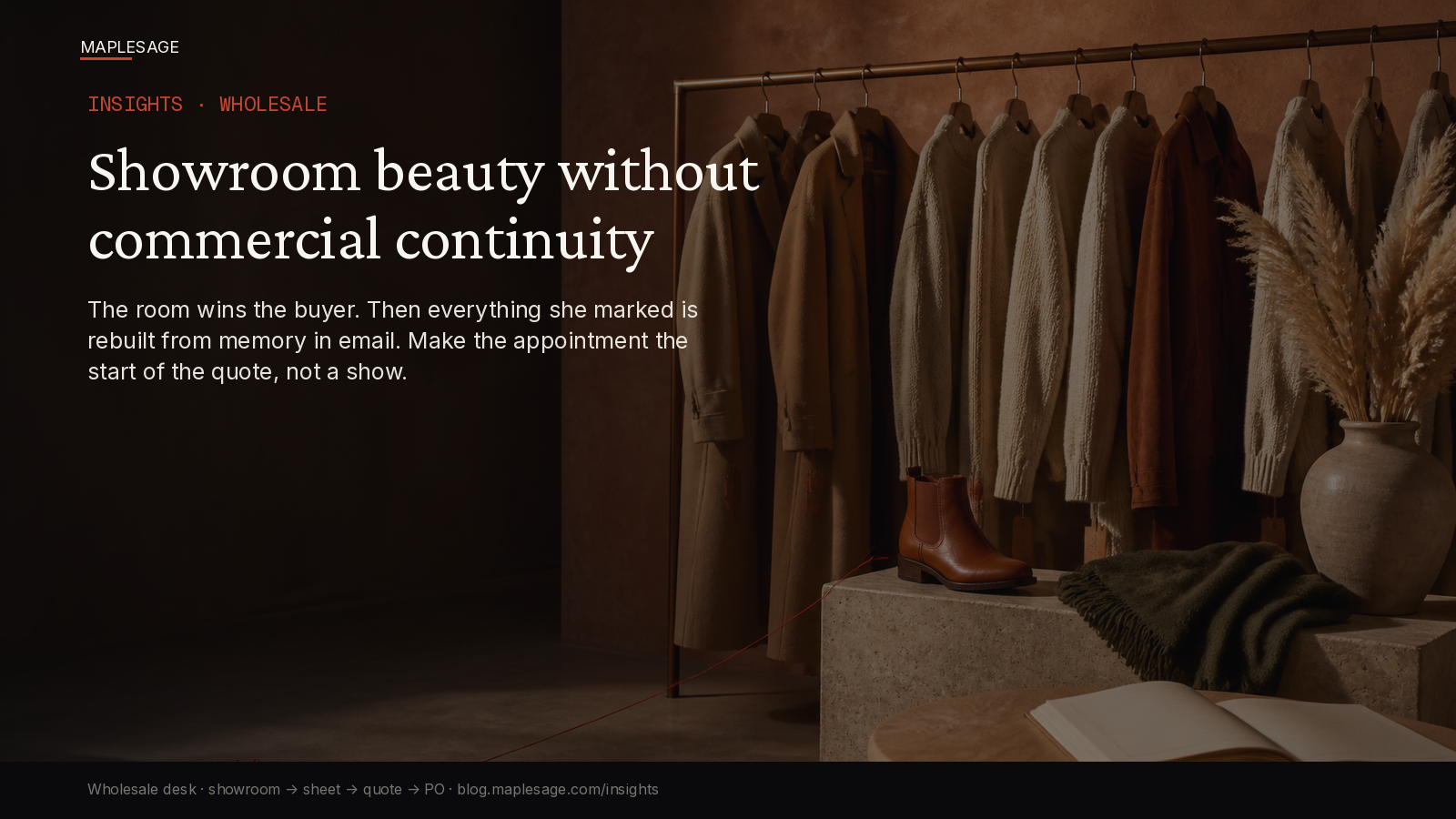
Market week. The showroom looks right: the rail is merchandised by story, the hero coat is on the plinth, the lighting is warm, the playlist is on. A buyer from a key specialty account walks the collection with the rep for ninety minutes. She touches the coats twice, asks for the rust suede in a second colourway, says the knit story is “exactly what our floor needs”, and asks whether the boot can land a drop earlier than the sheet says.
Then she leaves for her next appointment. The rep has a phone full of photos, a notebook page of shorthand, and a promise to “send everything over tonight”.
What gets sent is a PDF line sheet, the same one every account received, and a friendly email. The buyer’s interest in the second colourway, the early drop on the boot and the knit story she loved are all in the rep’s head. By the time the quote goes out, some of it is in there and some of it isn’t. The room did its job. Everything after the room starts from zero.
This follow-up sits on the spine: showroom → account-aware line sheet → quote → size/assortment → approved PO. Day 2 said the showroom should know the account. Day 17 said a sheet that doesn’t know the account is a brochure. This one is about the gap between them: a beautiful showroom without commercial continuity is a presentation, not the start of an order.
The misuse
Brands invest in the showroom as an experience: the space, the styling, the samples, the walkthrough. That investment is real and it matters. Buyers decide a lot in the room.
The misuse is treating the appointment as the end of the brand’s job and the start of the rep’s admin. What the buyer reacted to in the room is captured, if at all, in places that don’t connect to anything:
- Photos on the rep’s phone: the styles she lingered on, with no account or style link
- A notebook page: “rust suede, 2nd CW?”, “boot, earlier drop”, “knit story ++”
- The buyer’s own notes: on her phone or a printed sheet she takes away
- A follow-up email: written that night, from memory, after five more appointments
- The generic line sheet: sent as the “recap”, with none of the appointment on it
Each of these is partial. None of them is the account’s offer, and none of them becomes the quote without someone retyping it.
Showroom as presentation vs showroom as the start of the commercial object
| Question | Presentation showroom | Continuous showroom |
|---|---|---|
| What does the buyer leave with? | A generic PDF and a promise | Her account’s sheet, with what she marked in the room |
| Where do her reactions live? | Rep’s phone, notebook and memory | On the account’s sheet as marks, notes and requests |
| Special requests (colourway, drop date) | A line in a follow-up email | Logged as exceptions against the style, routed to an owner |
| What does the rep do that night? | Rebuild the appointment from memory | Review what’s already captured and send the quote |
| How fast does the quote go out? | When the rep catches up | From the appointment, once requests are decided |
| What does the next person see? | Nothing, unless the rep tells them | The appointment history on the account |
| What does the PO trace back to? | An email recap | The marks and decisions from the room |
The presentation showroom asks: did the buyer like it? The continuous showroom asks: what did the buyer mark, and is it already on her quote?
Why showroom beauty without continuity is too expensive
The room is the most expensive hour of the season. Losing what happened in it costs more than it looks:
- The decay cost. The buyer’s enthusiasm is highest when she leaves the room. Every day between the appointment and a usable quote, other brands’ quotes arrive, open-to-buy gets committed, and “exactly what our floor needs” becomes “let me come back to you”.
- The reconstruction cost. The rep rebuilds each appointment from photos and shorthand, after a full day of appointments. Things get dropped: the second colourway, the size note, the store that wanted the boot first.
- The trust cost. When the recap doesn’t match what was said in the room, the buyer notices. She starts checking everything, and the next appointment opens with corrections instead of selling.
- The exception cost. Requests made in the room, like an earlier drop or a colourway extension, are commercial decisions. Left in an email, they’re either promised without an owner or quietly forgotten, and both surface later as disputes.
Related: Account-Aware Showroom. The Sheet That Doesn’t Know the Account Is a Brochure. The Rep Shouldn’t Re-Enter What the Buyer Already Marked. WhatsApp Exceptions That Never Reach the PO. Your Quote Isn’t a Thread. Full spine: The Wholesale Season Breaks When the Sheet Stops Being the System.
What commercial continuity looks like
Keep the room as beautiful as it is. Then make sure the appointment produces something the rest of the season can use:
- The appointment opens on the account: the rep walks the collection with that account’s sheet, so prices, terms, channel rules and availability are already right
- Marks happen in the room: styles the buyer wants, passes on and questions are marked on her sheet during the walkthrough, not reconstructed afterwards
- Requests become exceptions on the spot: the second colourway or the earlier drop is logged against the style with the account and a reason, and routed to whoever owns that decision
- Notes stay with the account: “knit story is the floor lead” sits on the account, visible to the next rep, the planner and the buyer’s next appointment
- The buyer leaves with her version: not the generic PDF, but her sheet with what she marked and what’s pending
- The quote continues from the sheet: once requests are decided, the marked sheet becomes the quote revision, and the approved revision becomes the PO
When the appointment carries into the sheet, the quote and the PO, the room is the start of the order. When it doesn’t, the room is a show and the order starts again in email.
ICP framing
For mid-market AFL brands selling to retailers (roughly $10M to $250M wholesale), showroom continuity is an input to:
- how quickly a quote follows a market appointment
- how much of what the buyer asked for in the room actually reaches the PO
- whether room requests get a decision and an owner, or a vague yes
- how much rep time goes on recaps instead of selling
It isn’t a better showroom fit-out, a nicer recap email template, or a digital lookbook that the buyer browses and the rep still retypes.
Heads of wholesale feel it when the best appointment of the week turns into the slowest quote of the week.
Product proof note: the Retail-OS wholesale path
MapleSage Retail-OS opens the showroom appointment on the account’s own line sheet. Buyer marks, notes and requests are captured during the walkthrough, requests route as exceptions to their owner, and the marked sheet continues into a quote revision and then the approved PO, without retyping.
See the buyer path: b2b.maplesage.com. Wholesale surface: www.maplesage.com/retail/wholesale/. Talk: go.maplesage.net.
What we won’t pitch
- A less beautiful showroom in exchange for more process
- AI that writes the recap from the rep’s photos
- Showroom-app or competitor screenshots as the hero
Next step
Take your five best appointments from last market. For each one, list what the buyer asked for or reacted to in the room, then check the first quote you sent. Count how many of those items made it onto the quote without the buyer having to ask again, and how many days the quote took. Every gap is where the room’s work was lost.