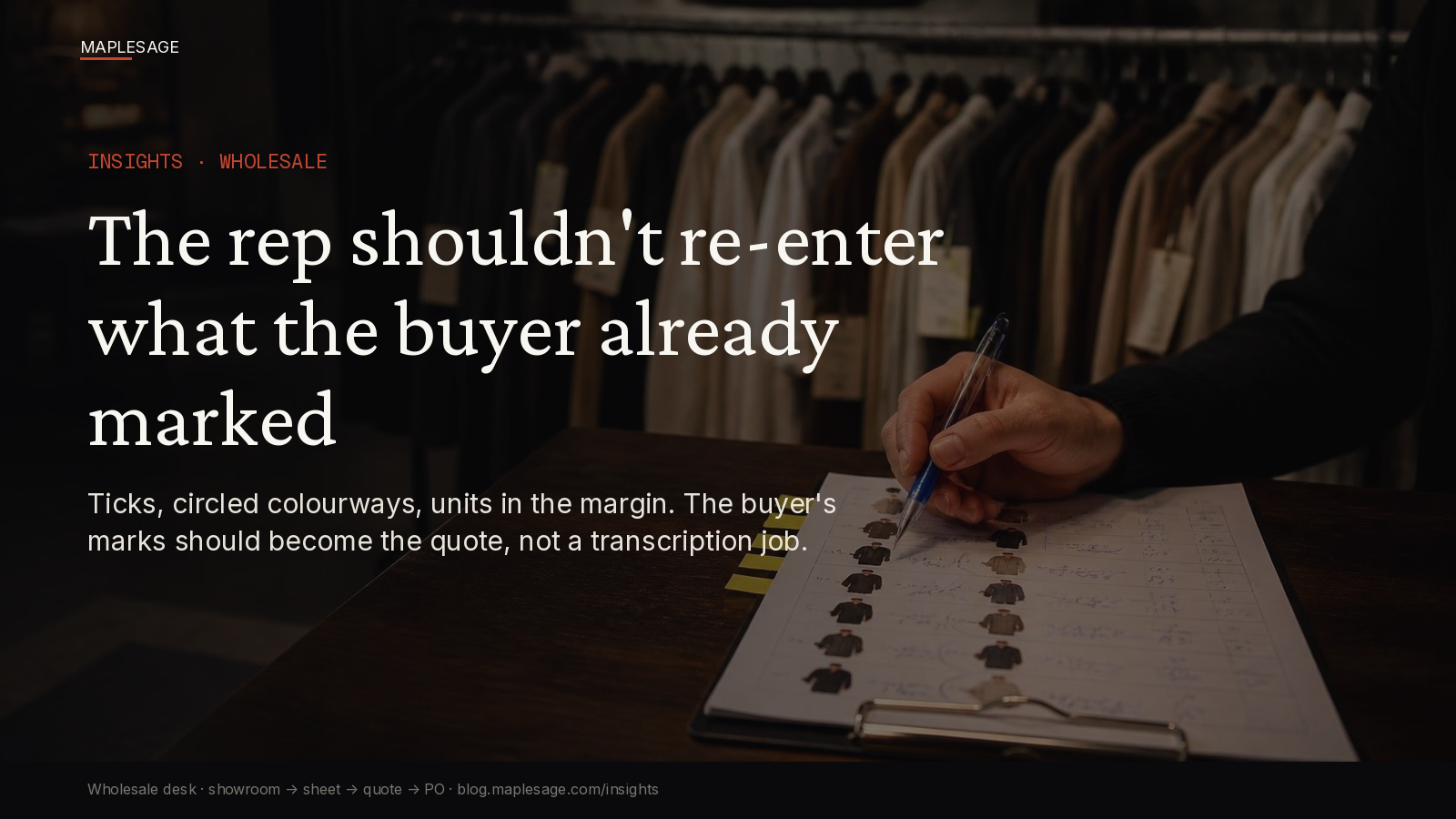
The buyer already did the order entry. It just happened in pen.
Every rep knows the evening after a good appointment. The buyer spent two hours in the showroom ticking styles, circling colourways, writing units in the margin and flagging the samples they want deeper. Then the buyer leaves, and the rep sits down to type all of it in again.
First into the order form. Then into the spreadsheet planning asked for. Then, a week later, someone in ops keys the same order into the ERP from whichever version landed in their inbox.
This follow-up sits on the spine: showroom → account-aware line sheet → quote → size/assortment → approved PO. Day 2 made the showroom account-aware. Day 10 put account history on the sheet before the room. This one is about what happens to the buyer’s marks after the room: they should become the quote, not a transcription job.
The misuse
The buyer’s marks get treated as notes. Raw input the rep has to clean up, re-key and “turn into an order” later.
In wholesale, the buyer’s marks are the order in its first form. They already carry the decisions that matter:
- “Take the navy and the oat, skip the rust”
- “Twelve units of the crew, go deeper on the cardigan”
- “Hold the outerwear for the two flagship doors only”
- “Ship the first drop in the February window, not March”
Every time those marks get re-entered, the decision gets reinterpreted by someone who wasn’t in the room:
- The rep reads a circled colourway as a yes when the buyer meant maybe
- A unit count written next to the wrong style ends up on the wrong line
- The size split the buyer sketched in the margin becomes the default curve
- The door note never makes it past the first spreadsheet
- The ship window changes between the order form and the ERP because nobody re-checked the sheet
Nobody made a mistake on purpose. The order was just copied three times by three people, and each copy lost a little.
Re-keyed marks vs marks that become the quote
| Moment | Marks re-keyed after the room | Marks that become the quote |
|---|---|---|
| In the showroom | Buyer marks a printed sheet or a PDF | Buyer marks the live account-aware sheet |
| After the appointment | Rep types the marks into an order form | The marked sheet is already a draft quote |
| Colourways | Circled options get read as yes or no later | Each mark is a selected colourway on the line |
| Units | Margin numbers copied style by style | Units entered once, on the style they belong to |
| Size split | Sketched in the margin, defaulted on entry | Size split captured where the buyer set it |
| Doors | “Flagship only” lives in the rep’s notebook | Door allocation sits on the line it applies to |
| Ship window | Retyped from memory into the ERP | The window the buyer picked travels to the PO |
| Changes | Every revision is another re-key | Revisions update the same object, with history |
The re-keying desk asks: what did the buyer mean by this mark? The quote desk doesn’t have to ask, because the mark was made on the thing that becomes the order.
Why “I’ll type it up tonight” is too expensive
Re-entry looks like admin. It’s actually where three of the season’s costliest errors start:
- The transcription error. A unit count on the wrong line, a colourway that got dropped, a style code typed one digit off. Each one ships, and each one comes back as a return, a short-ship or a credit note.
- The interpretation error. The rep fills the gaps in the buyer’s marks with assumptions: the default curve, every door, the earliest window. The buyer approves a quote that no longer matches what they marked, and only finds out when the delivery doesn’t match the plan.
- The latency error. Every hour between the appointment and the entered order is an hour the buyer’s intent sits in a notebook. Availability moves. Cut commitments move. By the time the order is keyed, the units the buyer marked may already be promised to another account.
Typing it up tonight doesn’t remove any of these. It just moves them downstream, where they’re more expensive to find.
Related: The Account-Aware Showroom. Your Quote Isn’t a Thread. The PO Is Not a Form. ATP on the Buy. Account History Is Assortment Logic. Full spine: The Wholesale Season Breaks When the Sheet Stops Being the System.
What a buyer’s mark has to carry to skip re-entry
The marks only become the quote if they’re captured on the sheet in a form nobody has to reinterpret:
- Style and colourway selections: what the buyer took, what they skipped, and what they flagged as maybe
- Units by line: entered once, against the style and colourway they belong to
- Size split: the curve the buyer set for this account, not the default
- Door allocation: which doors take which lines, captured on the line itself
- Ship window and drop: the delivery the buyer chose, checked against availability while they’re still in the room
- Buyer notes with an owner: “hold”, “confirm price”, “swap if the rust is late”, attached to the line and assigned to someone
- One record: the marked sheet becomes the quote, the approved quote becomes the PO, and nobody types it in again
When those live on the account-aware sheet, the rep’s evening goes to follow-ups, not data entry. When they live on paper, the order gets rebuilt from someone’s reading of it.
ICP framing
For mid-market AFL brands selling to retailers (roughly $10M to $250M wholesale), whether the buyer’s marks become the quote or get re-keyed after the room is an input to:
- how many lines per order ship with the wrong units, colourway or size split
- how many days pass between the appointment and an order production can actually see
- how much rep time each market week goes to re-entry instead of selling
- how often the PO the buyer approves differs from what they marked in the showroom
It isn’t an OCR tool for scanned line sheets, a faster order-entry screen, or a reminder to “type it up the same day.”
Heads of wholesale feel it when a market week’s orders take two weeks to reach the ERP, and the first credit notes arrive before the last order is keyed.
Product proof note: the Retail-OS wholesale path
MapleSage Retail-OS lets the buyer’s marks land on the same account-aware commercial object as the sheet: showroom, live sheet where selections, units, size split, doors and ship windows are captured as the buyer makes them, quote built from those marks, availability for the window, and a gated PO approval. The rep reviews and confirms; nobody re-keys.
See the buyer path: b2b.maplesage.com. Wholesale surface: www.maplesage.com/retail/wholesale/. Talk: go.maplesage.net.
What we won’t pitch
- “AI that reads your handwritten line sheets” as a fix for re-entry
- A faster order-entry form that still asks the rep to type the buyer’s order twice
- Competitor order-entry or ERP screenshots as the hero
Next step
If your reps spend the night after market typing in what buyers marked that afternoon, stop treating those marks as notes. Capture the buyer’s selections, units, sizes, doors and windows on the sheet in the room, so the marked sheet is already the quote.