Six versions on the table. Nobody can say which one the buyer signed.
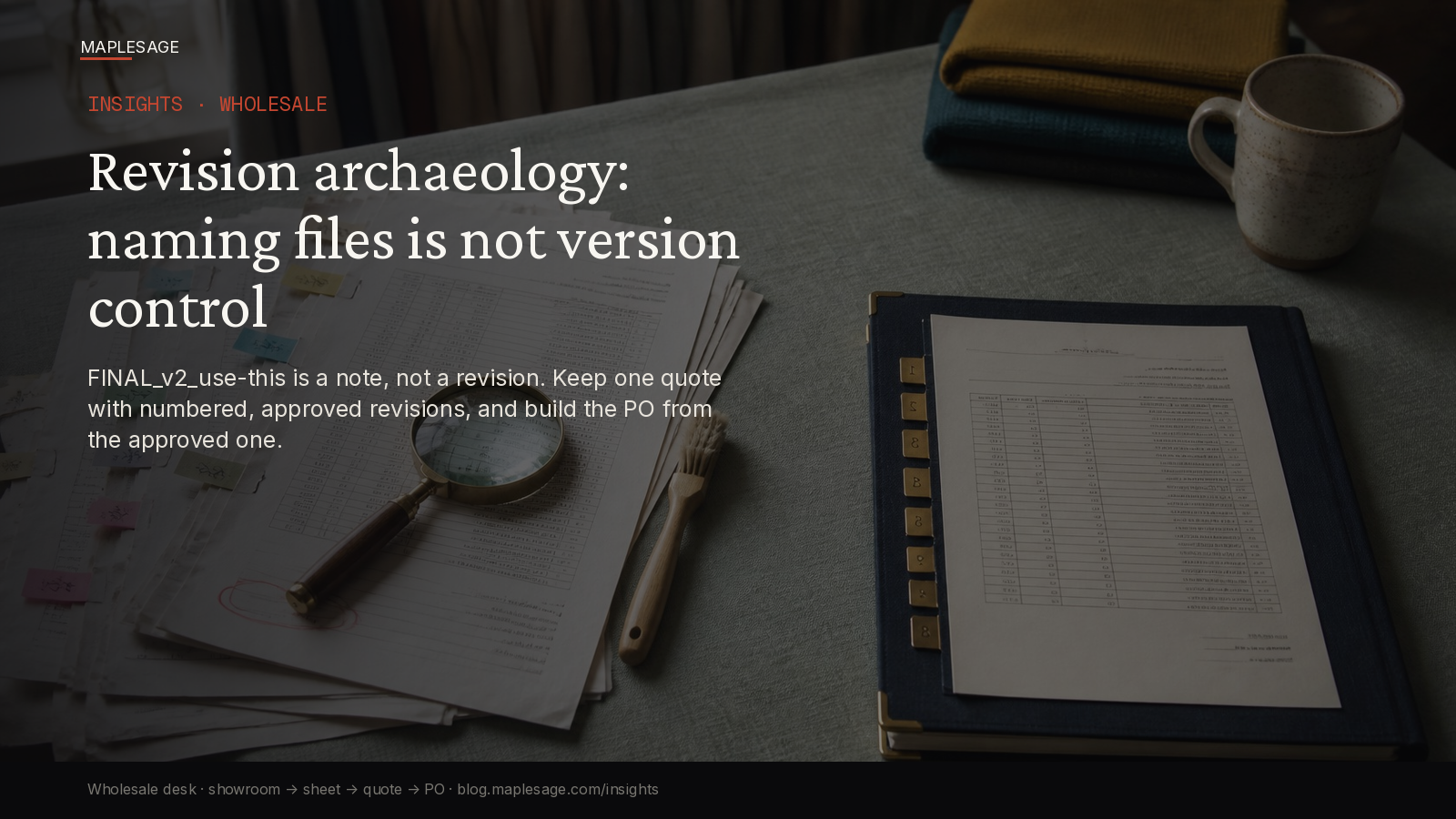
It’s three weeks after market. A buyer emails: the invoice doesn’t match what they agreed. The rep opens the shared drive and finds a folder with Quote_Spring_ACME.xlsx, Quote_Spring_ACME_v2.xlsx, Quote_Spring_ACME_FINAL.xlsx, Quote_Spring_ACME_FINAL_v2_JM.xlsx, and one more in their downloads called ACME revised (use this one).xlsx. The PO was built from the third one. The buyer approved the fifth.
Nobody did anything careless. Everyone saved a copy before changing something, named it as clearly as they could, and sent it on. The problem is that a file name is a note, not a record. It can’t tell you which version was sent, which was approved, who changed what, or what the PO was built from.
This follow-up sits on the spine: showroom → account-aware line sheet → quote → size/assortment → approved PO. Day 1 said the quote isn’t a thread. Day 14 said portals don’t fix fragmented quotes. Day 18 said every exception has to land on a quote revision. This one is about the revision itself: naming files is not version control, and a quote without real revisions turns every dispute into archaeology.
The misuse
Wholesale teams version quotes the way everyone versions documents: save as, add a suffix, attach to an email. It feels like control because there’s a trail. But the trail is spread across places that don’t agree with each other:
- File names:
v2,FINAL,FINAL_FINAL, initials, dates in three formats - Email attachments: the version sent to the buyer, which may not be the one saved on the drive
- Shared-drive folders: copies saved by the rep, the assistant and the planner, each edited separately
- Local downloads: the file the buyer marked up and sent back, opened once and never filed
- The ERP: whatever was keyed in when the PO was created, from whichever file was open at the time
Each copy is a snapshot with no link to the others. None of them says what changed since the last one, who approved the change, or whether it’s the version the buyer confirmed.
File names vs revisions on the commercial object
| Question | Versions live in file names | Revisions live on the quote |
|---|---|---|
| Which is current? | The newest-looking name, or the last one emailed | The latest approved revision, by number |
| What changed? | Open two files side by side and compare | Each revision lists the lines and fields it changed |
| Who changed it? | Initials in the name, if anyone added them | Recorded on the revision automatically |
| Was it approved? | Somewhere in an email reply | Approval status and approver on the revision |
| What did the buyer see? | Whatever was attached to the last email | The revision the buyer was sent and confirmed |
| What’s the PO from? | The file someone had open | The approved revision, linked to the PO |
| Dispute | Dig through folders and inboxes | Open the revision history |
The file-name desk asks: which file is the right one? The revision desk asks: what’s the latest approved revision, and what changed to get there?
Why file-name versioning is too expensive
Saving a copy costs a second. The costs show up later:
- The wrong-file cost. The PO, the cut plan or the allocation gets built from a version that was superseded. The mismatch surfaces at pick, at invoice or at delivery, when it’s most expensive to fix.
- The dig cost. Every question from the buyer, finance or production means someone reconstructs history from folders and inboxes. On a busy account that’s hours per season, usually from the person who should be selling.
- The approval cost. Without a revision that records who approved it, a change made by anyone looks the same as a change signed off by the owner. Discounts and dating slip in between
v2andFINAL. - The handover cost. When the rep is out or leaves, their naming scheme goes with them. The next person inherits a folder of near-identical files and a guess.
Related: Your Quote Isn’t a Thread. B2B Portals Don’t Fix Fragmented Quotes. Why “Looks Good” in Email Is Not Approval. WhatsApp Exceptions That Never Reach the PO. Cut Commitments Without a Canonical Quote Are Folklore. The PO Is Not a Form. Full spine: The Wholesale Season Breaks When the Sheet Stops Being the System.
What real revisions look like
A better naming convention won’t fix it. What fixes it is keeping one quote and letting it carry its own history:
- One quote per account per season: not one file per version, one object with revisions
- Numbered revisions: Rev 1, Rev 2, Rev 3, created by the system, never typed into a name
- A change summary on every revision: which lines, prices, quantities, dates or terms changed, and from what to what
- Author and reason recorded: who made the change and why, including whether it came from the buyer, the rep or an exception request
- Approval on the revision: changes that need an owner route to them, and the revision shows who approved it and when
- Buyer confirmation tied to a revision number: the buyer confirms Rev 4, not “the attached”
- The PO points at its revision: the PO is generated from the approved revision, and any later change opens a new revision against it
When revisions live on the commercial object, the current version is a fact, not a search result. When they live in file names, every team works from the copy they happened to find.
ICP framing
For mid-market AFL brands selling to retailers (roughly $10M to $250M wholesale), how quotes are versioned is an input to:
- how many POs, cut plans and invoices are built from a superseded version
- how much time reps and assistants spend reconstructing what was agreed
- whether discounts and term changes can be traced to an approver
- how safely an account can be handed to a new rep mid-season
It isn’t a file-naming policy, a shared-drive folder structure, or a document management tool bolted onto spreadsheets that still get emailed around.
Heads of wholesale feel it when a buyer, finance and the rep each send a different file and all three are called FINAL.
Product proof note: the Retail-OS wholesale path
MapleSage Retail-OS keeps the line sheet, the quote and the PO as one account-aware commercial object. Each change creates a numbered revision with what changed, who made it and who approved it; the buyer confirms a specific revision, and the approved revision converts to the PO.
See the buyer path: b2b.maplesage.com. Wholesale surface: www.maplesage.com/retail/wholesale/. Talk: go.maplesage.net.
What we won’t pitch
- A stricter file-naming convention as a wholesale process
- AI that guesses which file was the final one
- Shared-drive or competitor screenshots as the hero
Next step
Pick five accounts from last season. For each, count how many versions of the quote exist across the shared drive, email attachments and downloads, and check whether you can say, without asking anyone, which version the buyer approved and which one the PO was built from. Every account where you can’t is an account running on archaeology.