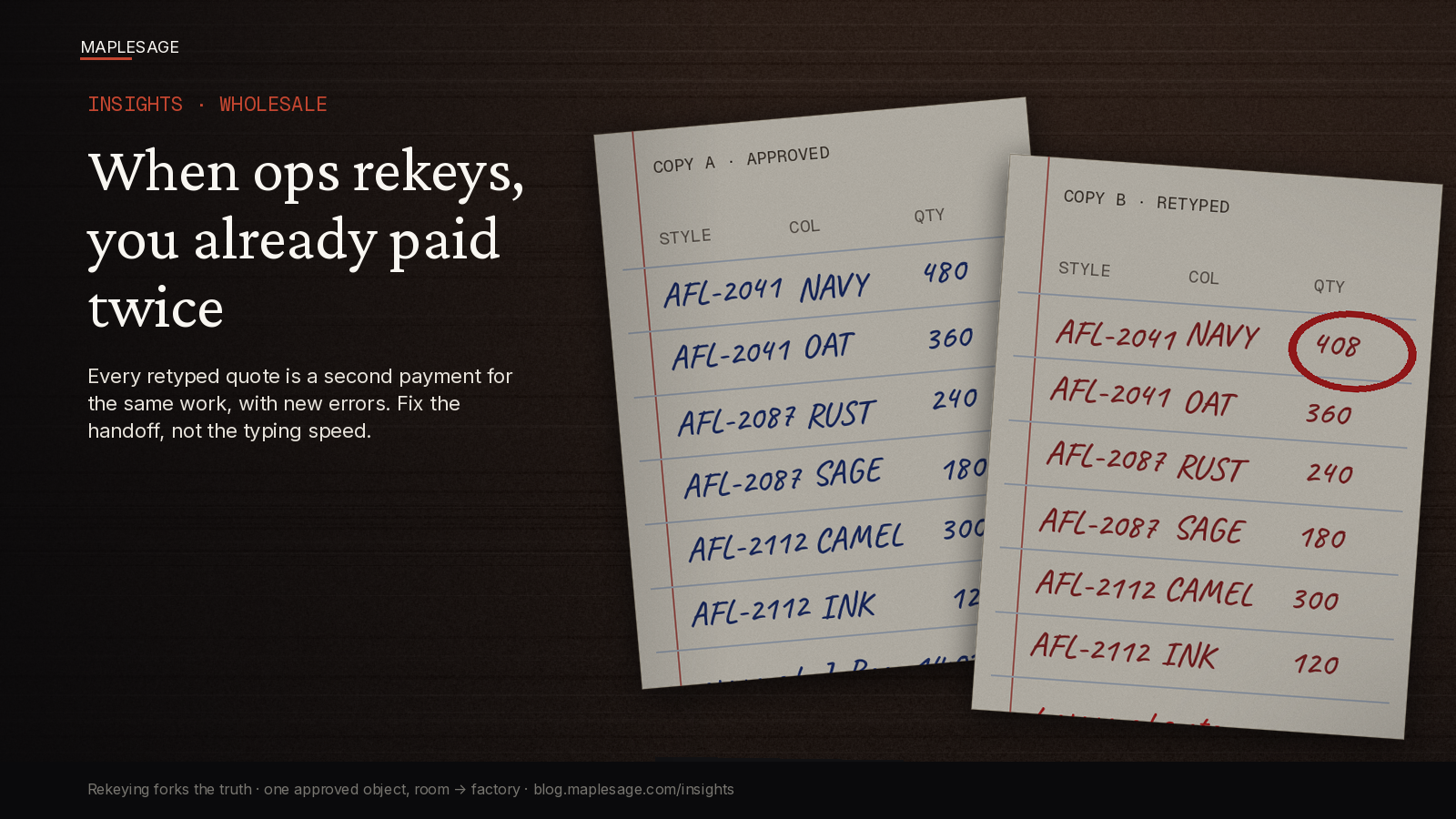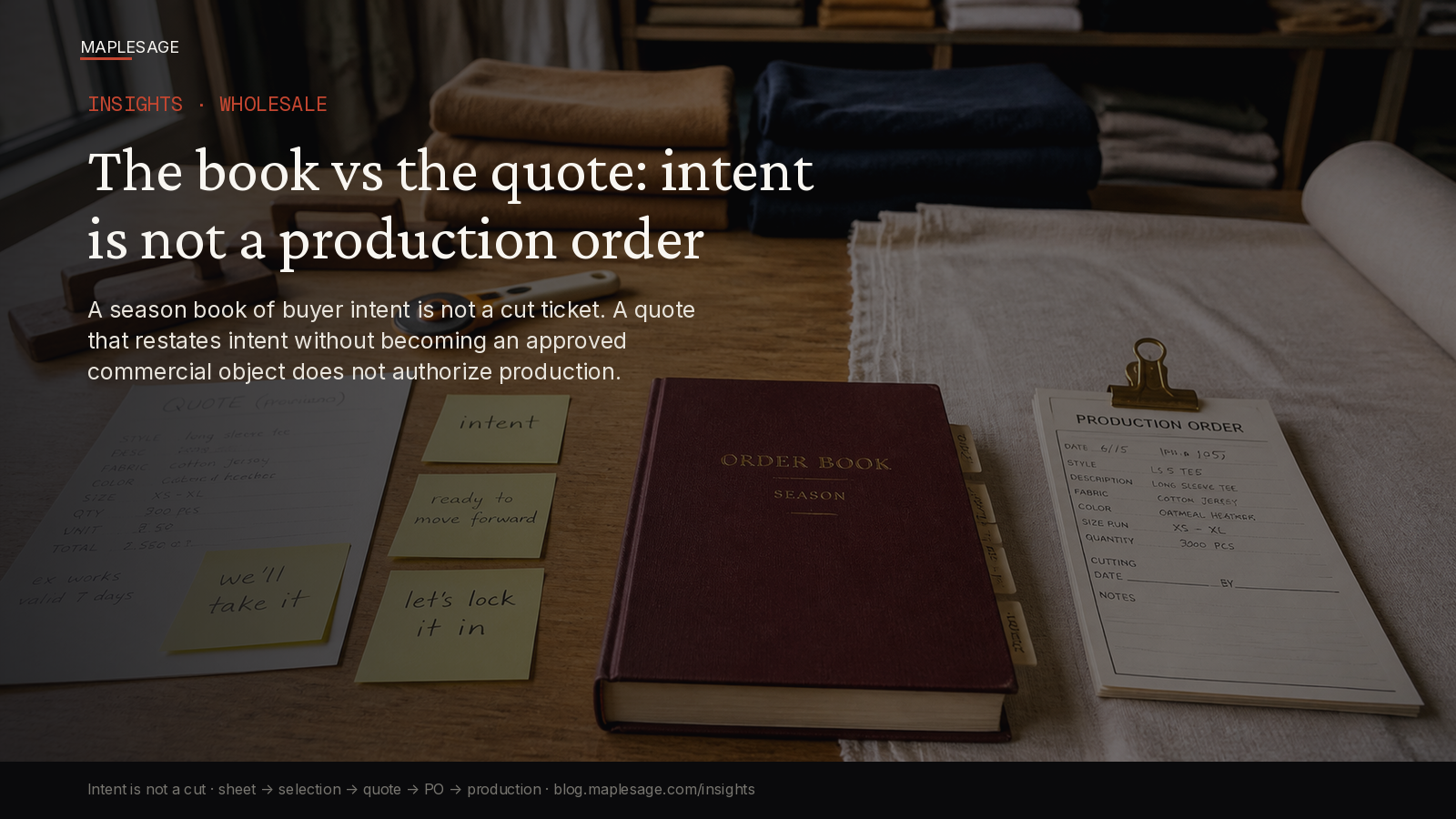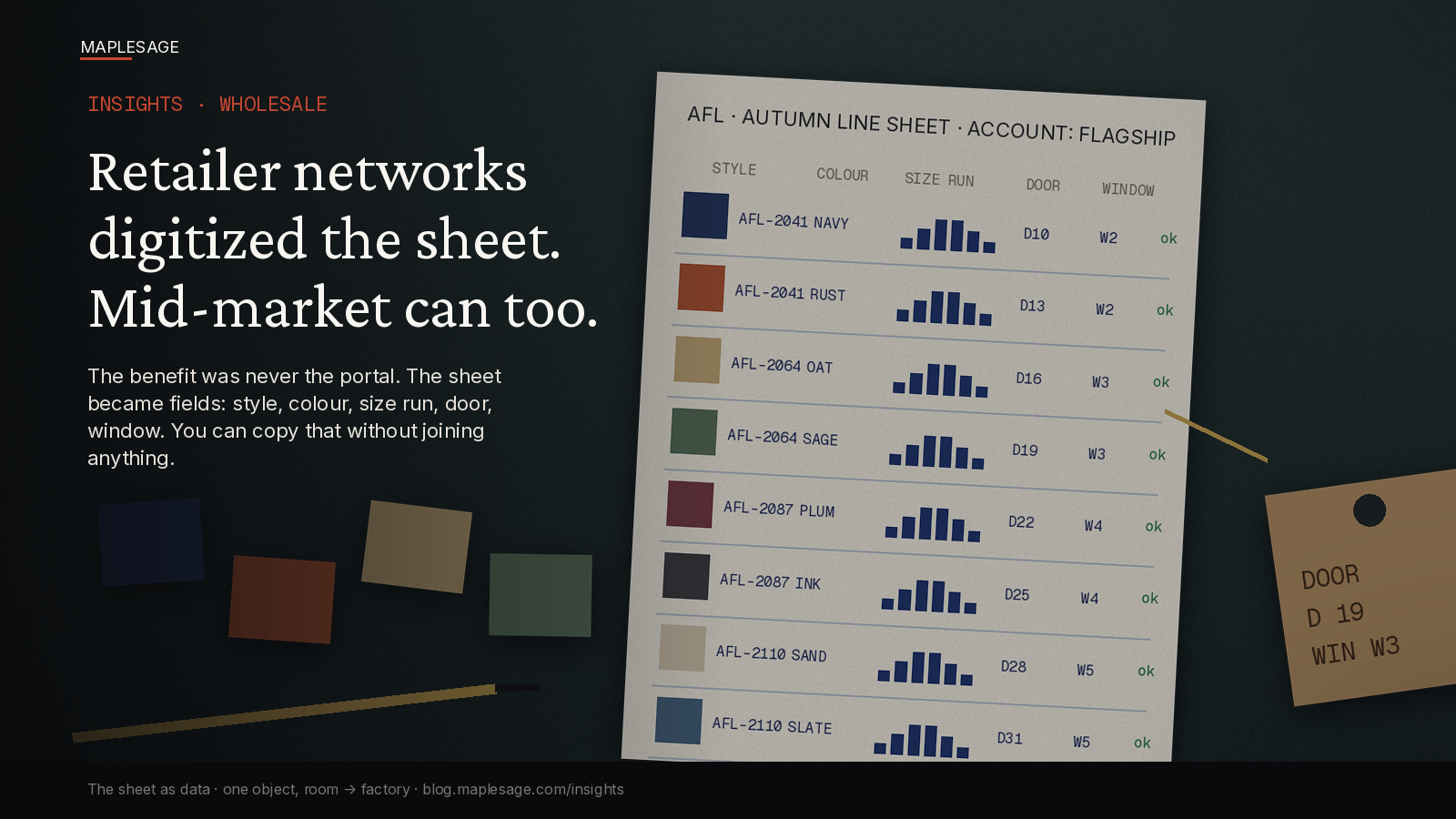
The sheet stopped being a picture of the line. It became a set of fields that other systems can read.
Walk into any large retailer’s buying office and the sheet has already changed. It is no longer a PDF that someone annotates. It is a structured record: style, colourway, size run, cost, retail, door, delivery window, terms. Wholesale networks and retailer portals made that shift years ago, because a buyer with hundreds of brands cannot reconcile hundreds of layouts.
Mid-market brands often read that as someone else’s advantage. It is a property, not a platform. You can have it without joining anything.
This follow-up sits on the spine: showroom → account-aware line sheet → quote → size/assortment → approved PO → production. Day 4 said the PO is a commercial object, not a file. Day 14 said portals do not fix fragmented quotes. Day 32 said rekeying charges you twice. This one asks what the retailer side already got right about the sheet, and how a brand of any size copies the useful part.
What the networks actually digitized
Not the look of the line sheet. The fields. Once styles, colourways, sizes, prices, doors and windows are separate, typed values, three things become possible that a PDF cannot do:
- The buyer can build an order from the sheet instead of retyping it into their own system.
- Terms and windows travel with the lines, so a ship window is attached to a style and not to a paragraph on page six.
- A change is a change to a field, visible to everyone who reads it, not a new file called FINAL_v3.
That is the whole trick. The benefit is not the portal. It is that the sheet became data.
Why mid-market brands still ship pictures
- The line sheet was built in a design tool, and the design tool outputs a picture.
- The commercial facts live in a spreadsheet, the terms in an email, the doors in a rep’s notes.
- Nobody owns the join between them, so the join is a person.
- Joining a network is a procurement project, and it only covers the accounts that happen to be on it.
Each reason is real. None of them requires you to stay at the picture stage.
What you can copy without joining anything
A short list, and it is about the object, not the software:
- One row per style and colourway, one column per fact. If a fact lives in a paragraph, it will be missed.
- Size runs as values. Not “S to XL, standard curve”, but the units, per size, per door.
- Terms and windows on the line. Dating, minimums and ship window attached to the style they govern.
- An account on the sheet. The sheet for a flagship door is not the sheet for an outlet. If it does not know which account it is for, it is a brochure.
- A revision number and a named approver. So that “which version” has an answer.
A retailer network gives you these by force. You can give them to yourself by design.
Where the network model stops
Networks digitize the hand-off to the buyer. They rarely reach the part after approval: credit check, cut commitment, factory format, refill. That is the stretch where mid-market brands bleed, because the approved object leaves the portal and is retyped into whatever production uses. If the sheet is data on your side too, the same fields flow forward instead of being rebuilt.
So the aim is not to match a network’s feature list. It is to make sure the data does not die at the edge of the sales team.
Where agents fit, and where they don’t
An agent can read an existing PDF or spreadsheet sheet, propose the structured rows, and flag the lines that do not parse: a size run that does not add up, a door with no window, a colourway with two codes. That is useful, because it turns a one-off cleanup into a review. It is the wrong job to let an agent invent commercial facts. Humans commit the terms. The agent prepares the object.
A simple test
Take your current line sheet for one account and ask:
- Could a buyer’s system build an order from it without anyone retyping a unit?
- Is every ship window attached to a style, not a footnote?
- If a size run changed this morning, could you show which version each department holds?
If the answers are “no”, “no” and “no”, your sheet is still a picture. The retailer side moved on a while ago.
The close
Networks proved the sheet can be data. You do not need their rails to get the benefit. Make your own sheet carry the fields, the account, the terms and a revision, and the quote, the PO and the cut can read it instead of rebuilding it.
MapleSage Retail-OS is built around that spine: sheet → selection → quote → PO → production.