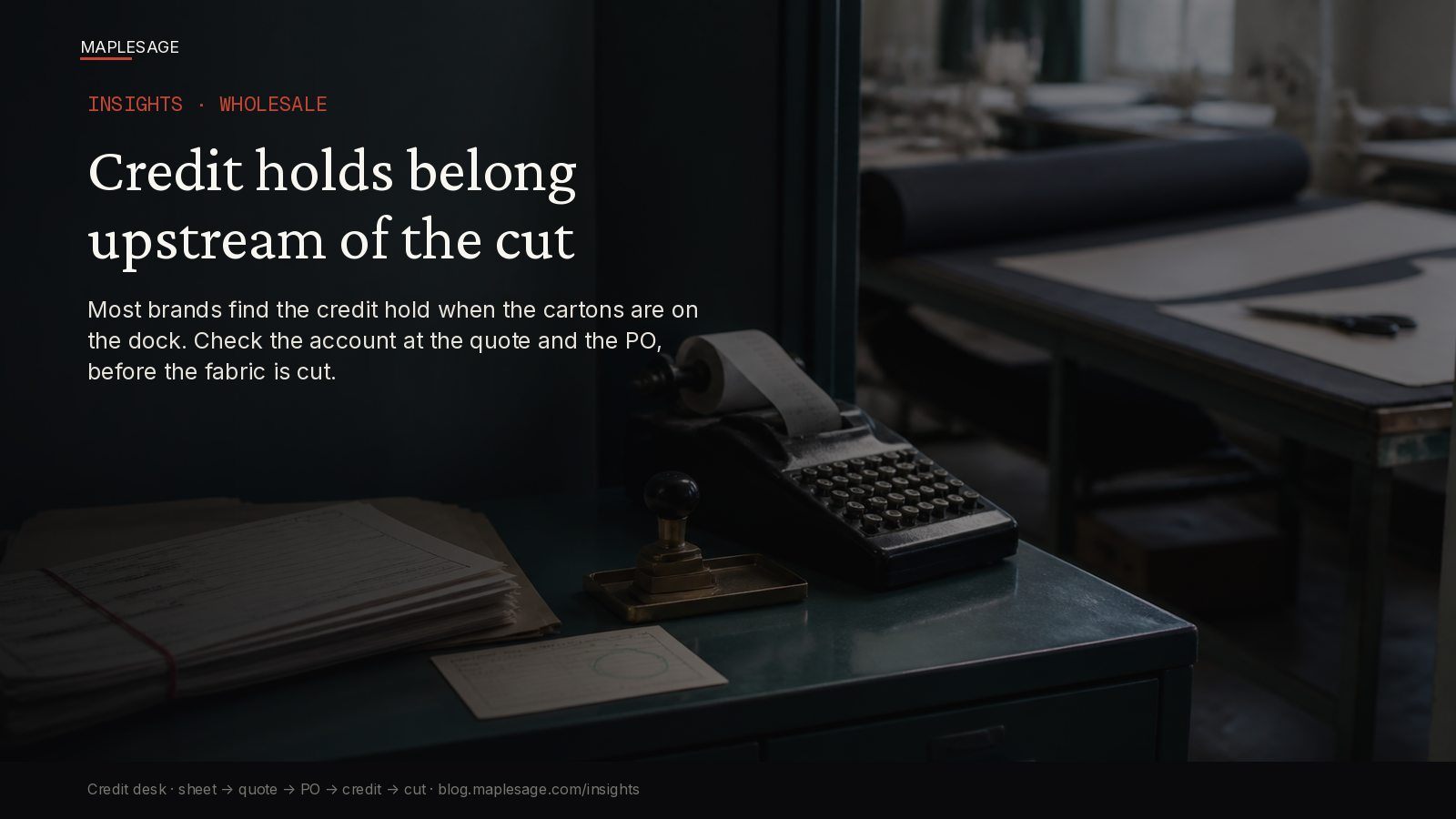
The credit decision sits at the desk by the door. The shears wait until it’s made.
The order was approved in the room. The buyer signed, the rep confirmed the delivery window, and the lines went into the production buy. Six weeks later the goods are cut, sewn, packed and staged for the first delivery.
Then finance places the account on credit hold. The retailer is past terms on last season’s invoices, or its credit limit can’t cover the new order, or the insurer has cut its line. Nobody in sales or production knew until the cartons were on the dock.
Now the brand has three bad options: ship at risk, hold finished goods that were cut for one account’s curve and colourways, or try to resell them to someone else at a discount. The credit decision was correct. It was just made at the wrong point in the season.
This follow-up sits on the spine: showroom → account-aware line sheet → quote → size/assortment → approved PO → production. Day 9 said when finance discovers dating late, the season is already lost. Day 21 said the season is lost between the room and the factory. This one is about one specific signal that keeps arriving too late: a credit hold belongs upstream of the cut, not at the shipping dock.
The misuse
In most mid-market brands, credit is checked at two moments: when an account is first opened, and when an order is about to ship. Everything in between runs on the assumption that the account is still good.
The misuse is treating credit as a shipping control instead of a commitment control. In practice:
- Sales quotes without credit context: the rep sees the account’s history and assortment, but not its open balance, limit or terms status
- Approval ignores exposure: a PO is approved on styles, quantities and windows, with no check that this order plus open orders fits the account’s limit
- Production commits on approved lines: fabric is bought and cut against orders that finance hasn’t looked at yet
- Finance checks at release: the hold lands when the warehouse asks to ship, after the money is already in inventory
- Exceptions live in email: “we’ll ship them anyway, they always pay” is a reply in a thread, not a decision on the order
Each team is doing its job. The problem is that the one fact that decides whether the order should be built at all reaches the people building it last.
Credit at the dock vs credit before the cut
| Question | Credit checked at the dock | Credit checked upstream of the cut |
|---|---|---|
| When is the account’s position visible? | At shipment release | On the quote and at PO approval |
| What does sales see while quoting? | Styles, history, prices | Styles, history, prices and credit status |
| Order exposure | Checked one order at a time, at release | This order plus open orders vs the limit, before approval |
| What happens on a hold? | Finished goods sit on the dock | The line is flagged before fabric is committed |
| Who decides an exception? | Whoever answers the email in time | A named owner, recorded on the order with a reason |
| Production’s view | Approved lines, no risk signal | Approved lines with credit status attached |
| Cost of a late “no” | Cut and sewn inventory for one account | A conversation with the buyer, a deposit or reduced quantities |
The dock check asks: should we release these goods? The upstream check asks: should we build them?
Why a late credit hold is too expensive
A credit hold at the dock looks like finance doing its job. The cost is everything that happened before it:
- The stranded-inventory cost. Goods cut for one account carry its size curve, colourways and sometimes its labels or packaging. When that account goes on hold, the inventory doesn’t easily become anyone else’s order.
- The capacity cost. Factory slots and fabric spent on an order that won’t ship are slots and fabric that weren’t available for accounts that would have paid.
- The ship-at-risk cost. Under pressure to clear the dock, brands release goods to accounts they already doubted. The receivable gets bigger and the decision gets harder next season.
- The relationship cost. Telling a buyer at delivery that their order is held is a worse conversation than asking for a deposit or reduced quantities at approval. The buyer remembers being surprised.
- The blame cost. Sales says finance should have flagged it, finance says nobody told them the order was in production, and production says the PO was approved. Nothing changes for next season.
Related: When Finance Discovers Dating Late, the Season Is Already Lost. Door Terms Belong on the Sheet. Cut Commitments Without a Canonical Quote Are Folklore. The PO Is Not a Form. How Mid-Market AFL Loses the Season Between Room and Factory. Full spine: The Wholesale Season Breaks When the Sheet Stops Being the System.
What credit upstream of the cut looks like
Keep credit decisions with finance. Then move the signal to where commitments are made:
- Credit status is on the account: current terms, limit, open balance and any hold are visible on the account’s quote, not only in the finance system
- Exposure is checked at approval: when a PO is approved, the order plus the account’s other open orders are compared to its limit, so finance sees the risk before production does
- Holds stop lines before fabric is committed: an order on credit review is flagged on the lines production reads, so nothing is cut against it until the review is cleared
- Exceptions are decisions on the order: “ship on deposit”, “reduce to the first delivery” or “approved over limit” sits on the order with owner, reason and date, not in a thread
- Changes re-check: a late add or a quantity increase after approval triggers the same check, because exposure changes with the order
- Release is a confirmation, not a discovery: by the time goods reach the dock, the credit question was answered weeks ago
When credit is checked before the cut, a hold is a conversation. When it’s checked at the dock, a hold is inventory.
ICP framing
For mid-market AFL brands selling to retailers (roughly $10M to $250M wholesale), where the credit check sits is an input to:
- how much finished inventory gets stranded by accounts that can’t take delivery
- how often goods ship at risk because they’re already made
- how early sales can ask for deposits, adjusted terms or reduced quantities
- how cleanly finance, sales and production agree on which orders are real
It isn’t a new credit-scoring tool, a factoring arrangement, or another approval step bolted onto shipping.
Heads of wholesale feel it when a full delivery sits on the dock for an account everyone was worried about in the room.
Product proof note: the Retail-OS wholesale path
MapleSage Retail-OS keeps the wholesale order as one object from the account’s line sheet through quote revisions to the approved PO. Account terms and approval decisions travel with the order, so the people approving and building it see the same commercial context instead of finding out at shipment.
See the buyer path: b2b.maplesage.com. Wholesale surface: www.maplesage.com/retail/wholesale/. Talk: go.maplesage.net.
What we won’t pitch
- Replacing your finance team’s credit judgement or your ERP
- AI that predicts which retailers will pay
- Finance-system or competitor screenshots as the hero
Next step
Take last season’s credit holds and ship-at-risk releases. For each one, note the date the order was approved, the date fabric was committed and the date finance raised the hold. Count the orders where the hold came after the cut. Every one of those is inventory that a credit check upstream would have turned into a conversation.