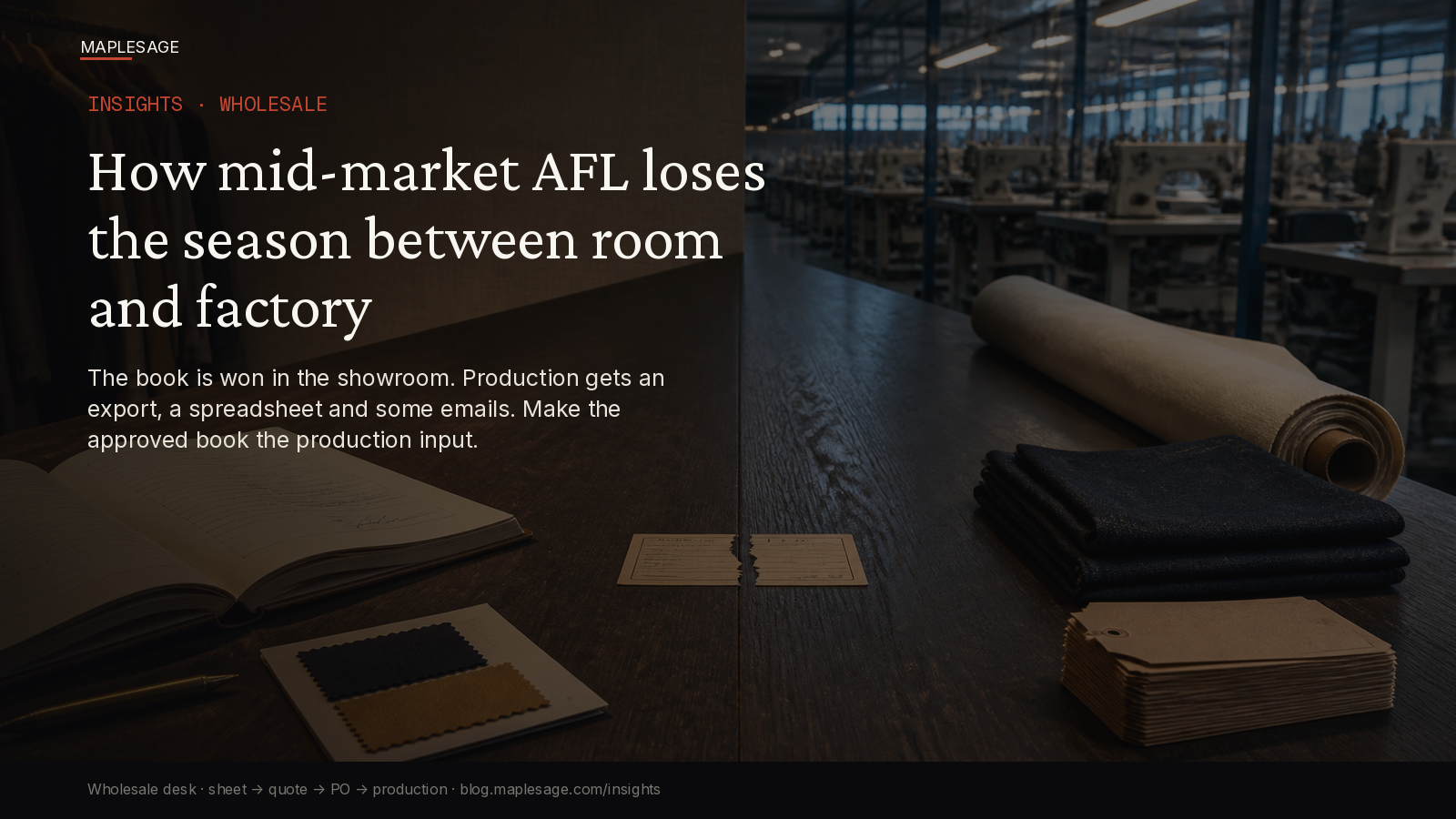
The order was signed at one end of the table. The factory only saw what made it across the gap.
Market closes well. The book looks strong: key accounts placed, the hero styles landed, two buyers asked for a colourway extension that got approved, and the outlet accounts took a different size curve than the flagships. Everyone leaves feeling the season is made.
Three weeks later, the production buy goes to the factory. It’s built from an export of the order system, a planner’s spreadsheet, and a set of emails about the exceptions. The colourway extension is in it for one account and missing for the other. The outlet curve has been averaged into the flagship curve. One account’s earlier delivery window is a note in someone’s inbox. The factory cuts exactly what it was sent.
The season wasn’t lost in the room. It was lost between the room and the factory.
This follow-up sits on the spine: showroom → account-aware line sheet → quote → size/assortment → approved PO → production. Day 13 said cut commitments without a canonical quote are folklore. Day 7 said one season book beats five spreadsheets. This one is about the handoff itself: if the approved book isn’t the production input, the factory builds a guess.
The misuse
Most mid-market brands treat wholesale and production as two systems with a handoff in between. Sales owns the book until market closes. Planning or sourcing owns the buy after that. The handoff is a file.
The misuse is assuming that file carries the season. In practice, what reaches production is a summary, rebuilt from several places:
- The order export: totals by style and colour, often without the account, door or delivery window behind each line
- The planner’s spreadsheet: where curves are adjusted, buffers added and late orders squeezed in by hand
- Exception emails: colourway extensions, MOQ waivers and early drops approved in the room or in a thread
- The rep’s forecast: “this account will add more” or “this one always cuts back”, passed on verbally
- Last season’s buy: used to fill the gaps where the current data is thin
Each of these is partial, and none of them is the approved book. The production buy becomes a re-keyed interpretation of the season, made weeks after the decisions, by people who weren’t in the room.
Handoff by file vs handoff by object
| Question | Handoff by file | Handoff by object |
|---|---|---|
| What does production receive? | An export plus a spreadsheet plus emails | The approved book: lines tied to account, door and window |
| Where do size curves come from? | Averaged in the planner’s sheet | Carried from each account’s approved curve |
| Approved exceptions | In emails, if someone forwards them | On the line, with owner, reason and decision |
| Delivery windows | Collapsed into one ship date | Kept per account, so the cut plan can sequence |
| Late changes after market | Patched into the spreadsheet | New revision of the book, visible to both sides |
| When does production see demand? | When the file is ready | As orders are approved, before the buy closes |
| What does a short ship trace back to? | Whoever built the file | The approved line it was meant to fill |
The file handoff asks: what were the totals? The object handoff asks: what exactly was committed, to whom, when, and on what terms?
Why losing the season in the handoff is too expensive
The gap between room and factory looks like admin. It’s where margin and trust go:
- The averaging cost. When account curves and door mixes are flattened into one buy, the factory makes the wrong sizes in the right total. Flagships run out of the middle, outlets get sizes they didn’t ask for, and the gap shows up as markdowns and chargebacks.
- The lost-exception cost. An approved colourway extension or MOQ waiver that doesn’t reach production becomes a promise the brand can’t keep. The buyer remembers the room; the factory never heard of it.
- The sequencing cost. When every account’s delivery window collapses into one date, the cut plan can’t prioritise the earliest commitments. Early accounts ship late, and the dating conversation with finance starts badly.
- The latency cost. Every week the buy waits for a clean file is a week of factory capacity and fabric lead time the brand doesn’t get back. Late buys mean air freight, substitutions or missed windows.
- The blame cost. When something ships wrong, sales points at planning, planning points at the file, and the factory points at the PO. Nobody can trace the short ship to the approved line, so the same gap opens again next season.
Related: Cut Commitments Without a Canonical Quote Are Folklore. One Season Book Beats Five Spreadsheets. Size Mix by Door. ATP on the Buy. Showroom Beauty Without Commercial Continuity. Full spine: The Wholesale Season Breaks When the Sheet Stops Being the System.
What a clean room-to-factory handoff looks like
Keep sales and production as separate teams with separate jobs. Then give them the same object:
- The approved book is the production input: production reads approved PO lines directly, not a summary rebuilt from them
- Every line keeps its context: account, door group, size curve, delivery window and terms stay attached from quote to cut plan
- Exceptions travel with the line: an approved colourway extension, MOQ waiver or early drop sits on the line it changes, with owner and reason, so production sees it without a forwarded email
- Demand is visible as it’s approved: planning sees the book building during market, not three weeks after it closes, so fabric and capacity conversations start early
- Changes are revisions, not patches: a late add or a cut-back after market is a new revision of the book, visible to sales and production at the same time
- Short ships trace back: when the factory can’t fill something, the gap is tied to the approved account lines it affects, so sales can talk to the right buyers first
When production builds from the approved book, the factory makes what was sold. When it builds from a file, it makes what survived the handoff.
ICP framing
For mid-market AFL brands selling to retailers (roughly $10M to $250M wholesale), the room-to-factory handoff is an input to:
- how closely the production buy matches what accounts actually committed to
- whether approved exceptions are honoured or quietly dropped
- how early fabric and factory capacity can be secured
- how many short ships, wrong-size deliveries and chargebacks the season carries
It isn’t a new PLM, a bigger planning spreadsheet, or another integration that moves totals from one system to another faster.
Heads of wholesale feel it when the best book in years ships like an average one.
Product proof note: the Retail-OS wholesale path
MapleSage Retail-OS keeps the wholesale book as one object from the account’s line sheet through quote revisions to the approved PO. Each approved line carries its account, size curve, delivery window and any approved exceptions, so planning and production read the season as it was committed instead of rebuilding it from exports and emails.
See the buyer path: b2b.maplesage.com. Wholesale surface: www.maplesage.com/retail/wholesale/. Talk: go.maplesage.net.
What we won’t pitch
- Replacing your factory relationships, sourcing team or PLM
- AI that forecasts the buy instead of reading what was approved
- Factory-floor or competitor screenshots as the hero
Next step
Take last season’s production buy for your top ten styles. For each one, compare the size curve, colourways and delivery dates in the buy against the approved orders behind it. Count the lines where the buy averaged a curve, dropped an approved exception or collapsed a delivery window. Every mismatch is a place the season was lost between the room and the factory.