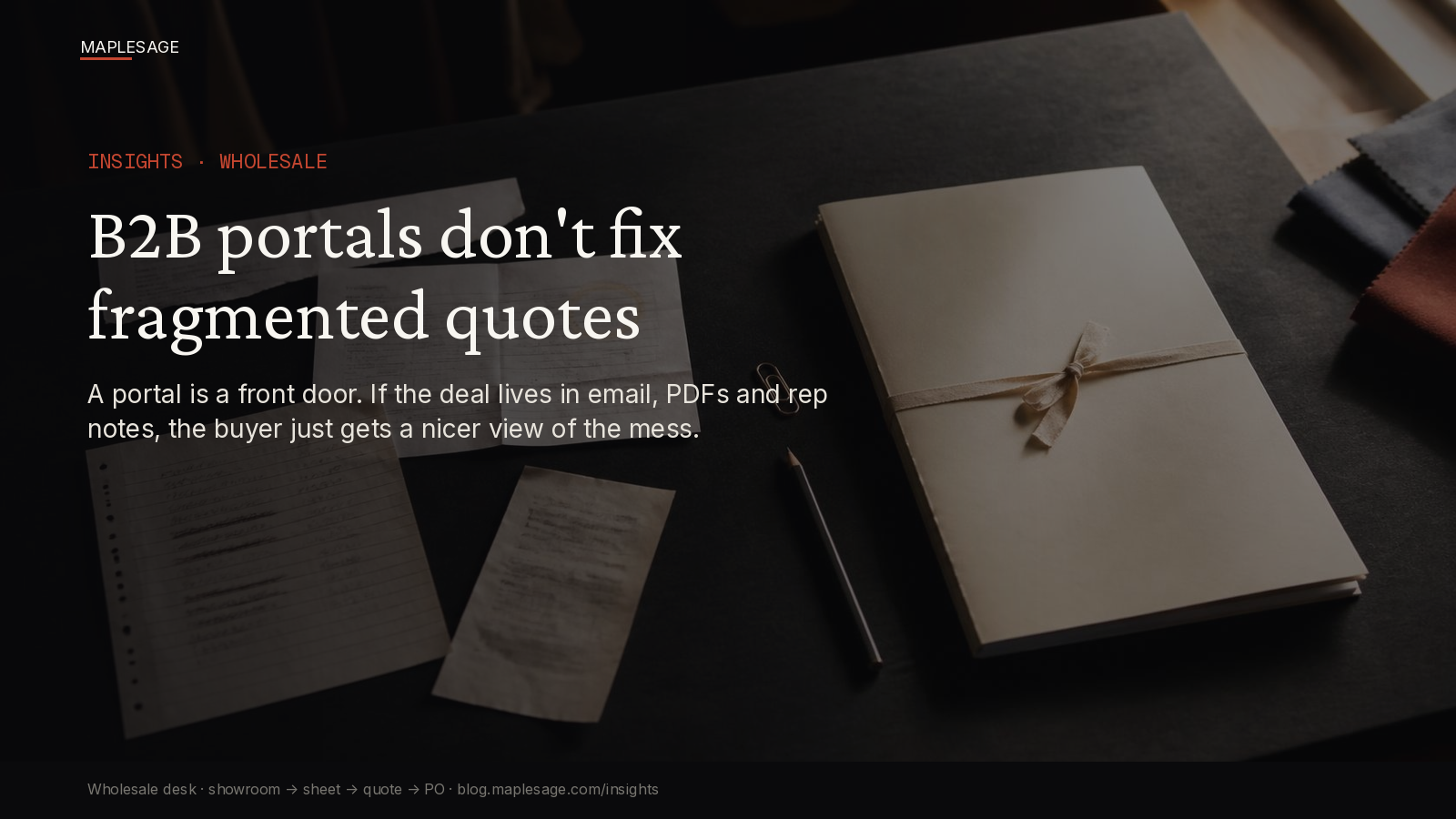
A portal is a front door. If the quote behind it is in four pieces, the buyer just gets a nicer view of the mess.
Most wholesale teams reach for a B2B portal when quoting starts to hurt. Buyers keep asking for “the latest version.” Reps keep resending PDFs. Customer service keeps re-keying orders. A portal promises self-serve: the buyer logs in, sees the line, places the order, done.
Then market week happens. The rep agrees a door-level price break on the phone. The buyer marks units on a printed sheet. Finance approves extended dating in an email. Planning holds ATP on a spreadsheet. The portal shows list price, standard terms and live inventory — and none of what was actually agreed.
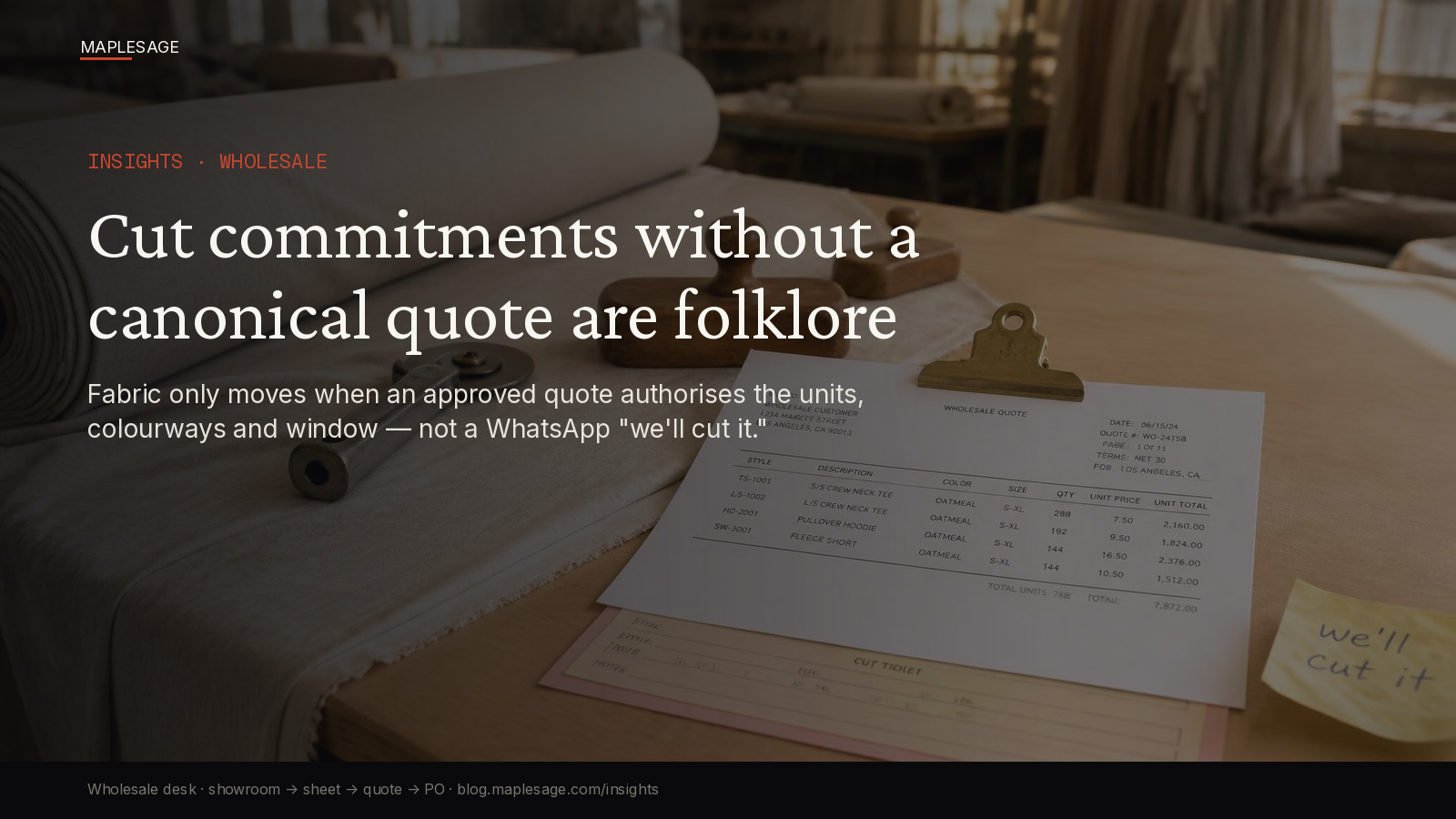
This follow-up sits on the spine: showroom → account-aware line sheet → quote → size/assortment → approved PO. Day 1 said the quote isn’t a thread. Day 8 said wholesale isn’t DTC checkout. Day 13 gated the cut on the canonical quote. This one is about the tool most teams buy instead: a portal is a channel, not a source of truth. It can’t fix a quote that is still fragmented.
The misuse
The portal gets bought as the quoting fix. The logic sounds right: if buyers order themselves, there’s nothing to re-key and nothing to lose.
In wholesale, the quote is not a cart. A real wholesale quote already carries:
- Which account, which doors and which price list or negotiated breaks apply
- Which styles, colourways and size curves were agreed for this buy
- Which ship windows, drops and ATP holds the units depend on
- Which terms, dating and deposit rules finance signed off
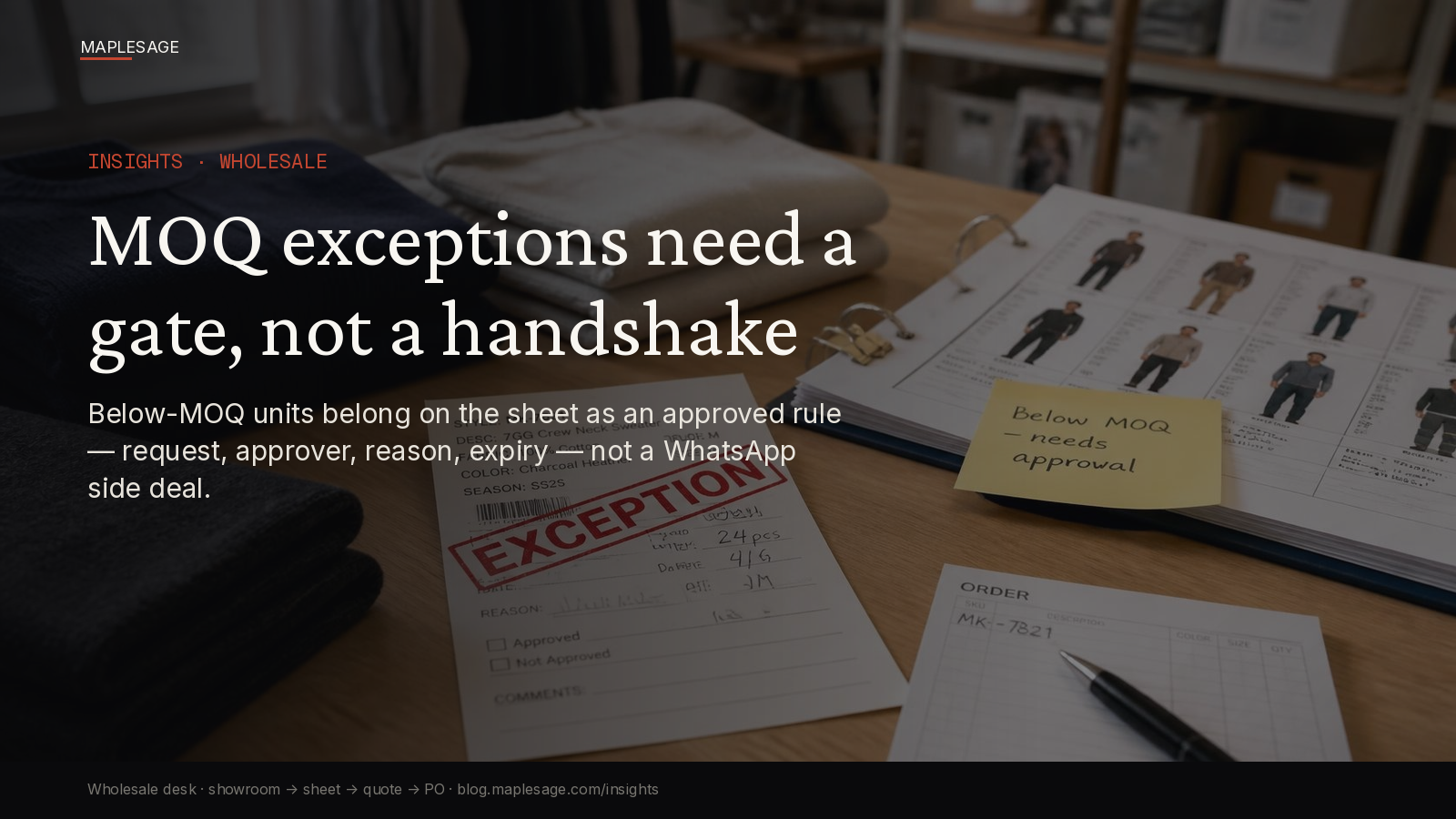
- Which exceptions (MOQ, substitutions, late adds) were approved, and by whom
When those terms live across the rep’s inbox, a PDF on a shared drive, a WhatsApp from the showroom and a row in the ERP, the portal can only show one of them. Usually the least negotiated one. The buyer sees a number that doesn’t match what the rep promised, calls the rep, and the order goes back to email. The portal didn’t remove a fragment. It added one.
Nobody bought the portal to create a fifth version of the quote. It’s just that the portal reads the catalogue, not the commercial object.
Portal on fragments vs portal on one quote
| Moment | Portal on fragmented quotes | Portal on one canonical quote |
|---|---|---|
| Pricing | List or tier price; negotiated breaks live in email | Account and door price from the approved quote |
| Assortment | Full catalogue; agreed styles and curves in rep notes | The styles, colourways and curves the account actually agreed |
| Availability | Live stock, no view of ATP holds for this buy | ATP held against the quote lines and windows |
| Terms | Standard terms; dating approved in a finance email | Terms and dating carried on the quote |
| Exceptions | Invisible; rep fixes them after the order lands | Approved exceptions visible, unapproved ones blocked |
| Buyer edits | Portal order diverges from what the rep agreed | Edits amend the same quote, with history |
| Order entry | CS reconciles portal order against the “real” quote | PO converts from the quote; nothing to reconcile |
| Audit | “Which version did the buyer see?” | One object: who saw, changed and approved what |
The fragmented desk asks: which version is the real one? The canonical desk doesn’t have to, because the portal, the rep and finance are all reading the same quote.
Why a portal on fragments is too expensive
A portal on top of scattered quotes looks like digital progress. It quietly carries three costs:
- The adoption cost. Buyers try the portal, see prices or assortments that don’t match what they agreed, and stop using it. The rep goes back to PDFs. You now pay for a portal and the old process.
- The reconciliation cost. Portal orders arrive against list terms. Customer service and finance re-check every one against the email, the sheet and the ERP. Self-serve becomes self-entry plus manual correction.
- The trust cost. Every mismatch teaches the buyer that the portal isn’t the deal. The next negotiation moves even further off-system, and the fragments multiply.
Related: Your Quote Isn’t a Thread. Wholesale Isn’t DTC Checkout With Extra Fields. Door Terms Belong on the Sheet. ATP on the Buy. The Rep Shouldn’t Re-Enter What the Buyer Already Marked. Cut Commitments Without a Canonical Quote Are Folklore. Full spine: The Wholesale Season Breaks When the Sheet Stops Being the System.
What has to be true before the portal helps
A portal only earns its place when the quote behind it carries enough for the buyer, the rep and finance to trust it:
- One quote per buy: a single account-aware quote ID, not a PDF, an email and an ERP row that each claim to be current
- Account-aware pricing and terms: door price, breaks, dating and deposit rules sit on the quote, so the portal shows the deal, not the list
- Agreed assortment: styles, colourways and size curves from the sheet the buyer marked, not the full catalogue
- ATP on the lines: availability held against the quote’s windows, not a raw stock number
- Governed edits: buyer changes in the portal amend the same quote with history; exceptions route to approval
- Clean conversion: the approved quote becomes the PO, so nobody re-keys a portal order against the “real” terms
- Visible status: reps, planning and finance open the same object the buyer sees
When those live on the quote, the portal is a window onto the deal. When they don’t, it’s a nicer screen in front of four spreadsheets.
ICP framing
For mid-market AFL brands selling to retailers (roughly $10M to $250M wholesale), whether the portal reads one canonical quote or a catalogue beside fragments is an input to:
- how many portal orders customer service still re-keys or corrects
- how often buyers see a price, curve or window that doesn’t match what the rep agreed
- how much negotiated business stays in email because the portal can’t show it
- how long it takes finance to approve an order that came in “self-serve”
It isn’t a new portal vendor, a prettier B2B storefront theme or another integration that syncs the catalogue nightly while the negotiated terms stay in the inbox.
Heads of wholesale feel it when the portal dashboard shows rising logins and the order desk is still reconciling every order by hand.
Product proof note: the Retail-OS wholesale path
MapleSage Retail-OS keeps the quote as one account-aware commercial object from the showroom to the PO: the sheet the buyer marked, door pricing and terms, ATP on the lines, governed exceptions and clean conversion. The buyer-facing path reads that same object, so what the buyer sees is what was agreed.
See the buyer path: b2b.maplesage.com. Wholesale surface: www.maplesage.com/retail/wholesale/. Talk: go.maplesage.net.
What we won’t pitch
- “Just add a portal” as a fix for quotes that live in four places
- A catalogue sync dressed up as account-aware pricing
- Competitor portal or storefront screenshots as the hero
Next step
If your buyers can log in to a portal but still email the rep to confirm the “real” price, the portal isn’t the problem and it isn’t the fix. Put the account, terms, assortment, ATP and approvals on one quote first. Then let the portal show it.