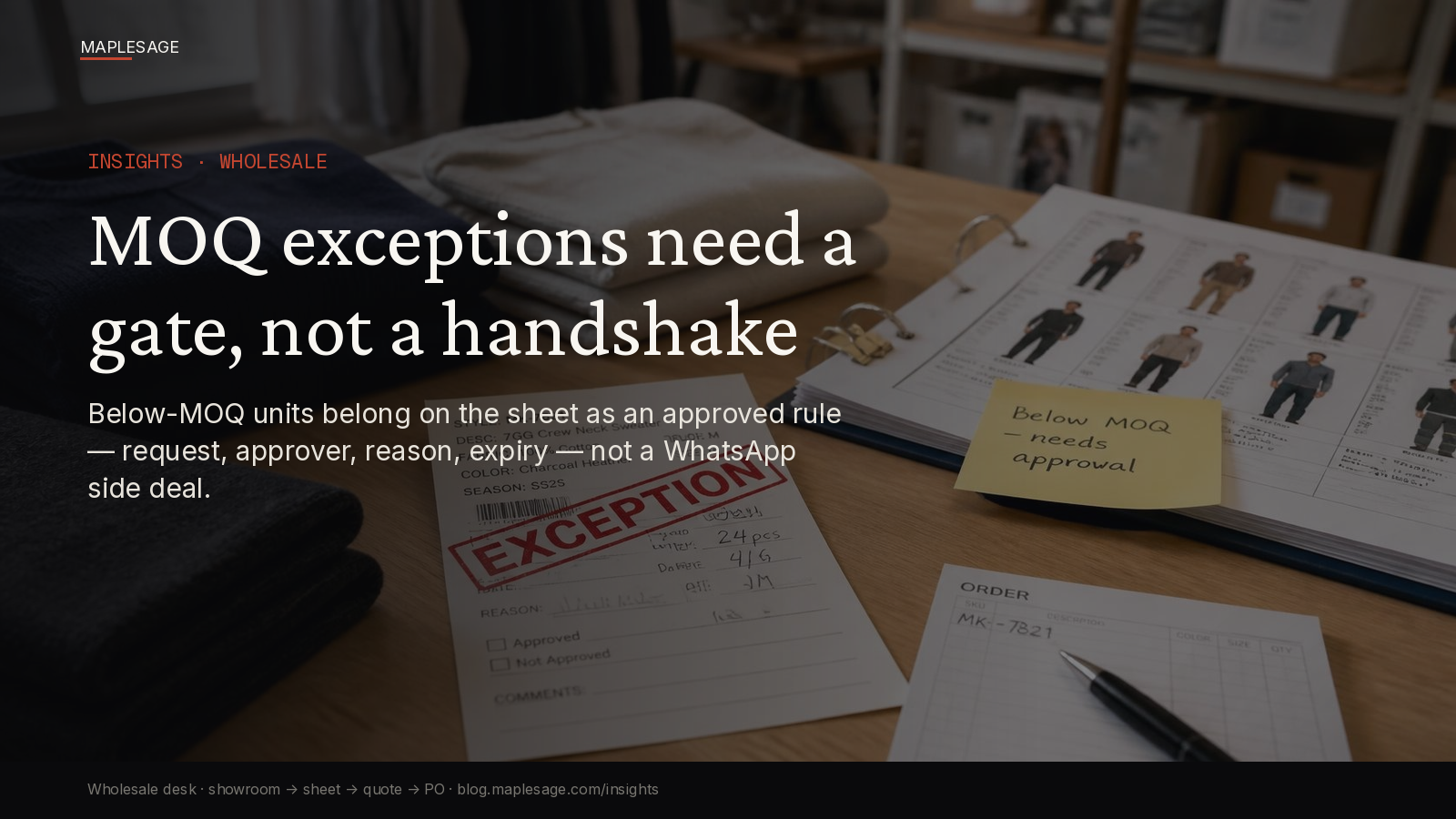
If the exception only lives in a chat, it isn’t an exception. It’s a risk nobody owns.
Every wholesale season has the same moment. A buyer wants eight units of a style that carries a twelve-unit MOQ. The rep wants the order. Somebody says “we’ll make an exception,” and it lands in WhatsApp or email. The line goes on the sheet. The PO gets approved. Nobody writes down who waived the MOQ, for which account, for which style, for which window, or why.
Then planning builds a cut on numbers that don’t match the MOQ rules. Finance asks why the margin on that account looks thin. Production asks why eight units of a style that was supposed to be twelve are sitting on the cut ticket. The handshake that felt like good selling becomes three people’s problem, with no commercial object to point at.
This follow-up sits on the spine: showroom → account-aware line sheet → quote → size/assortment → approved PO. Day 4 made the PO the end of a commercial object. Day 6 put ATP on the buy. This one is about the rule that gets waived most often and tracked least: the minimum order quantity exception.
The misuse
MOQ exceptions get treated as side deals. A favour the rep grants to close the appointment, or a concession the buyer extracts after the room.
In wholesale, an MOQ exception is a change to the commercial rules of the season. It already carries decisions that matter:
- Which account gets to go below the style MOQ
- Which styles and colourways the waiver applies to
- Which ship window or drop the exception covers
- Who approved it, and under what reason code
- When the exception expires — this order only, this account this season, or until revoked
When those decisions live in a chat, the sheet still looks like it follows the published MOQ. The quote still looks clean. The PO still gets approved. The only people who know the rule was waived are the two who shook hands — and by the time planning and finance need the record, the chat is three threads deep and the season has already moved.
Nobody made a mistake on purpose. The exception was just never put on the object that planning, finance and production read.
Handshake exceptions vs gated exceptions
| Moment | Handshake exception | Gated exception |
|---|---|---|
| Request | Buyer asks in WhatsApp or at the table | Exception requested on the style/line on the sheet |
| Approval | Rep says yes, or “I’ll check with the boss” | Named approver reviews and accepts or rejects |
| Reason | Lives in the chat, or nowhere | Reason code and note sit on the exception record |
| Scope | Implied: this order, maybe this account | Explicit: account, style/colourway, window, drop |
| Expiry | Forgotten until next season | Window or “this PO only” set at approval |
| On the sheet | Line shows below-MOQ units with no flag | Line shows exception status, approver and expiry |
| On the quote | Quote looks like a normal below-MOQ buy | Quote carries the gated waiver with the line |
| On the PO | PO inherits the units with no waiver trail | PO cannot clear until the gate is approved |
| Audit | “We agreed on WhatsApp” | Who waived what, when, why, for which window |
The handshake desk asks: did we say yes to this somewhere? The gate desk doesn’t have to ask, because the exception is on the same object as the line.
Why the handshake is too expensive
A WhatsApp yes looks free. It is where three of the season’s quietest costs start:
- The planning cost. Cut and buy plans assume published MOQs. An ungated below-MOQ line either gets rounded up (and the account gets more than they ordered) or left as-is (and the cut runs short of the rule the mill was given). Either way, the plan and the sheet disagree.
- The margin cost. MOQs exist because small lines don’t cover the cost to cut, pack and ship. An exception without a reason code and an approver is a margin decision made by whoever was in the chat — not by the person who owns the P&L.
- The precedent cost. Once one account gets a handshake waiver, the next buyer asks for the same. Without a gate, every exception is a new negotiation, and the published MOQ stops being a rule.
Related: Your Quote Isn’t a Thread. The PO Is Not a Form. ATP on the Buy. Account History Is Assortment Logic. The Rep Shouldn’t Re-Enter What the Buyer Already Marked. Full spine: The Wholesale Season Breaks When the Sheet Stops Being the System.
What the gate must carry
An MOQ exception only belongs on the sheet if it carries enough for planning and finance to trust it:
- Request on the line: the below-MOQ units are proposed on the style/colourway they belong to, not in a side chat
- Named approver: someone with authority accepts or rejects before the quote or PO can proceed
- Reason code and note: why this account, this style, this window — recorded, not implied
- Scope: which account, which styles/colourways, which ship window or drop
- Expiry: this PO only, this account this season, or a dated window — set at approval
- Visible status on the sheet and quote: the line shows it is below MOQ under an approved exception, not a silent override
- PO hard stop: the PO cannot clear below MOQ unless the gate is approved and still in window
When those live on the commercial object, the exception is a governed decision. When they live in WhatsApp, it’s a handshake that outlives the people who made it.
ICP framing
For mid-market AFL brands selling to retailers (roughly $10M to $250M wholesale), whether MOQ exceptions are gated or handshaken is an input to:
- how often cut plans diverge from the published MOQ rules
- how many below-MOQ lines reach production without a named owner
- how hard it is for finance to explain margin on exception accounts
- how fast “one favour” becomes the new informal MOQ for a whole door group
It isn’t a stricter MOQ policy document, a longer WhatsApp thread with the boss CC’d, or a spreadsheet of “approved exceptions” that nobody updates after market week.
Heads of wholesale feel it when planning asks which of last month’s below-MOQ lines were real exceptions — and the only answer is a search through chat.
Product proof note: the Retail-OS wholesale path
MapleSage Retail-OS puts the MOQ exception on the same account-aware commercial object as the sheet: request on the line, named approver, reason and expiry, visible status on the quote, and a PO that cannot clear below MOQ until the gate is approved. The handshake becomes a recorded rule, not a side deal.
See the buyer path: b2b.maplesage.com. Wholesale surface: www.maplesage.com/retail/wholesale/. Talk: go.maplesage.net.
What we won’t pitch
- “AI that reads your WhatsApp exceptions into the ERP” as a fix for ungated waivers
- A longer exception policy PDF that still leaves approval in the chat
- Competitor MOQ or order-entry screenshots as the hero
Next step
If your below-MOQ lines still clear because someone said yes in a chat, stop treating that as an exception process. Put the request, approver, reason and expiry on the sheet — so the line can only proceed below MOQ when the gate has actually opened.