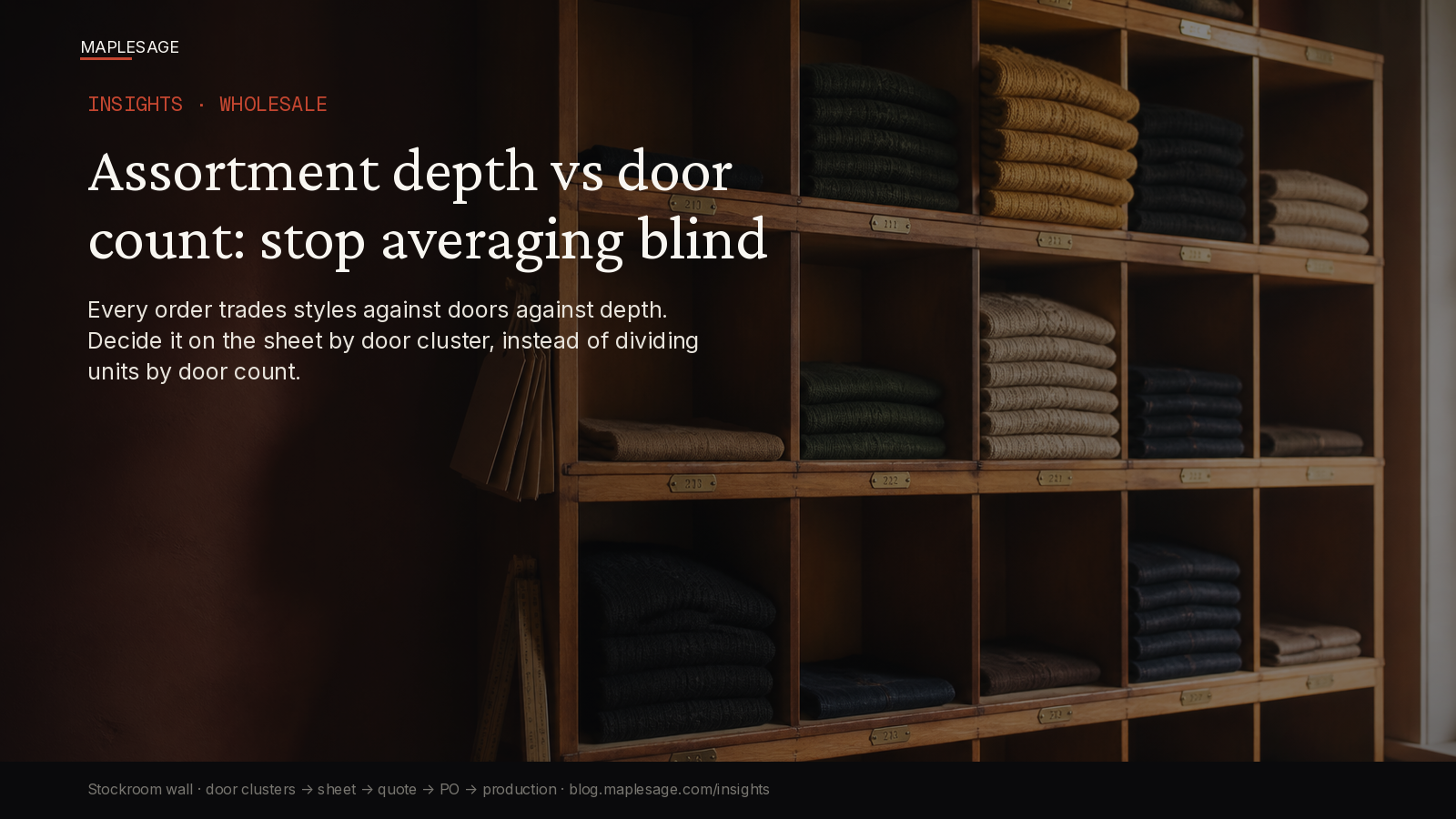
Some doors need the tall stack. Some need two pieces. An average gives every cubby the same half-stack.
The order looks balanced. The account takes forty styles into all of its doors, every style at the same depth, every door getting the same assortment. The rep is happy with the width, the buyer is happy the whole story is represented, and the PO goes through.
Eight weeks in, the account’s two best doors have sold out of the core styles and are showing customers an empty fixture. Most of the smaller doors have every style on the floor, a few units each, and not enough of anything to sell through before markdown. Across the account the sell-through looks average. In every single door it’s wrong.
Nobody planned it badly. They planned it blind: one assortment, one depth, divided by door count.
This follow-up sits on the spine: showroom → account-aware line sheet → quote → size/assortment → approved PO → production. Day 16 split the size mix by door cluster. Day 23 put the buyer’s budget on the sheet. This one is about the trade every order makes inside that budget: how wide, how deep and in how many doors. Make it on the sheet, or it gets made by averaging.
The misuse
Every wholesale order spends a fixed budget across three levers: the number of styles, the number of doors and the depth of each style in each door. Pull one up and another has to come down.
In most mid-market brands, nobody pulls the levers on purpose. The default is to average:
- Same assortment in every door: the account’s full selection goes to every door, whatever the door’s size or customer
- Depth set by division: total units per style are split by door count, so every door gets a thin, even slice
- Width wins the room: in the appointment, adding one more style feels like progress; taking depth out of the core never comes up
- Door count is a number, not a list: the order knows the account has a certain number of doors, but not which ones sell through and which ones carry stock
- The trade is invisible: when depth comes out to fit width, nobody sees it happen, so nobody decides it
The result is an order that’s wide everywhere and deep nowhere. That’s the one shape no door actually needs.
Averaged vs decided
| Question | Averaged | Decided on the sheet |
|---|---|---|
| Who gets which styles? | Every door gets the full selection | Core styles to all doors; edit styles to the doors that sell them |
| How is depth set? | Units divided by door count | By door cluster, from sell-through and fixture capacity |
| What happens to width vs depth? | Width grows quietly, depth thins | The trade is shown in the room and agreed |
| What does the PO carry? | One assortment, one depth | Assortment and depth by door cluster |
| What does production see? | A total that hides a thin spread | Units by style that reflect where they’ll sell |
| What does the season review learn? | “Average sell-through” | Which doors needed depth, which needed fewer styles |
The averaged model asks: how many styles did the buyer take? The decided model asks: which doors get how much of what?
Why averaging is too expensive
An averaged order looks fair and complete. The cost lands in every door, in different ways:
- The stock-out cost. The account’s best doors run out of the styles that sell, early, while units sit in doors that won’t move them. Replenishment arrives late or not at all.
- The markdown cost. Small doors carry a few units of everything. Broken assortments don’t sell through, and the tail goes to markdown at the end of the season.
- The fixture cost. A door with room for twenty styles gets forty, each at a depth too shallow to merchandise. The presentation the showroom sold never makes it to the floor.
- The production cost. Units are planned against a total that’s spread too thin. The brand cuts the right number in the wrong shape, and has nothing left to chase the styles that work.
- The relationship cost. The buyer’s review says the line underperformed. It didn’t; the spread did. Next season’s order comes in narrower and shallower everywhere.
Related: Size Mix by Door. Account History Is Assortment Logic. The Buyer’s Budget Is Part of the Sheet. Size Curves Belong on the Wholesale Sheet. The Sheet That Doesn’t Know the Account Is a Brochure. Full spine: The Wholesale Season Breaks When the Sheet Stops Being the System.
What deciding depth on the sheet looks like
The buyer still owns the assortment. The sheet just stops dividing by door count and starts showing the trade:
- Doors are grouped, not counted: the account’s doors sit on the sheet in clusters the buyer recognises (for example, lead doors, core doors, small doors), each with its own fixture capacity
- Styles are tiered: core styles go to every cluster; edit and statement styles go only to the clusters that sell them
- Depth is set per cluster: units per style per door are set from the account’s own sell-through by cluster, not from an even split
- The trade is visible: adding a style shows what it costs in depth across the clusters, inside the account’s budget, so width and depth are chosen together
- The PO carries the shape: the approved order holds assortment and depth by cluster, and the split to doors follows from it instead of being re-done later
- The review reads the decision: at season end, sell-through is checked against the depth and width that were chosen, by cluster, and next season’s sheet starts from that
When depth and door count are on the sheet, the order has a shape that fits the doors. When they aren’t, it has the average shape, which fits none of them.
ICP framing
For mid-market AFL brands selling to retailers (roughly $10M to $250M wholesale), whether depth is decided or averaged is an input to:
- how often the account’s best doors stock out of core styles mid-season
- how much of the order ends up as broken assortments at markdown
- whether production cuts units in the shape the doors will actually sell
- how the buyer judges the line at the season review
It isn’t a retailer allocation system, a replacement for the buyer’s planning team, or a push to cut the line.
Heads of wholesale feel it when a full, balanced order produces empty fixtures in one door and markdown racks in another.
Product proof note: the Retail-OS wholesale path
MapleSage Retail-OS keeps the wholesale order as one object from the account’s line sheet through quote revisions to the approved PO. Account context, including door groupings and assortment by door, travels with the order, so the rep, the buyer and the people planning production work from the same shape of order instead of rebuilding it after the appointment.
See the buyer path: b2b.maplesage.com. Wholesale surface: www.maplesage.com/retail/wholesale/. Talk: go.maplesage.net.
What we won’t pitch
- Replacing the retailer’s allocation or replenishment systems, or your ERP
- AI that sets depth for the buyer without the buyer
- Allocation-tool or competitor screenshots as the hero
Next step
Take last season’s five largest multi-door accounts. For each one, list the doors, the styles each door received and the units per style. Then mark which doors sold out of core styles early and which carried broken assortments to markdown. If the same styles went to every door at the same depth, the order was averaged. The trade between width, depth and door count was there to make; it just wasn’t on the sheet.