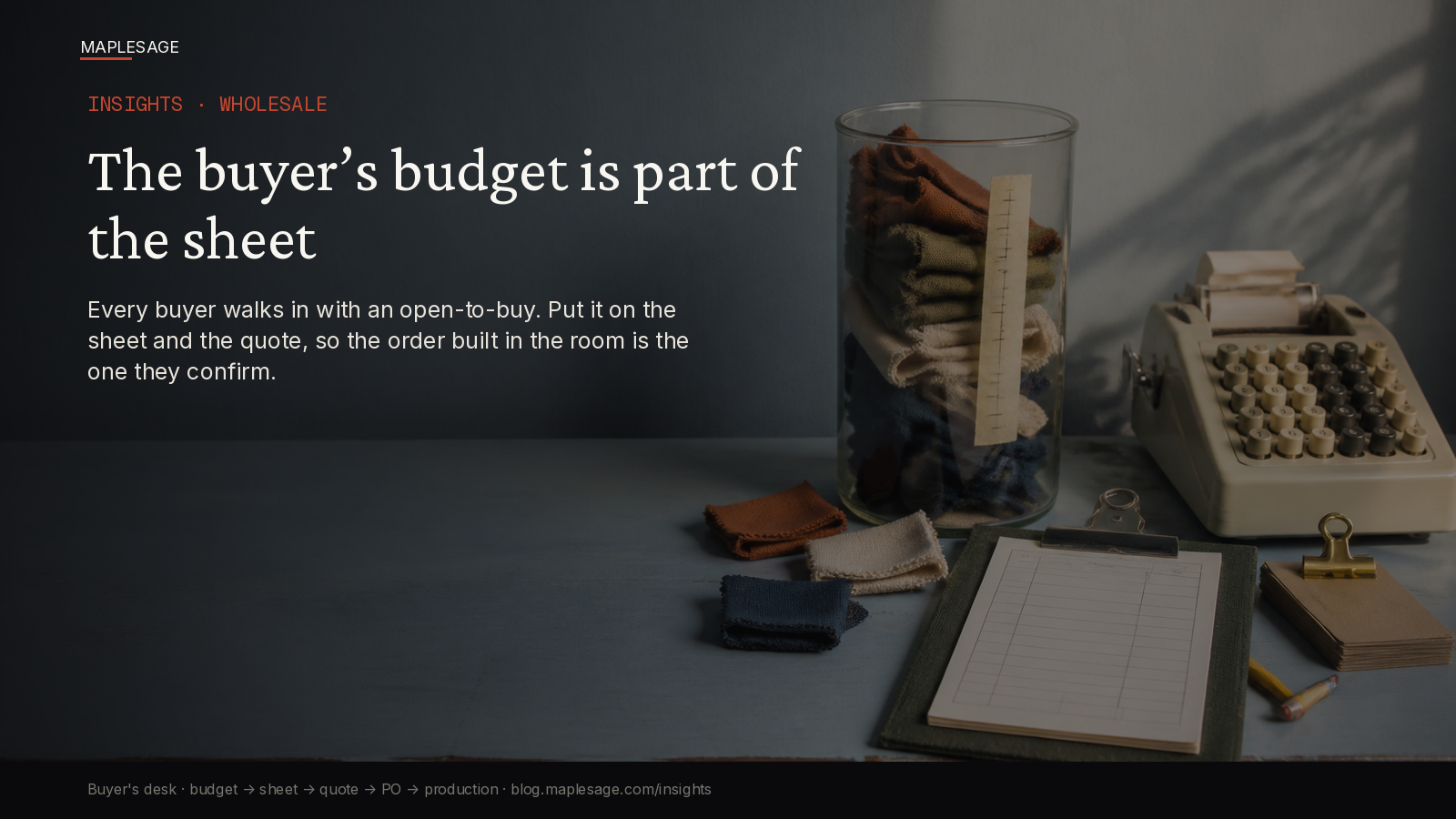
The jar only holds so much. The swatches outside it were never really in the order.
The appointment went well. The buyer loved the delivery, the rep walked the full line, and the selection came back with every hero style, three colourways deep, in every door. On paper it’s the account’s biggest order in years.
Then the confirmation comes back. The buyer’s open-to-buy for the season was set weeks ago by their planning team, and this selection is well over it. Lines get cut, colourways collapse to one, the second delivery disappears. The order that finally lands looks nothing like the one the rep forecast and production planned against.
Nobody lied. The buyer had a budget the whole time. The brand just sold as if it didn’t exist.
This follow-up sits on the spine: showroom → account-aware line sheet → quote → size/assortment → approved PO → production. Day 10 said account history is assortment logic. Day 17 said a sheet that doesn’t know the account is a brochure. This one is about the number the buyer brings into every appointment: the buyer’s budget is part of the sheet, or the order isn’t real.
The misuse
In most mid-market brands, the retailer’s open-to-buy lives in the buyer’s head, the rep’s notebook or an email from last season. The sheet, the selection tool and the quote don’t carry it.
The misuse is treating the budget as the buyer’s private problem instead of a constraint on the order. In practice:
- The sheet shows the line, not the room to buy: the rep presents every style at full depth, with no view of what the account can actually spend this season
- Selections are wish lists: the buyer marks everything they like, because the tool never says when they’ve passed their number
- The rep forecasts the selection: the sales forecast and the production plan pick up the selection before anyone has checked it against budget
- The cut happens at confirmation: the buyer’s planner trims the order later, alone, without the rep, using their own priorities
- The cut is invisible: which styles fell out, and why, comes back as a shorter PO, not as a decision anyone can learn from
Each person is doing their job. The problem is that the one number that decides how big the order can be arrives after the order has been built.
Budget outside the sheet vs budget on the sheet
| Question | Budget outside the sheet | Budget on the sheet |
|---|---|---|
| Where does open-to-buy live? | Buyer’s spreadsheet, rep’s notes | On the account’s sheet and quote, by season and delivery |
| What does the buyer see while selecting? | Styles and prices | Styles, prices and budget used vs remaining |
| When is the order trimmed? | After the appointment, by the buyer’s planner | In the room, with the rep, line by line |
| Who decides what falls out? | Whoever does the cut alone | Buyer and rep together, recorded on the quote |
| What does the forecast pick up? | The full selection | The selection that fits the budget, plus flagged stretch lines |
| Production’s view | A number that later shrinks | An order the account can confirm |
| What does next season learn? | Nothing; the PO is just shorter | Which lines were cut for budget and which for fit |
The outside-the-sheet model asks: what does the buyer like? The on-the-sheet model asks: what will the buyer actually commit?
Why an invisible budget is too expensive
An over-budget selection looks like a strong appointment. The cost shows up later:
- The forecast cost. Sales and production plan against selections that were never going to confirm. Fabric and capacity get reserved for units that won’t be ordered.
- The wrong-cut cost. When the buyer’s planner trims alone, they cut by their own logic. Sometimes that’s the brand’s best margin style or the colourway that anchors the story in the door.
- The depth cost. Budget pressure usually takes out depth before it takes out styles. The account ends up with a wide, thin assortment that sells out of core sizes early and marks down the rest.
- The time cost. A rep who spent two hours building a selection now spends another week chasing what survived, and ops re-keys the revised order.
- The learning cost. Without a record of what was cut for budget, next season’s sheet repeats the same over-reach, and the brand mistakes a budget problem for a product problem.
Related: Account History Is Assortment Logic. The Sheet That Doesn’t Know the Account Is a Brochure. Size Mix by Door. Your Quote Isn’t a Thread. Credit Holds Belong Upstream of the Cut. Full spine: The Wholesale Season Breaks When the Sheet Stops Being the System.
What budget on the sheet looks like
The buyer still owns their open-to-buy. The brand just stops pretending it isn’t there:
- Budget is an account field: the buyer’s season budget, split by delivery or category where they share it, sits on the account and travels to the sheet
- Selections show budget used: as lines are added, the sheet shows spend against budget at wholesale cost, by delivery, so both sides see when the order passes the number
- Trade-offs happen in the room: when the selection is over, the rep and buyer decide together what drops, swaps or moves to a later delivery, while the context is still on the table
- Stretch lines are labelled: lines the buyer wants but can’t fund yet are kept on the quote as flagged stretch, not mixed into the committed order
- The forecast reads the committed quote: sales and production plan against lines inside budget, with stretch shown separately
- Cuts are recorded with a reason: “cut for budget” and “cut for fit” are different signals, and both are kept for next season’s sheet
When the budget is on the sheet, the order the rep builds is the order the buyer confirms. When it isn’t, the selection is a wish list with prices.
ICP framing
For mid-market AFL brands selling to retailers (roughly $10M to $250M wholesale), where the buyer’s budget sits is an input to:
- how far confirmed orders drift from the selections built in the room
- how much fabric and capacity get planned against units that never confirm
- whether depth survives the buyer’s cut or gets thinned out across the line
- how quickly reps and ops get from appointment to a confirmed PO
It isn’t a retailer planning tool, an OTB calculator for the buyer’s team, or a reason to sell less.
Heads of wholesale feel it when a record appointment turns into an average order a week later.
Product proof note: the Retail-OS wholesale path
MapleSage Retail-OS keeps the wholesale order as one object from the account’s line sheet through quote revisions to the approved PO. Account context travels with the order, so the rep, the buyer and the people planning production work from the same commercial picture instead of reconciling different versions after the appointment.
See the buyer path: b2b.maplesage.com. Wholesale surface: www.maplesage.com/retail/wholesale/. Talk: go.maplesage.net.
What we won’t pitch
- Replacing the retailer’s own open-to-buy planning or your ERP
- AI that guesses a buyer’s budget for them
- Planning-tool or competitor screenshots as the hero
Next step
Take last season’s ten largest accounts. For each one, compare the selection built in the appointment with the PO that was finally confirmed. Mark every line that fell out and note whether it was cut for budget or for fit. If most of the gap is budget, the number was in the room the whole time; it just wasn’t on the sheet.