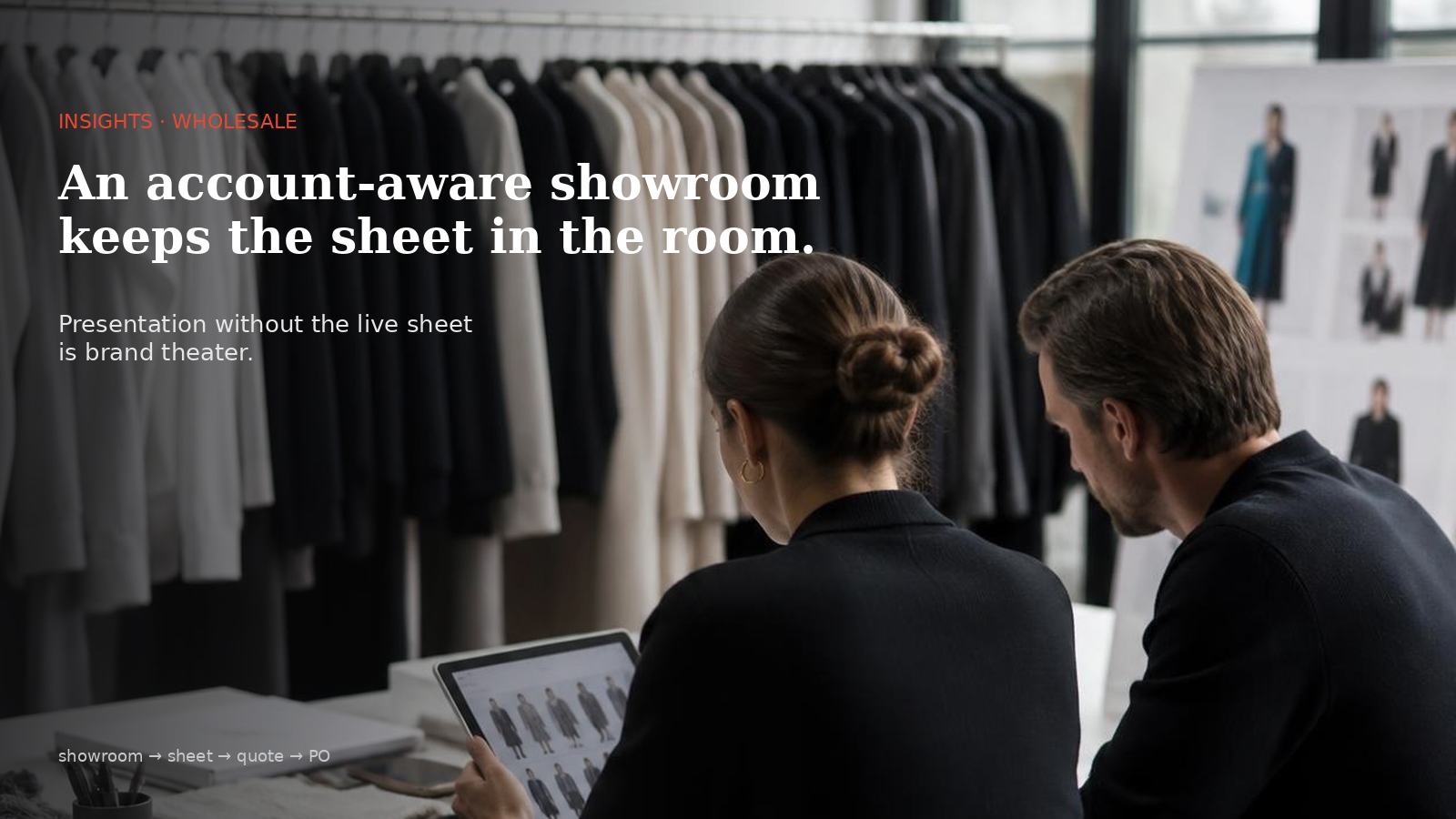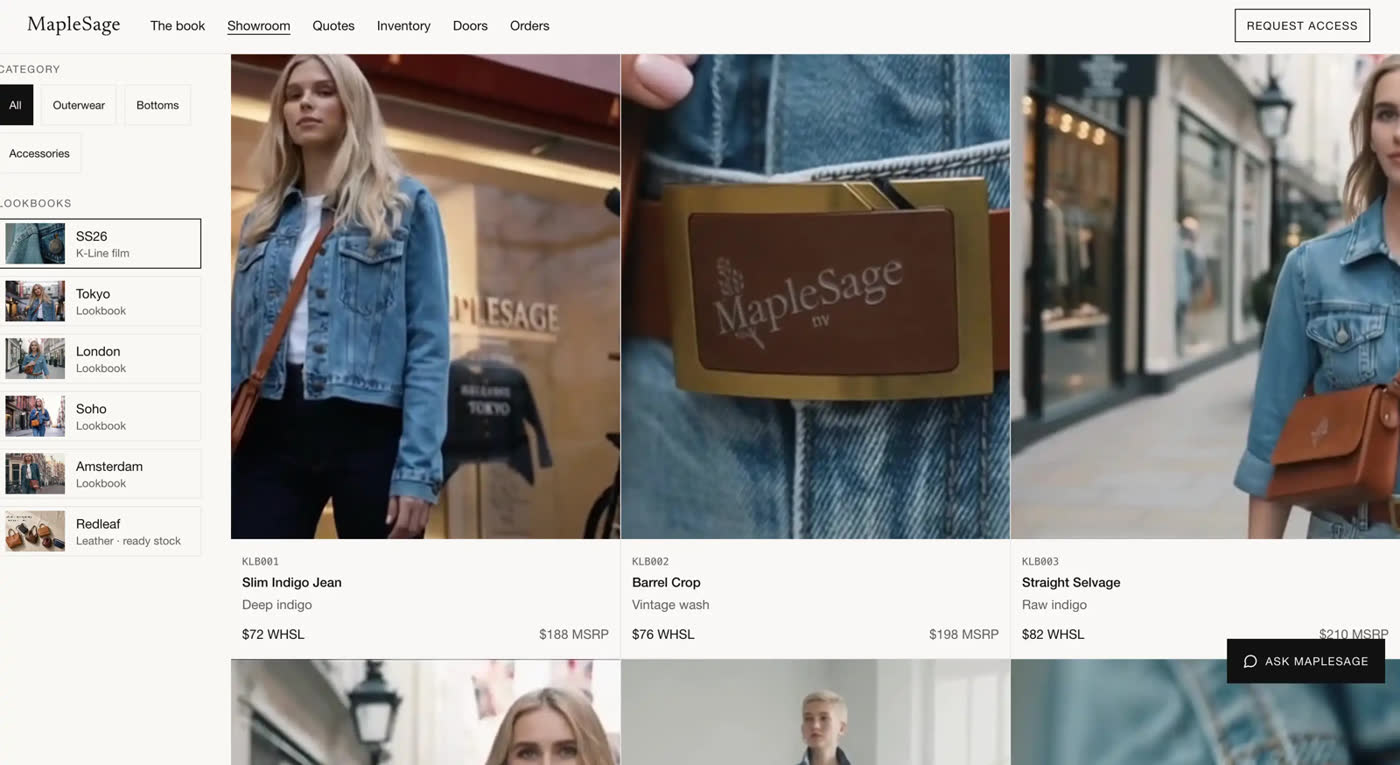
MapleSage showroom — the buyer walks the season against the same catalog the desk will quote.
For a wholesale fashion brand, the buying appointment is rarely where the deal breaks.
The buyer sees the collection. Styles are discussed. Quantities are marked. Someone says, “Send me the sheet.”
And then the process leaves the room.
A PDF gets emailed. Someone updates an Excel file. A sales rep sends a WhatsApp about pricing. Another person checks inventory. Finance discovers a special payment term. Operations receives a purchase order that doesn’t quite match what the buyer thought they bought.
The problem isn’t any one of those tools.
The problem is that the commercial truth has fragmented.

When the room ends in paper and folders, the commercial object has already started to fragment.
A modern wholesale operation needs to carry the same context through the entire buying journey:
account → season → assortment → line sheet → quote → approval → PO
That sounds obvious. In practice, it is where many wholesale workflows still become manual.
The three most common breaks happen around the showroom, the quote, and the assortment.
1. The showroom shouldn’t end with “send me the sheet”
A beautiful digital showroom can solve the presentation problem without solving the selling problem.
The buyer can see the collection, zoom into product photography, and understand the brand story. But if the next step is a generic PDF sent by email, the commercial context has been stripped away.
The retailer should walk the season — physical or digital — against the same catalog and availability the wholesale team will use to quote and approve the order.
That distinction matters.
Imagine a contemporary denim brand showing Fall. The retailer isn’t buying “the collection.” They might be buying:
- 12 styles for six stores
-
- particular washes for particular doors
-
- a different depth of denim than tops
-
- only certain delivery windows
-
- a negotiated wholesale discount
-
- a specific size mix
-
- quantities that fit an agreed seasonal budget
A generic line sheet doesn’t know that. An account-aware buying experience can.
This is already visible in how wholesale software talks about the sheet. Platforms such as JOOR describe digital line sheets that connect product information, availability, and ordering. NuORDER’s linesheet documentation treats the line sheet as a wholesale selling tool — images, pricing, sizing, shipping, inventory — not a leave-behind PDF.
The point isn’t that every mid-market brand must buy another platform tomorrow.
The point is that the line sheet is not merely a presentation document. It is part of the commercial system.
Real-world direction of travel
NuORDER’s public material describes brands and retailers using digital linesheets and assortment tools for seasonal collections, with retailer networks that include names such as Nordstrom, Saks Fifth Avenue, Bloomingdale’s, and Macy’s.
That isn’t a mandate to copy enterprise stacks. It’s evidence that digital wholesale buying is becoming where assortment decisions happen — not just where catalogs look nicer.
2. The quote shouldn’t become an email thread
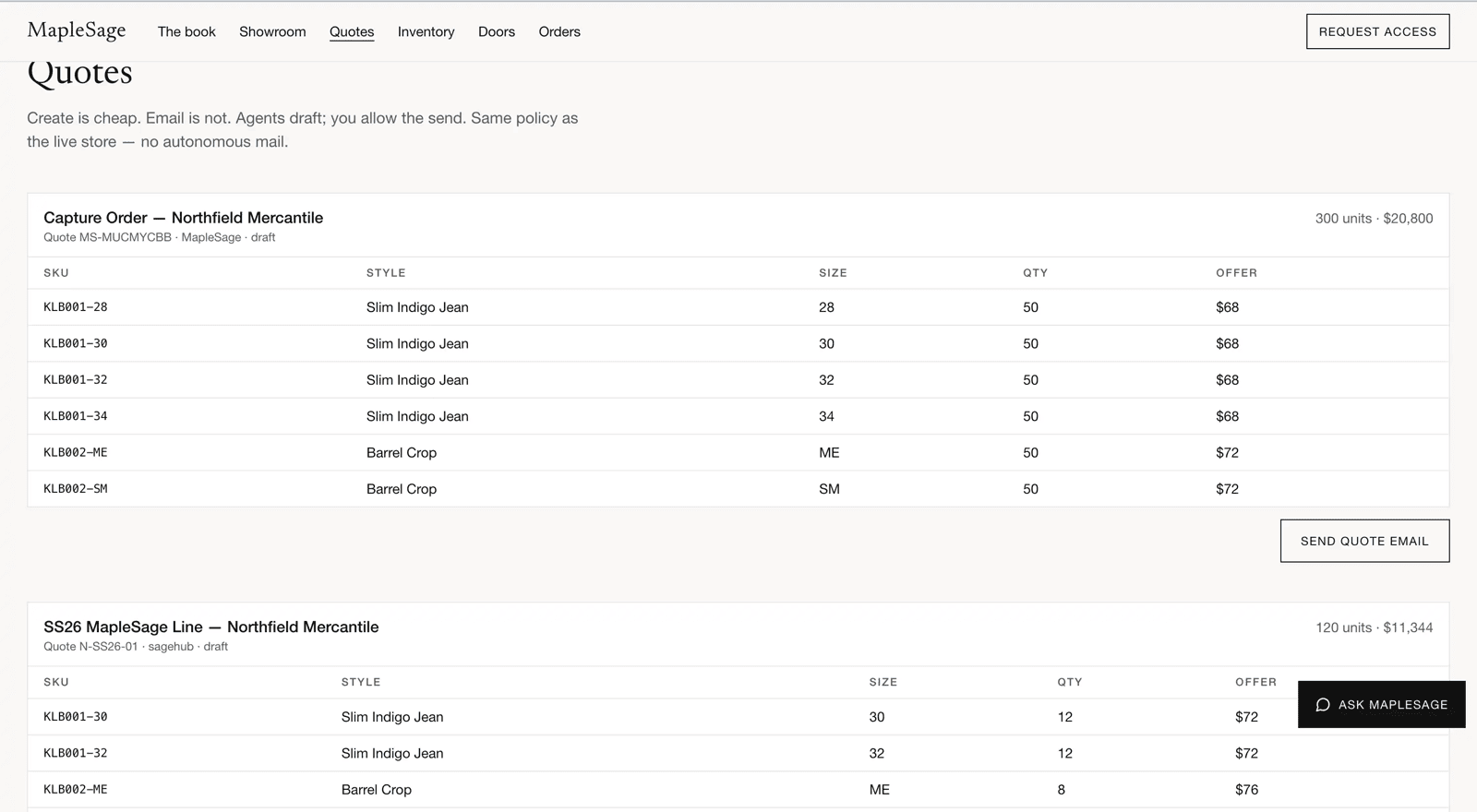
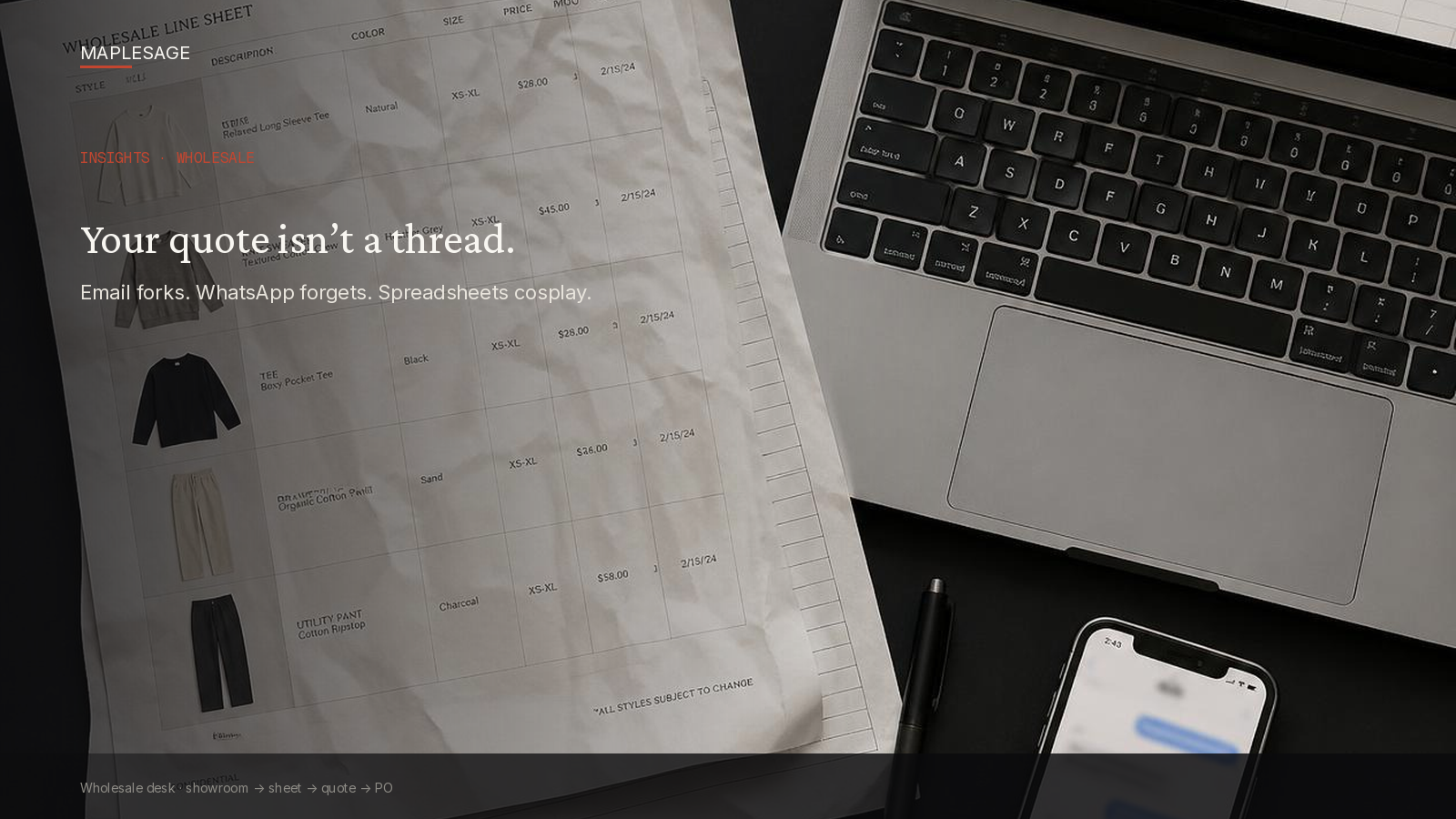
The quote is an object with units, terms, and a gate — not a reply-all thread.
This is where many otherwise modern wholesale workflows fall apart.
The buyer has selected products. Someone needs to turn those selections into a commercial agreement.
Instead, the quote becomes:
“Can you add another 12 units?”
Then: “Can we do 2/10 net 30?”
Then: Actually, remove doors 4–7.”
Then an updated spreadsheet arrives as Fall2026_Quote_FINAL_v3_REVISED2.xlsx.
A quote needs to retain four things:
- Units tied to the live assortment — not copied from a PDF snapshot
-
- Commercial terms on the same object — discounts, freight, dating, exclusivity, payment terms
-
- One revision history — if three people have three versions, you don’t have control; you have archaeology
-
- A clear approval gate into the PO — the order shouldn’t become a production commitment because someone emailed “looks good”
Ask those four questions of your current wholesale quote. Missing any one means you’re negotiating folklore.
Industry case material points the same way. JOOR’s published Erdem case study describes a London luxury brand that had expanded past 170 retailers, used a centralized wholesale workflow, and reported a reduction of more than 60% in order-processing time — with real-time order edits, collaboration, payment terms, and ERP integration. Treat that as a vendor case-study claim, not an audited benchmark. The transferable lesson: the order needs to retain the commercial context that produced it — exactly what disappears when the quote becomes an inbox conversation.
3. Size curves belong before the buy — not only after the sale
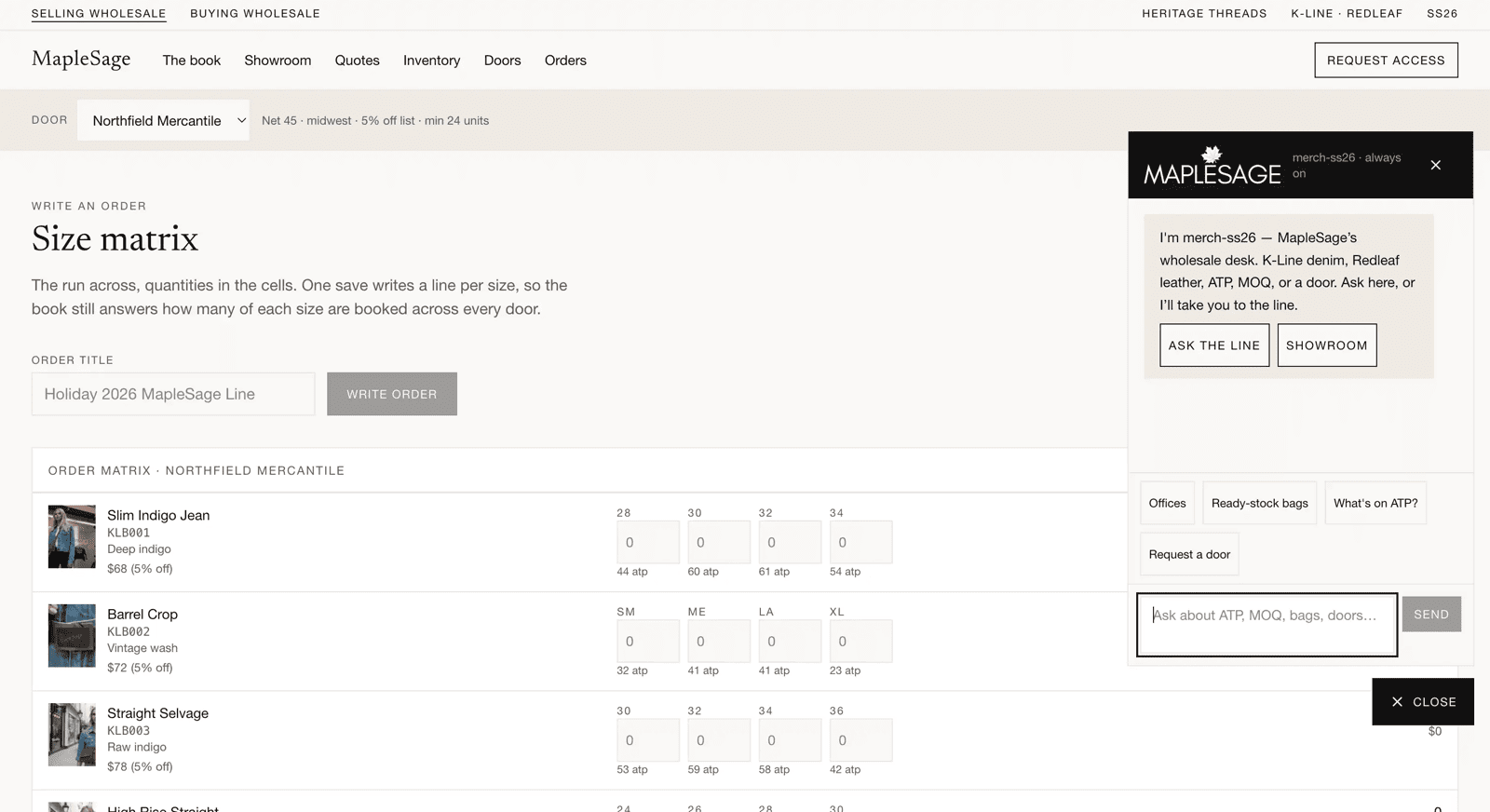
Size mix on the account’s matrix before the buy — door terms and ATP in the same place.
Size intelligence is another place where timing matters.
A brand may have excellent DTC data on which sizes sell, return, size up or down, or vary by region. Useful. But if that information never reaches the wholesale buying decision, you’re using the data too late.
Fit and size intelligence create wholesale value when they influence the account’s line sheet before the buy — not when they appear months later on a returns dashboard.
Simple example: a retailer wants 60 units of a denim style across four doors.
A generic curve might allocate: XS 6 / S 12 / M 18 / L 14 / XL 10
The account’s history might require: XS 3 / S 9 / M 19 / L 18 / XL 11
Those aren’t analytics decoration. They are the wholesale order.
Flagship urban, outlet, resort, and pure-play retail doors often need different assortments. That’s why size curves increasingly live inside assortment-planning workflows — allocating units across doors with size totals and per-door quantities visible while the buy is happening.
Again: the curve belongs where the buying decision is made — not three months later when the returns report arrives.
The common problem: the artifact keeps changing
These three problems look different.
The showroom problem looks like presentation.
The quote problem looks like operations.
The size-curve problem looks like analytics.
They’re the same failure: the commercial artifact changes identity as it moves through the organization.
The buyer sees one collection.
The sales rep sees another spreadsheet.
Finance sees an email with negotiated terms.
Operations sees a PO.
Merchandising sees a size report later.
Nobody necessarily sees the entire chain.
That is why the wholesale line sheet has to be treated differently. It shouldn’t simply be a PDF. It should be a living representation of the season for that account.
What an account-aware wholesale sheet should know
For a specific retailer, season, and collection, the system should answer:
What can this account buy?
Not every product the brand has ever created — the styles, colors, deliveries, and availability relevant to that account.
What should this account buy?
Assortment logic can use prior buying behavior, door requirements, size curves, and commercial rules.
What has the buyer actually selected?
Selections stay attached to account and season.
What did we quote?
Quantities, prices, terms, revisions — one object.
What was approved?
Explicit, not inferred from email.
What becomes the PO?
The consequence of the approved commercial object — not another chance to re-enter the same data.
This isn’t theoretical
Pieces of this workflow already run in production elsewhere.
JOOR publicly describes virtual showrooms, digital linesheets, order management, assortment planning, and retailer-specific pricing. Published case studies include Erdem and Loake. Loake is reported (vendor case study) to have seen a 20% increase in in-season refill orders after adopting JOOR — again, a customer claim, not an independent audit.
On assortment, NuORDER by Lightspeed describes visual assortment planning and shared buying workflows, with published examples involving major retailers. 7 For All Mankind is cited in NuORDER material as standardizing wholesale workflows around assortments, orders, and inventory.
The lesson for a mid-market AFL brand is not “copy Nordstrom’s stack.”
It’s that the direction is clear: wholesale buying is becoming more account-specific, data-connected, and collaborative.
Where agents fit
This is where the workflow gets interesting for MapleSage.
The objective isn’t another chatbot for wholesale.
An agent can do the repetitive commercial work around the season:
- prepare the account’s collection
-
- assemble the relevant line sheet
-
- apply account and season context
-
- surface availability
-
- draft the quote
-
- carry terms forward
-
- apply size or assortment logic
-
- identify exceptions
-
- prepare the next step for approval
Boundary: the agent prepares the commercial object. It should not silently become the authority that commits the business.
Humans still decide when the quote is ready, when terms are approved, and when the order can move.
Agents do the work. People control the commitment.
The wholesale season should have one commercial spine
The goal isn’t to eliminate the showroom, the sales rep, or the buyer conversation. And it isn’t to turn wholesale into DTC checkout.
The goal is to stop losing information between those moments.
A buyer should be able to move:
Showroom → account-aware line sheet → assortment → quote → approval → PO
without reconstructing commercial truth from email, spreadsheets, and memory.
That is the difference between digitizing artifacts and connecting the workflow.
For a wholesale brand, the question isn’t only: “Do we have a digital showroom?”
It’s: Does what the buyer sees become the same commercial object that sales quotes, finance approves, and operations turns into a PO?
If the answer is no, the showroom is still only the beginning.
If the quote is still an email thread, the system isn’t finished.
How MapleSage approaches it
MapleSage is building around that specific wholesale workflow: account-aware showroom, live line sheet, quote, and approval-gated PO.
The focus is the space between the brand and the retail door — not another generic CRM, and not a DTC storefront.
- Wholesale solutions: https://www.maplesage.com/retail/wholesale/
-
- Buyer experience: https://b2b.maplesage.com
-
- Talk wholesale: https://go.maplesage.net
Related: Your Line Sheet Isn’t a System