A quote is a promise of units. The count behind it should be one you can defend on the PO date.
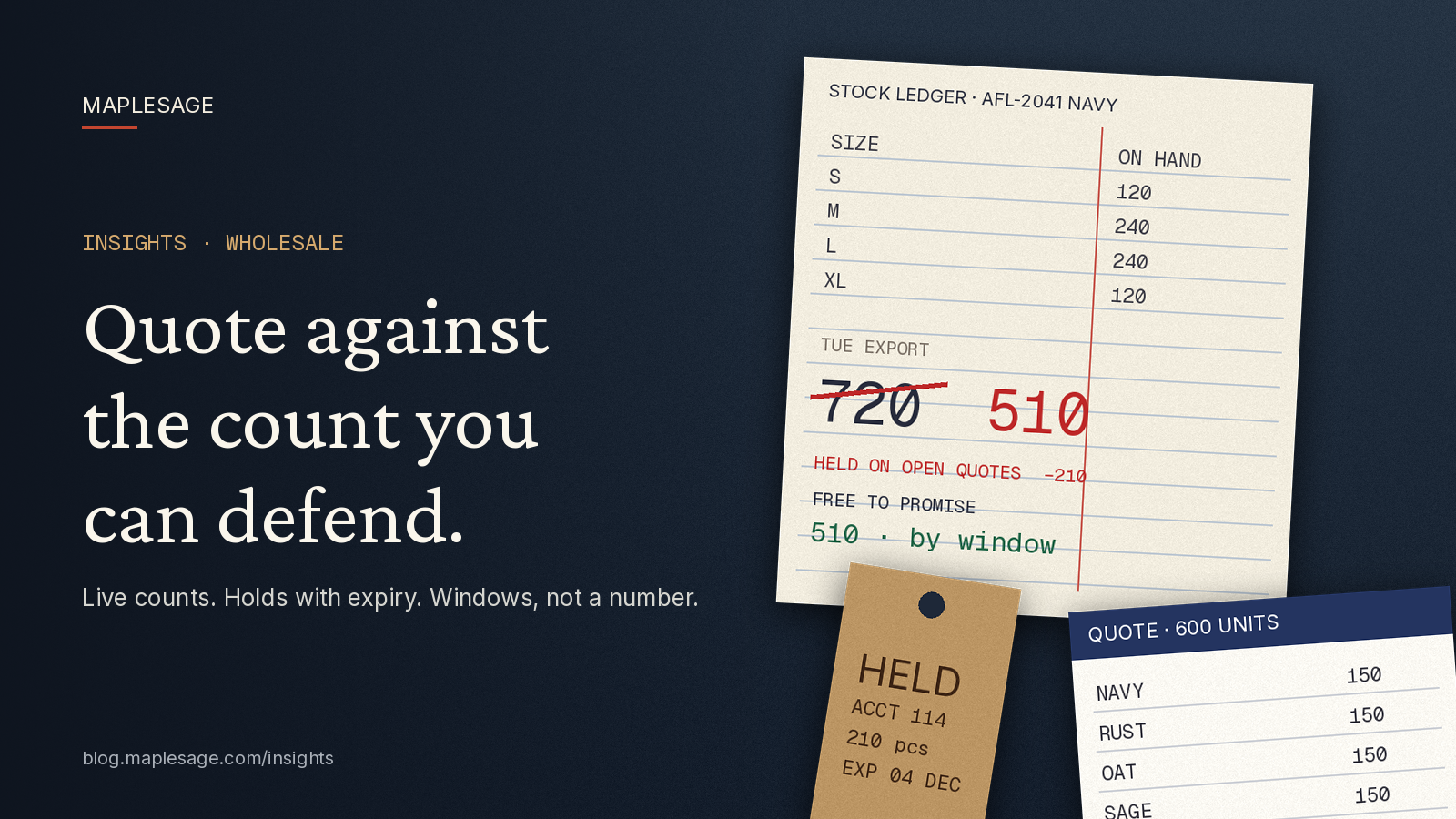
A buyer asks for 600 units of a style in four colours. Your rep checks a spreadsheet exported on Tuesday and says yes. The quote goes out Thursday. The PO lands the next Monday. Production tells you 210 of those units went to another account on Friday.
Nobody lied. The number was just old.
Where the quote count goes wrong
- It is an export. A file pulled from the ERP or a warehouse sheet is true at the moment it is pulled, and wrong after.
- It ignores holds. Units promised on other open quotes still show as free.
- It mixes stock with intent. On-hand, inbound, in-production and not-yet-cut are summed as one number.
- It has no date. The buyer cannot tell if “available” means today or in the next delivery window.
What it costs
Short ships on a PO the buyer thought was confirmed. Cancelled lines. Substitutions the buyer did not choose. A rep who now over-holds to protect themselves, which starves the next account.
Each one reads to the buyer as a reliability problem, not a data problem.
Four states, not one number
For each style, colour and size, a quote should show:
1. On hand. In the building, unallocated.
2. Held. Promised on open quotes, with the account and the expiry date.
3. Inbound or in production. With the delivery window it lands in.
4. Not yet cut. Open to the buy, with the cut date after which it is not.
The buyer is quoted from the first three by window. The fourth is stated as a cut date, never as stock.
Three rules for quoting against stock
1. Quote from live counts. Pull availability when the quote line is added, not when the sheet was built.
2. Every quote line holds units, with an expiry. A hold with no expiry is a permanent block. A quote with no hold is a hope.
3. Release on expiry and say so. When a hold lapses, the units return to free stock and the rep sees it. Silent lapses create the next surprise.
What changes
First, fewer short ships. The units on the quote are the units on the PO.
Then, cleaner allocation across accounts. Reps see what is held and by whom before they promise.
Then, a better conversation with buyers. “Held for you until the 4th” is a commitment. “We should have it” is not.
A one-week test
Take your ten most recent quotes that became POs. For each, compare the units quoted to the units shipped.
- How many lines shipped short?
- Was the cause a stale count, a hold you could not see, or a late inbound?
- Can you tell which quotes held units and until when?
If you cannot answer the third question in ten minutes, the quote is promising stock it does not hold.
The short version
A quote that cannot see inventory is a guess with a price on it. Quote from live counts, hold the units with an expiry, and show the window the buyer can count on.
MapleSage Retail-OS keeps the wholesale spine in one place: sheet → selection → quote → PO → production. More Insights at blog.maplesage.com.