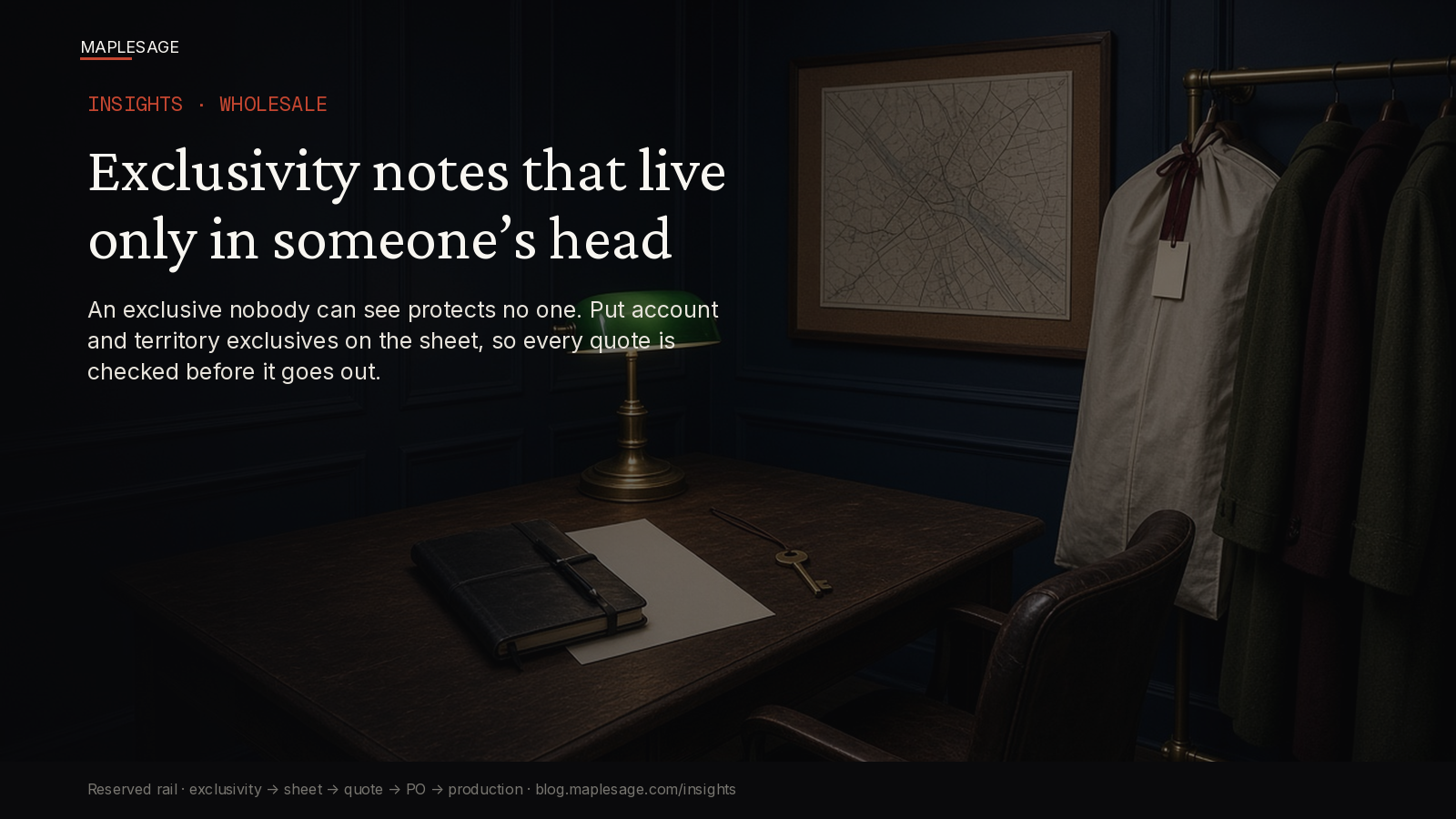
The style is reserved. The only record of who it’s reserved for is in a closed notebook.
The order is good. A new boutique in the city has picked the season’s strongest coat, in two colours, for both of its doors. The rep covering the appointment is filling in for a colleague on leave. The style is on the sheet, stock is available and the quote goes out the same afternoon.
Two weeks later the brand’s oldest account in that city calls. They were promised that coat exclusively in the city for the season. It was agreed over dinner three years ago and renewed every season since, by the rep who’s now on leave. It was never written on the sheet, the quote or the account record. The account wants the other order cancelled or a discount on theirs. The boutique has already planned its floor around the coat.
Nothing was wrong with either order. The term that decided between them only existed in one person’s memory.
This follow-up sits on the spine: showroom → account-aware line sheet → quote → size/assortment → approved PO → production. Day 5 put door terms on the sheet. Day 25 made delivery windows a commercial term. This one is about the term that is most often never written down: exclusivity. If it isn’t on the sheet, it doesn’t protect anyone. It just waits to be broken.
The misuse
Wholesale exclusivity comes in a few forms: a style or colourway reserved for one account, a territory or city where only certain doors carry the line, a capsule made for one retailer, or a period before a style can be offered to anyone else. Each one is a promise with a commercial value. The account often accepted a bigger order, a higher price or a better floor position because of it.
In most mid-market brands, those promises are kept informally:
- The rep remembers: exclusives sit in a notebook, a personal spreadsheet or the rep’s head, and leave when the rep does
- The sheet doesn’t know: every account sees the same styles, so nothing stops a protected style being offered to the account next door
- Agreements are verbal: “you’ll be the only one in the city with this” is said in the room and never added to the quote
- Expiry isn’t tracked: an exclusive agreed for one season is still being honoured three seasons later, or quietly dropped without telling the account
- Cover reps can’t see it: when someone else runs the appointment, they have no way to know what was promised
The result is a brand that has made promises it can’t check. It finds out it broke one when the protected account sees the style in a competitor’s window.
Memory vs a term on the sheet
| Question | Exclusivity in someone’s head | Exclusivity on the sheet |
|---|---|---|
| Where is the promise recorded? | A rep’s notebook or memory | On the account, the style and the territory it covers |
| What does another account’s sheet show? | The protected style, like any other | The style hidden, or flagged as not available to them |
| Who can see it in the room? | Only the rep who agreed it | Any rep or cover running the appointment |
| What happens when an exclusive is agreed? | A handshake | A quote revision the buyer approves, with its scope and end date |
| When does it end? | When someone forgets it | On the date agreed, visible to the rep and the account |
| What does management see? | Nothing until there’s a complaint | Every live exclusive, by account, style and territory |
The memory model asks: does anyone remember promising this to someone? The sheet model asks: what has this account been promised, and does this quote break a promise to anyone else?
Why an exclusive off the sheet costs more than it earns
An exclusive that nobody can see works until two orders meet. Then the cost lands all at once:
- The concession cost. The protected account asks for a discount, a markdown allowance or free goods to make up for the broken promise. The margin from both orders shrinks.
- The cancellation cost. One of the two orders has to be reduced or cancelled, often after production is planned. The brand is left with stock it sold twice and can now only sell once.
- The rep-turnover cost. When a rep leaves, their exclusives leave with them. The new rep either breaks them without knowing or has to guess which ones still apply.
- The negotiation cost. Without a record, every disagreement about scope is one person’s memory against another’s. The account usually wins, because the brand can’t prove what was agreed.
- The trust cost. An account that has paid for exclusivity with order size or price and then sees it broken doesn’t ask for exclusivity next season. It asks for a smaller order.
Related: Door Terms Belong on the Sheet. Account History Is Assortment Logic. WhatsApp Exceptions That Never Reach the PO. The PO Is Not a Form. Delivery Windows Are Commercial Terms Too. Full spine: The Wholesale Season Breaks When the Sheet Stops Being the System.
What exclusivity on the sheet looks like
The rep still agrees exclusives in the room. The sheet just remembers them for everyone:
- Exclusives are records, not recollections: each one names the account, the styles or colourways, the territory or doors it covers and the date it ends
- Sheets respect them: a protected style is hidden from, or flagged on, the line sheet of every account it would conflict with, so it isn’t offered by mistake
- Quotes are checked: before a quote goes out, the styles on it are checked against live exclusives in that account’s territory, and any conflict is resolved before the buyer sees it
- New exclusives are revisions: when a rep agrees an exclusive in the room, it’s added to the quote as a term the buyer approves, with its scope and end date
- Expiry is visible: the rep and the account both know when an exclusive ends, so it’s renewed on purpose or released on purpose, not forgotten
- Cover reps see the same thing: anyone running the appointment works from the same account record, so a promise doesn’t depend on who’s in the room
When exclusivity is on the sheet, the brand can sell it as a term it can keep. When it isn’t, every new account in a city is a risk to an old one.
ICP framing
For mid-market AFL brands selling to retailers (roughly $10M to $250M wholesale), whether exclusivity is recorded or remembered is an input to:
- how often the same style is sold to competing doors in the same territory
- how much margin is given back in concessions when a promise is broken
- how much account knowledge leaves the business when a rep moves on
- whether exclusivity can be offered confidently as a reason to place a bigger order
It isn’t a contract management system, a replacement for legal agreements with accounts or a way to enforce distribution restrictions.
Heads of wholesale feel it when the best account in a city calls to ask why their exclusive coat is in someone else’s window.
Product proof note: the Retail-OS wholesale path
MapleSage Retail-OS keeps the wholesale order as one object from the account’s line sheet through quote revisions to the approved PO. Account terms travel with the account and the order, so what was agreed in the room is on the record the next rep opens, and the sheet and quote for each account are built from the same view of what has already been promised to whom.
See the buyer path: b2b.maplesage.com. Wholesale surface: www.maplesage.com/retail/wholesale/. Talk: go.maplesage.net.
What we won’t pitch
- Replacing your contracts, your legal team or your distribution agreements
- AI that decides which accounts deserve an exclusive
- CRM or competitor screenshots as the hero
Next step
Ask each of your reps to list every exclusive they’ve promised that’s still live: account, styles, territory and end date. Then check this season’s orders against the list. Count the exclusives that exist nowhere but on that list, and the orders that already conflict with one. Each of those is a promise the brand is keeping by luck.