Why AFL brands need PLM-to-headless integration to power fashion-grade AI personalization, faster launches, and consistent CX across channels.
Why AFL headless commerce fails without PLM and PIM integration
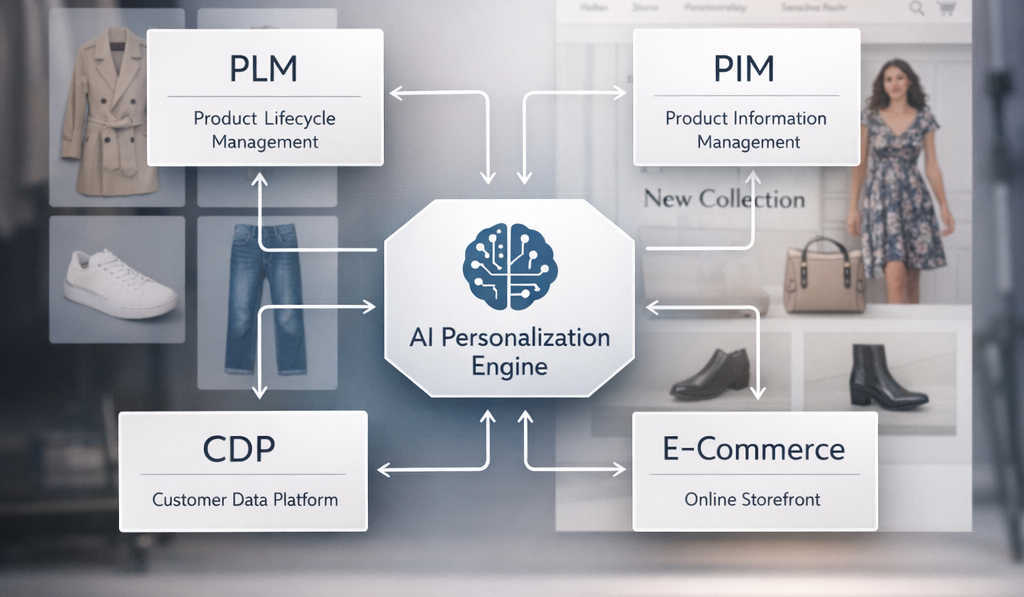
Many AFL brands have already “gone headless” on paper—Hydrogen or React front ends, composable checkout, microservices in the stack—yet still struggle with slow launches, brittle merchandising workflows, and underwhelming AI personalization. The storefront changed; the product truth did not. PLM is still semi-isolated in the design room, PIM is patchily implemented, and ecommerce teams are copy-pasting attributes and media into multiple systems. The result is exactly what McKinsey’s State of Fashion 2026 and K3 Fashion Solutions’ commentary warn about: brands adopt AI and modern architectures without fixing data foundations, so pilots look good in decks but stall at scale (McKinsey, K3 Fashion Solutions). For AFL CTOs, E-commerce Directors, and Merchandising VPs, the core problem is simple: headless commerce without PLM integration is just a prettier monolith. Fashion-grade AI needs a fashion-grade data spine. That means PLM and PIM feeding a single, structured product graph into headless storefronts and into MapleSage’s SageRetail engine: silhouettes, rises, lengths, fabrics and stretch, heel and last shapes, climate and modesty tags, sustainability flags, regional size systems. Computools’ work on integrating PLM with ecommerce systems in fashion retail shows how brands moving to API- and event-driven PLM–ecommerce architectures cut time-to-market, reduce errors in product data, and unlock more advanced analytics and AI down the line (Computools). This post argues that PLM-to-headless wiring is not a technical nice-to-have; it is the precondition for MapleSage’s AFL campaigns to work. Campaign 1 (AI Personalization for Fashion Customer Loyalty) relies on accurate, attribute-rich product data to build credible style profiles and capsules. Campaign 2 (Seamless Integration with Fashion Tech Stacks) is fundamentally about PLM, PIM, CDP, and commerce acting as one system, not four. Campaign 3 (Fashion Merchandising Automation & Trend Intelligence) needs consistent attributes for trend signals and size-curve models. Campaign 4 (Fashion E-commerce Conversion Through AI) needs fast, consistent feeds for style feeds, visual search, and fit recommendations. The promise: once the spine is in place, headless stops being an integration headache and becomes the canvas on which SageRetail can orchestrate AI-first fashion CX across web, app, and store.
Designing a PLM-to-headless data spine for fashion ecommerce and SageRetail
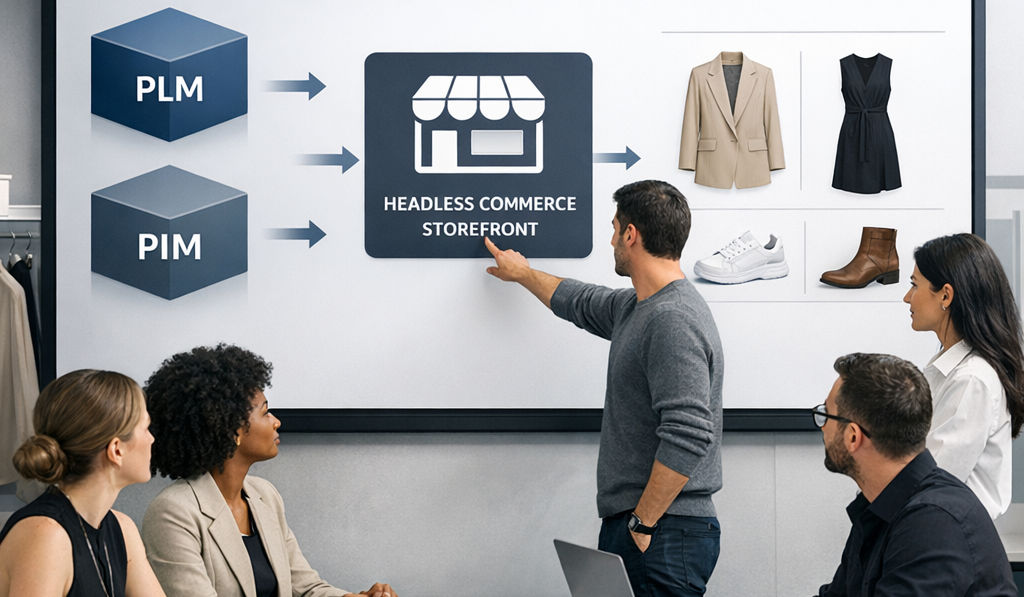
Designing that data spine starts with a fashion-specific product model, not with front-end components. General headless content often treats products as simple SKUs with a handful of attributes; AFL needs something far richer. PLM should hold blocks, grading, fabric specs, and approvals; PIM should translate that into silhouettes, rises, lengths, heel heights, palette families, climate tags, sustainability attributes, and localized copy. Fashion PIM vendors like Centra, Pimberly, Catsy, and BetterCommerce consistently argue that apparel and footwear require deeper, more structured attributes than general retail to support both search and personalization (Centra, Pimberly, Catsy, BetterCommerce). MapleSage’s own headless fashion article walks through how that attribute spine must be defined and versioned before any Hydrogen or React component work begins (MapleSage). Once the entity model is set, the integration pattern matters more than the specific platforms. Computools’ deep dive on PLM–ecommerce integration in fashion describes an API- and event-driven approach: PLM milestones (design approved, BOM frozen, size curves signed off) trigger PIM enrichment, which then triggers updates in ecommerce and OMS, keeping one product truth everywhere (Computools). For AFL brands on Shopify Plus, BigCommerce, Centra, Medusa, or custom headless builds, SageRetail can subscribe to the same events: when a new silhouette is approved, it gets the full attribute set and imagery needed for style-aware search, recommendations, and merchandising; when a fabric or size curve changes, it can adjust fit predictions and trend intelligence. Reports from Centric Software and K3 Fashion Solutions around State of Fashion 2026 emphasize that brands who treat PLM as the upstream source of product truth and wire it cleanly into ecommerce and AI are the ones seeing AI move from pilots to scaled impact (Centric, K3 Fashion Solutions). For MapleSage’s AFL ICPs, this architecture directly supports active campaigns. Campaign 1 (AI Personalization for Fashion Customer Loyalty) relies on SageRetail understanding silhouettes, fabrics, and style codes deeply enough to build credible style profiles and capsules. Campaign 2 (Seamless Integration with Fashion Tech Stacks) is about exactly this: PLM, PIM, commerce, and AI working as one fabric. Campaign 3 (Merchandising Automation & Trend Intelligence) needs PLM attributes exposed cleanly so trend signals and size-curve models know what they’re reasoning over. Campaign 4 (Fashion E-commerce Conversion Through AI) depends on fast, attribute-rich product feeds to power style feeds, visual search, and fit intelligence. The data spine is the shared dependency.
Operating PLM-to-headless integration with KPIs, governance, and rollout roadmap
To turn PLM-to-headless integration into a reliable growth engine rather than an expensive science project, AFL brands need a scoreboard, phased rollout, and guardrails that protect both brand and operations. On the KPI side, Fashion CTOs, Digital VPs, and Merchandising leaders should track: time-to-publish (from PLM milestone to PDP live), defect rates in product data (missing or wrong attributes, images, or variants), search and filter success (refinement and zero-result rates), conversion and AOV uplift on categories running through the new pipeline vs legacy paths, and returns or CS contacts tied to inaccurate product information. Computools’ PLM integration case study for a global apparel platform documents reductions in time-to-market and returns linked to misrepresented product details once PLM and ecommerce were wired into a unified ecosystem (Computools). Rollout should be staircase, not “big replatform overnight.” Start with one hero category—denim, sneakers, dresses—and one region. Map and test the full flow: PLM spec → PIM enrichment → headless build → SageRetail-powered search and recommendations. Run the new and old pipelines in parallel for a season, using feature flags to direct traffic and collect comparative data. As confidence grows, expand sideways to more categories and regions, and vertically into more journeys (cross-sell, style feeds, email, in-store tools). BetterCommerce and Shopify’s guidance on headless vs composable architectures both emphasize that brands who treat composability as a program—with clear scopes and iterations—see far better outcomes than those chasing buzzwords (SparxIT, BetterCommerce). Guardrails span reliability, brand expression, and governance. Reliability demands contract tests between PLM, PIM, ecommerce, and SageRetail APIs, with observability that alerts teams when attributes or media fail to sync. Brand expression requires design systems and content models that let marketing and merchandising maintain a coherent look and feel across fast-moving headless front ends. Governance means schema versioning, a change-control process when new attributes are introduced, and clear ownership: PLM for technical truth, PIM for customer-facing enrichment, SageRetail for decisioning, ecommerce for presentation. For MapleSage, the strategic payoff is that once this spine is in place, new AI capabilities—style feeds, fit intelligence, climate-aware assortments, circular journeys—can plug in quickly without another round of painful integrations. Headless stops being a fragile experiment and becomes the natural stage on which MapleSage’s AFL AI story plays out.