
#FashionAI
#Composable-tech
ai-first-fashion-cx

How AFL brands compare virtual try-on and fit AI to cut returns and lift conversion in fashion e‑commerce.
For Apparel, Footwear & Luxury brands, returns and conversion are now board-level conversations, not back-office headaches. Online fashion return rates commonly sit between 24 and 40 percent, with size and fit issues as the primary driver, while conversion on mobile PLPs still hovers painfully low for many brands (Outvio, Baymard). In that context, it’s no surprise that “virtual try-on” and “fit AI” are two of the hottest budget lines in fashion e‑commerce roadmaps. The problem: they are often evaluated as standalone gadgets rather than parts of a single, style-aware fit strategy. Vendors promise magical reductions in returns or double-digit conversion lifts, but pilots underperform because experiences are bolted onto generic PDPs, disconnected from merchandising and returns flows, or aimed at the wrong use cases. A 3D shoe visualization won’t fix a broken size curve, and a size-recommendation widget can’t rescue imagery that doesn’t show true drape or coverage. For MapleSage’s AFL ICPs—Fashion CMOs, E‑commerce Directors, CX Directors, Merchandising VPs, and Fashion CTOs—the real question is not “Should we do virtual try-on?” or “Should we buy fit AI?” It is: “Where does each capability actually move the P&L in our specific segments, and how do we orchestrate them using our fashion data spine?” Fast fashion, contemporary, luxury, and athletic wear all face different shopper expectations, margin structures, and tech constraints; a one-size-fits-all answer doesn’t work. Virtual try-on, whether via 3D avatars, AR overlays, or real-body model matching, is best understood as a confidence layer for style: it helps shoppers see whether a silhouette, length, or color story feels right on a body like theirs or in their environment. Fit AI, by contrast, is a probability engine for size and keep-likelihood: given what we know about this shopper, this block or last, and similar customers, which size is most likely to fit comfortably and stay in the wardrobe? Both are important in AFL, but they solve different problems. Research on digital fitting and returns repeatedly shows that expectation gaps—between how products look on site and how they behave in real life—drive a large share of returns for dresses, denim, footwear, and tailored pieces. Industry overviews from platforms like Shopify and McKinsey emphasise that fit technology and richer product data are key levers for reducing this gap (Shopify, McKinsey). MapleSage’s own work with fit intelligence in denim and footwear underscores the same pattern: when brands combine style-aware visualization with honest, data-backed size recommendations and exchange-first returns journeys, they see fewer “wardrobe orphans,” lower bracketing, and higher lifetime value. This post gives AFL leaders a structured way to compare virtual try-on and fit AI, decide which problems each will tackle, and design journeys where the two reinforce each other instead of competing for budget.
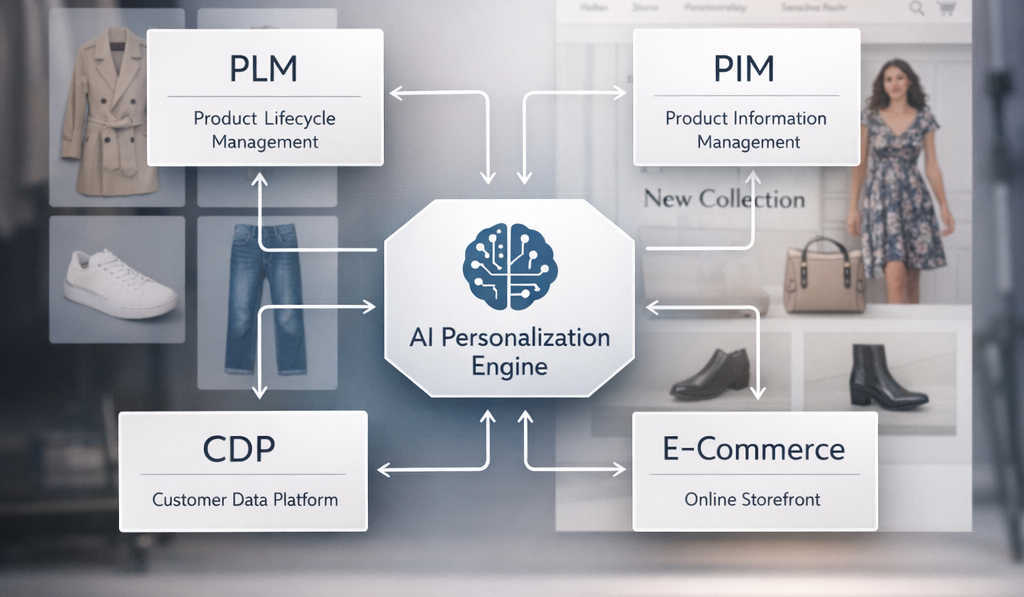
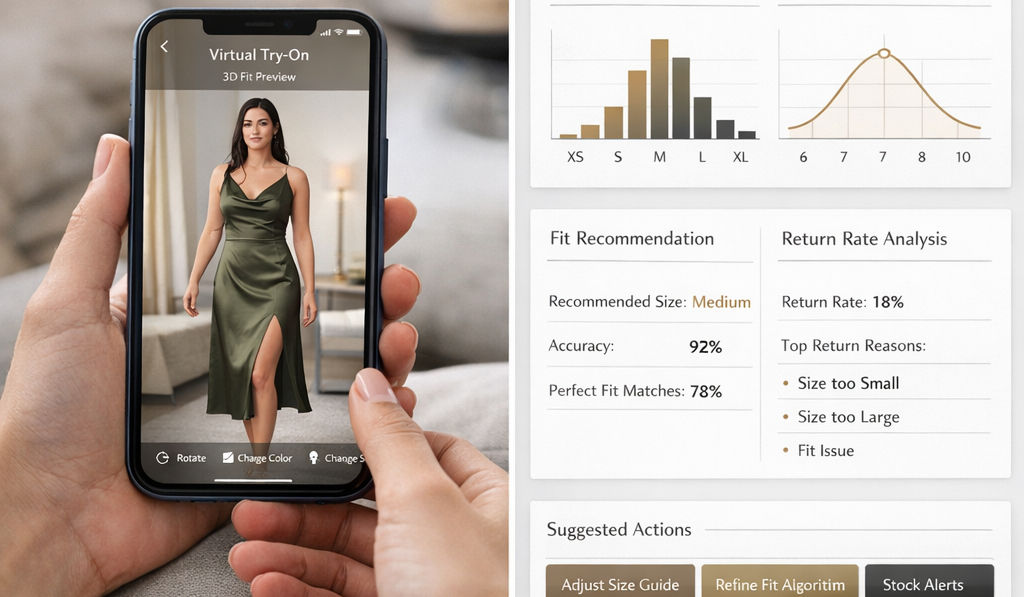
Blending virtual try-on and fit AI into one coherent fashion journey starts by deciding what job each technology is hired to do. Virtual try-on shines at reducing style uncertainty: “Will this silhouette, length, or color suit me?” Fit AI shines at reducing size uncertainty: “Which size in this specific block or last am I most likely to keep?” In Apparel, Footwear & Luxury, those are related but distinct anxieties—and they show up at different stages in the journey. AFL leaders should map a canonical path from inspiration to repeat purchase and decide where each capability adds the most value. For example, discovery surfaces (home, style feeds, lookbooks, social landing pages) are ideal for lightweight virtual try-on moments: virtual try-on thumbnails on hero products, AR overlays that show hem or neckline in context, or quick “see this on body shapes like mine” carousels. This is where virtual try-on behaves like interactive storytelling, helping shoppers decide whether a look even belongs in their world, before they engage deeply. Once a shopper is seriously considering an item, fit AI should take the lead. That’s the point where MapleSage’s SageRetail can combine PLM/PIM attributes (block, fabric stretch, rise, heel, width), shopper history (kept vs returned items, size behaviour by category), and peer data (size-curve sell-through, return reasons by size and region) to recommend one or two sizes with clear confidence ranges. Research from returns specialists like Outvio and ILG shows that size and fit are consistently the top drivers of fashion returns; experiences that give a single, well-argued recommendation (“We recommend 40 based on what you kept and how this fabric behaves”) beat vague charts every time (Outvio, ILG). Design choices differ by segment. Fast fashion can prioritize ease and speed: simple AR try-on that shows approximate silhouette and length, paired with fit AI that nudges shoppers toward exchange-friendly behaviour (“Most shoppers like you keep size M in this block; exchanges are instant and free”). Contemporary and premium brands should emphasize realism and editorial quality—on-model try-on for diverse bodies, plus fit copy that feels like a stylist’s advice, not a lab report. Luxury houses may use more restrained virtual try-on (e.g., accessories, footwear) but lean heavily on fit intelligence in boutiques and appointment flows, where returns are especially damaging to experience and margin. Behind the glass, both technologies depend on the same fashion data spine. PLM and PIM must provide accurate measurements, block IDs, fabric stretch percentages, and image sets; CDP and analytics must provide size behaviour and returns; logistics systems must feed back what actually happened. Vendors who treat virtual try-on or size recommendation as islands will always struggle to reach production-grade ROI. MapleSage’s composable approach—plugging fit and visualization into SageRetail’s graph of styles, bodies, and behaviours—gives AFL brands room to mix and match interfaces on top of a stable intelligence layer.
To treat virtual try-on and fit AI as serious investments rather than experiments, AFL leaders need hard KPIs, a test plan, and clear guardrails. On the KPI side, focus on: • Conversion rate lift on products and categories where visual try-on or fit AI is active vs control. • Size- and fit-related return-rate deltas for cohorts exposed to fit recommendations vs those who only saw charts. • Multi-size order share (“bracketing”) and the share of returns that convert to exchanges when recommendations are paired with exchange-first flows. • Engagement metrics on virtual try-on: usage rate, completion of multi-angle views, add-to-cart after try-on. Industry benchmarks give helpful ranges. Case studies from virtual try-on providers in footwear and apparel often cite 10–20% conversion lifts and double-digit reductions in fit-related returns when experiences are well integrated; returns platforms such as Outvio and nShift show that exchange-first journeys can recover 15–25% of refund-bound orders (Outvio, nShift). Your tests should be instrumented to see whether your numbers fall within or above these bands. Experiment design should be staircase, not big-bang. Start with one or two hero categories where fit anxiety is high—denim, dresses, sneakers—and run A/B or multi-cell tests: PDPs with fit AI alone vs PDPs with virtual try-on alone vs PDPs with both, plus a control with neither. Segment results by device (mobile vs desktop), acquisition channel (social vs search vs direct), and cohort (new vs returning). Over time, add pre-PDP try-on in style feeds and app home, and test whether earlier visualization shifts browsing patterns toward styles with better keep rates. Guardrails matter, especially for luxury and body-sensitive categories. Virtual try-on must not distort bodies or create unrealistic expectations; include disclaimers and design for “looks like” rather than photo-real clones where necessary. Fit AI should be transparent about uncertainty—borderline calls might be presented as “both 38 and 40 could work; here’s how they’ll feel,” not as a false binary. From a privacy standpoint, clearly explain what body and fit data you store and why, and avoid linking highly sensitive data to marketing without explicit consent. For MapleSage, this topic is a natural extension of Campaign 1 (AI Personalization for Fashion Customer Loyalty) and Campaign 4 (Fashion E-commerce Conversion Through AI). It gives Fashion CMOs, E-commerce Directors, and CX leaders a framework to compare two popular investments, decide where each fits in their roadmap, and design combined journeys that actually reduce returns instead of just adding more widgets to the PDP.
