#FashionAI
Fashion-Merchandizing
#fashiontrend

How AFL brands design composable tech stacks that connect PLM, PIM, CDP, and AI to power fashion-grade CX.
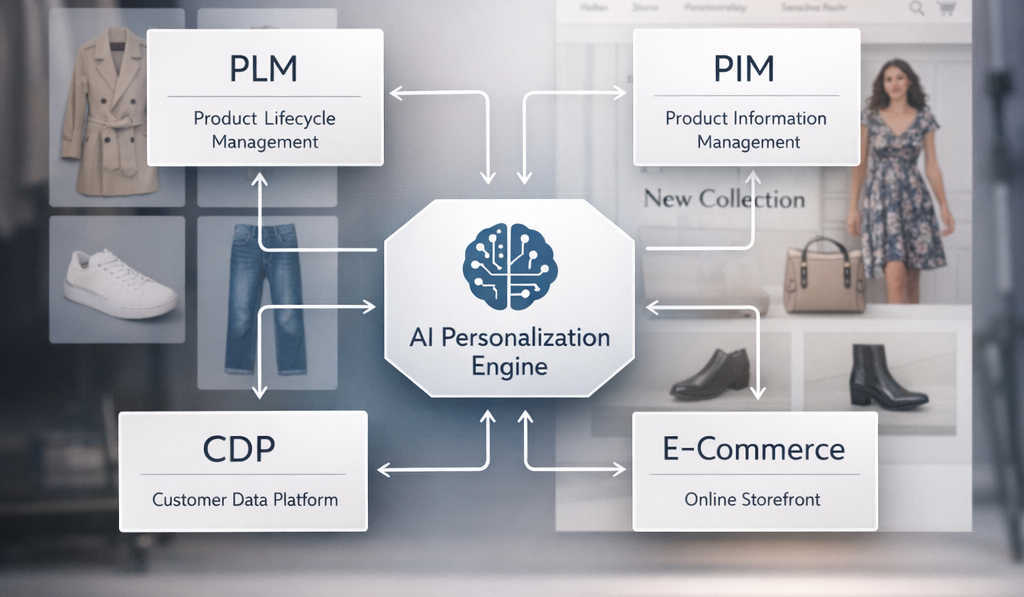
Many fashion brands have already “gone digital” but still feel stuck. They’ve migrated to Shopify Plus or a headless front end, plugged in personalization widgets, and rolled out a CDP—but the experience for shoppers still feels fragmented, and internal teams are drowning in integration work. Product data looks different in every system, omnichannel journeys break whenever a field changes, and AI pilots stall because models can’t see a clean picture of either products or customers. The root problem is architectural. Most Apparel, Footwear & Luxury brands are trying to graft modern AI capabilities onto stacks that were never designed for continuous change. Even when they adopt newer tools, those tools are often wired together point‑to‑point: PLM to ecommerce here, ERP to OMS there, a personalization engine scraping the storefront for context. Over time, each new campaign or channel adds another integration, and the whole structure becomes fragile. Composable commerce offers a way out—but only if fashion brands treat it as more than a buzzword. In a composable stack, core capabilities such as PLM, PIM, ecommerce, CDP, and AI are decoupled yet connected through clear contracts and events. Each system does one job well and exposes its truth via APIs. For AFL, the goal isn’t microservices for their own sake; it’s a tech stack that can support style-led personalization, fit intelligence, merchandising automation, and cross-border CX without needing a nine‑month project for every new idea. Industry analyses from Shopify, BigCommerce, and the MACH Alliance show that retailers who adopt composable patterns see faster experimentation and better returns on AI investments, because teams can plug new services into an already-structured data spine instead of rebuilding from scratch each time (Shopify, MACH Alliance). For MapleSage’s AFL ICPs—Fashion CTOs, Digital and Ecommerce VPs, CMOs, and Merchandising leaders—this is directly tied to the four active campaigns: • Campaign 1: AI personalization for loyalty demands unified style and fit profiles. • Campaign 2: Tech stack integration hinges on PLM, PIM, and commerce talking fluently. • Campaign 3: Merchandising automation needs real-time demand and inventory signals. • Campaign 4: E‑commerce conversion wins when mobile and web can adopt new AI journeys quickly. This post argues that “AI‑first fashion CX” is, in practice, “data‑first and composable CX.” It lays out what a composable stack looks like for AFL, how to design the fashion data spine that underpins it, and how to run it with governance and KPIs that both technology and business leaders can stand behind.
The spine of a composable fashion stack is its data model. Without a shared understanding of products and customers, API-first architecture just accelerates the chaos. For Apparel, Footwear & Luxury, that means prioritising three connected layers: PLM for creation, PIM for consumer-facing enrichment, and CDP for customer truth—then wiring them cleanly into ecommerce, marketing, and AI. PLM remains the design room’s source of truth: blocks, BOMs, grading rules, fabric specs, and approvals. PIM translates that into the language search engines, shoppers, and AI understand: silhouettes, lengths, fits, palette families, climate tags, sustainability attributes. Fashion-focused PIM vendors like Centra, Pimberly, Catsy, and BetterCommerce all argue that apparel and footwear require far richer, more structured attributes than general retail to support the complexity of variants and channels (Centra, Pimberly, Catsy, BetterCommerce). CDP, finally, unifies behavioural, transactional, and preference data into a single profile per shopper across store, web, and app. In a composable architecture, each of these systems exposes its truth via APIs or events. Ecommerce platforms—Shopify Plus with Hydrogen, BigCommerce, Centra, Medusa, or custom builds—subscribe to product and customer events rather than holding their own divergent versions. An AI layer like MapleSage’s SageRetail sits alongside, consuming the same attribute spine and profiles to power search, merchandising, and personalization. Business of Fashion’s work with BigCommerce on AI-powered “composable retail” notes that retailers who centralise data in this way see more impact from AI pilots because models can learn from consistent signals across channels (Business of Fashion). Mapping this onto AFL realities means being explicit about fashion-specific data. For apparel: silhouettes, rises, sleeve/head shapes, fabrics and stretch, palette and print families, dress codes, climate and modesty tags. For footwear: lasts and widths, toe and heel shapes, heel heights, outsole compounds, performance tags. These attributes must be first-class citizens in PLM and PIM for SageRetail to treat products as a style graph rather than a flat SKU list. On the customer side, CDP schemas should reflect style tribes and fit behaviour, not just RFM. Research from Ionio and Heuritech on AI-driven customer profiling in fashion shows that clustering shoppers by style and behaviour yields more effective personalization and merchandising than demographics alone (Ionio, Heuritech). In a composable stack, those profiles become reusable everywhere: in email, onsite, apps, live shopping, in-store styling apps, and even wholesale portals.
Running a composable fashion stack in production is less about microservices and more about governance, KPIs, and change management. To stop “composable” from becoming “fragile,” AFL leaders need to treat the stack as a long-term program, not a one-off project. First, define a small, CFO-resonant scoreboard that connects architecture to business outcomes: • Conversion and AOV uplift in journeys powered by unified product and customer data (e.g., AI-personalized style feeds, fit-aware recommendations) vs baseline. • Full-price sell-through and markdown rates by category for products flowing through the new PLM→PIM→commerce pipeline vs legacy paths. • Time-to-market for new styles from PLM approval to live PDP, including enrichment and localization. • Engineering and operations metrics: deployment frequency, incident rates tied to integrations, and time-to-recover when services fail. Industry case studies on composable commerce, such as those from MACH Alliance members and Shopify’s enterprise fashion reports, highlight that brands see the greatest returns when they pair modular stacks with strong product and data governance rather than chasing microservice counts (Shopify, MACH Alliance). Second, roll out in staircase phases. For example: • Phase 1 – Data spine: implement or solidify PLM and PIM, define the fashion attribute model, and connect them to a CDP. Keep the frontend mostly intact. • Phase 2 – Frontend and AI pilots: introduce headless or Hydrogen storefronts on one region or brand, and plug SageRetail into search, recommendations, and merchandising using the new data spine. • Phase 3 – Scale and refactor: extend composable patterns to more regions, categories, and channels (apps, in-store, wholesale portals), gradually retiring brittle legacy integrations. Throughout, use feature flags and A/B testing to derisk changes. When SageRetail takes over search ranking or PDP recommendations for a category, compare performance to the old engine before rolling out widely. Guardrails should cover reliability and brand expression. For reliability, enforce strict contracts between services and observability across integrations; a broken PIM or CDP pipeline should be visible before it silently degrades CX. For brand expression, ensure design systems and content models let marketing and merchandising teams maintain a coherent visual and tonal identity even as underlying services change. For MapleSage, composable fashion stacks aren’t just a technical preference; they’re what makes our agentic AI approach viable. SageRetail, styling agents, and workflow automations can only operate as “co-pilots” for AFL brands when they can read clean product and customer truth and write back decisions without fighting monoliths. This post gives Fashion CTOs, Digital VPs, and CMOs a shared blueprint for moving there in a way that supports all four active AFL campaigns—personalization, tech stack integration, merchandising automation, and ecommerce conversion.