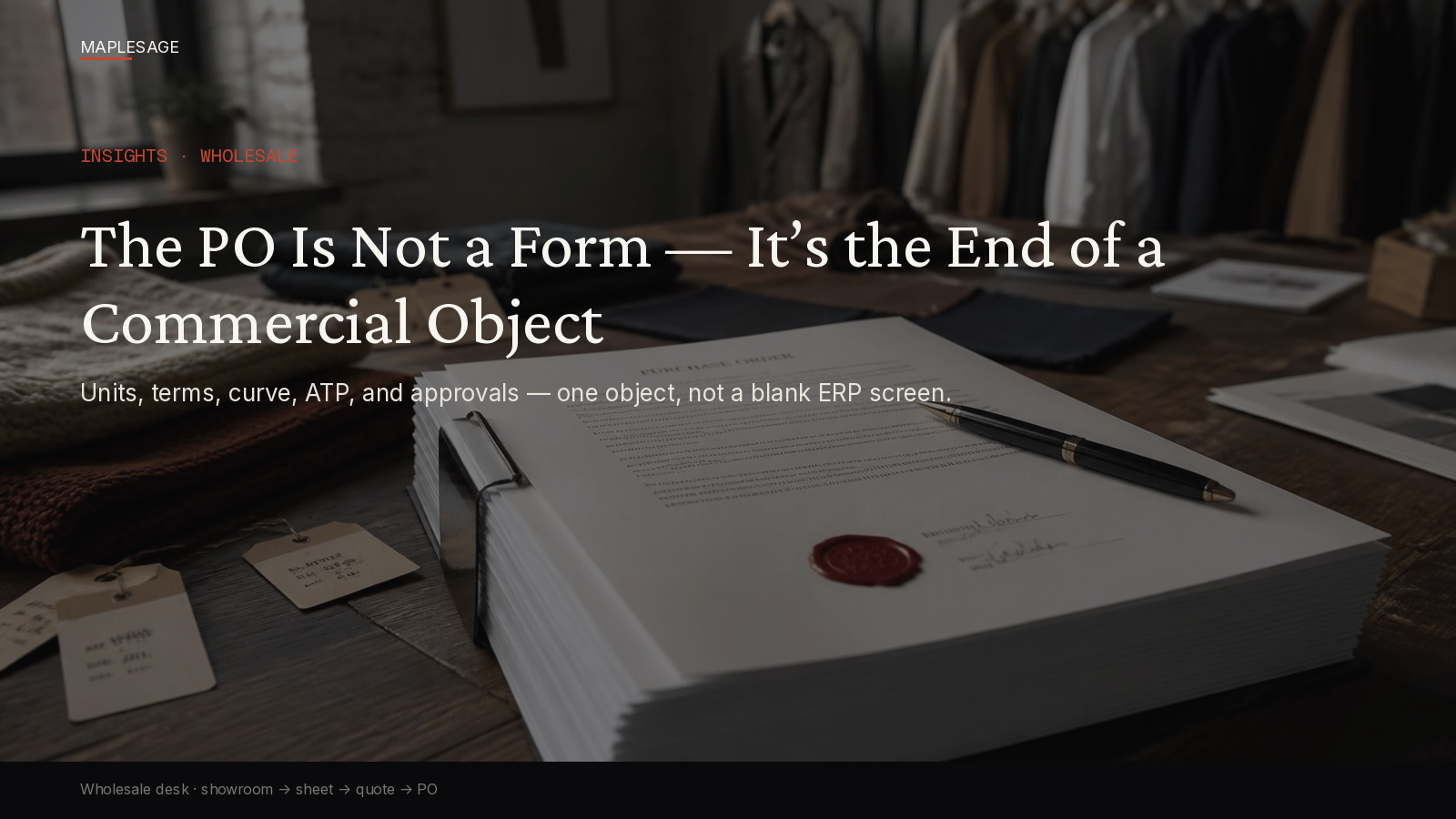
Signed PO as the end of one commercial object — units, terms, curve, ATP, approvals
Most wholesale teams treat the purchase order like a blank ERP form — something to fill after the real work happened somewhere else. That is the break.
The PO is not the start of data entry. It is the terminal state of one commercial object that already carried units, terms, size curve, ATP, and approvals from the showroom through the sheet and the quote.
This follow-up closes the spine: showroom → account-aware line sheet → quote → size/assortment → approved PO. The flagship covers why the sheet must stay the system. Here we stay on what the PO must inherit — and what re-keying destroys.
The misuse
Buyers mark units in the showroom. Ops rebuilds a sheet. Sales emails a quote. Merch adjusts the curve in a spreadsheet. Finance “opens a PO” in the ERP from whatever landed in the inbox.
By then the commercial object has been re-entered three or four times. Door terms live in Slack. Size mix lives in Excel. ATP was checked yesterday and never rechecked. Leadership asks why production is waiting on a PO that “should have been simple.”
It wasn’t simple. You treated a terminal commitment like a blank form.
Form vs commercial object
| View | What the PO is | What breaks |
|---|---|---|
| Form | Fields to key into ERP | Re-entry from email / Excel / WhatsApp |
| Commercial object | End state of showroom → sheet → quote → curve → approvals | Season break when the object is rebuilt |
A form asks: what numbers should we type?
A commercial object asks: what already-approved deal is production allowed to run?
If the answer isn’t already on one object — account, season, doors, units, terms, curve, ATP, who signed — the PO is fiction with a document number.
Related: Your Quote Isn’t a Thread. Account-Aware Showroom. Size Curves on the Wholesale Sheet. Full spine: The Wholesale Season Breaks When the Sheet Stops Being the System.
What must ride into the PO
Nothing new should be invented at PO time. The object should already carry:
- Units by style / color / size — the same matrix the buyer saw
- Door terms — not a side Slack exception typed after the fact
- Size / assortment curve — account- and door-aware, not a generic default
- ATP — availability that was true when the quote was approved, not when someone finally opened the ERP
- Approvals — who gated the deal, with revision history intact
If any of those live only in someone’s head or inbox, you don’t have a PO. You have a hope with a PO number.
Gated approval is the product
“Submit PO” without a gate is how wrong inventory gets booked. The gate isn’t bureaucracy. It’s the moment the commercial object stops being negotiable and becomes production truth.
Heads of wholesale feel this when:
- the ERP PO doesn’t match the quoted terms
- door three’s curve got flattened in re-entry
- ATP changed between quote and keying and nobody caught it
- finance asks which email is the source of truth
Gated approval on one object beats three people “confirming” in parallel threads.
ICP framing
For mid-market AFL brands selling TO retailers (~$10M–$250M wholesale), the PO is an input to:
- production commit
- allocation and ship windows
- buyer trust next season
- whether the sheet was ever the system
Not an ERP training problem. Not a “faster form.” Not a CRM activity that never touches units.
Ops and merch who own the book know the cost: chargebacks, refill friction, and buyers who stop believing the desk when last season’s re-keyed PO doesn’t match what they thought they bought.
Product proof note — Retail-OS gated PO
MapleSage Retail-OS treats the approved PO as the end of the same commercial path as the showroom, live sheet, quote, and size matrix — not a separate ERP form people re-key from email. Units, terms, curve, and ATP ride forward; the gate is on the object, not on a blank screen.
See the buyer path: b2b.maplesage.com. Wholesale surface: www.maplesage.com/retail/wholesale/. Talk: go.maplesage.net.
What we won’t pitch
- “Just integrate the ERP form” as the wholesale fix
- Competitor PO / ERP UI screenshots
- Another CRM that never carries units, terms, or curve into the commit
Next step
If your POs still start as blank forms filled from email and Excel, stop treating re-entry as normal. Make the PO the end of one commercial object — or expect the season to break there again.