One line. Three links. If it breaks, the order breaks.
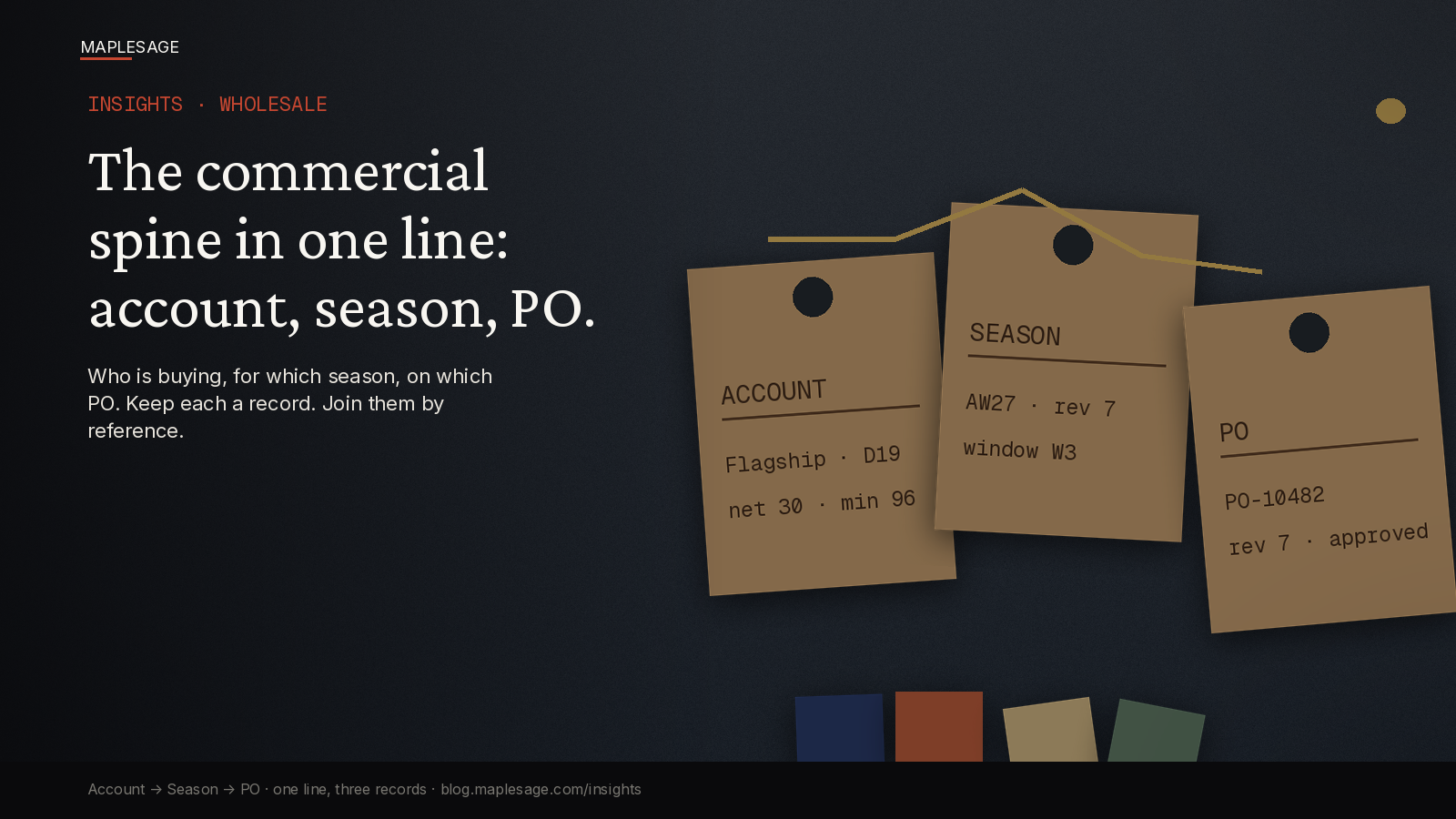
Strip a wholesale order down and there are three facts: who is buying, for which season, and on which PO. Account → Season → PO.
Most mid-market brands hold those three in three places. The account lives in the CRM or a rep’s head. The season lives in the line sheet and the planning file. The PO lives in email and the ERP. Each place is correct on its own. Nothing ties them together.
That gap is where wholesale errors are made.
This is the one-line version of the spine from the earlier follow-ups: showroom → account-aware line sheet → quote → size/assortment → approved PO → production. Compress it and what remains is Account → Season → PO. Every other step hangs off those three.
Link one: the account
Not a name. A record the rest of the chain can read.
- Which door. Flagship, outlet, e-commerce arm. Different doors, different terms.
- What was agreed. Dating, minimums, ship windows, cancel dates, price tier.
- What happened before. Last season’s buy, the chargebacks, the open disputes.
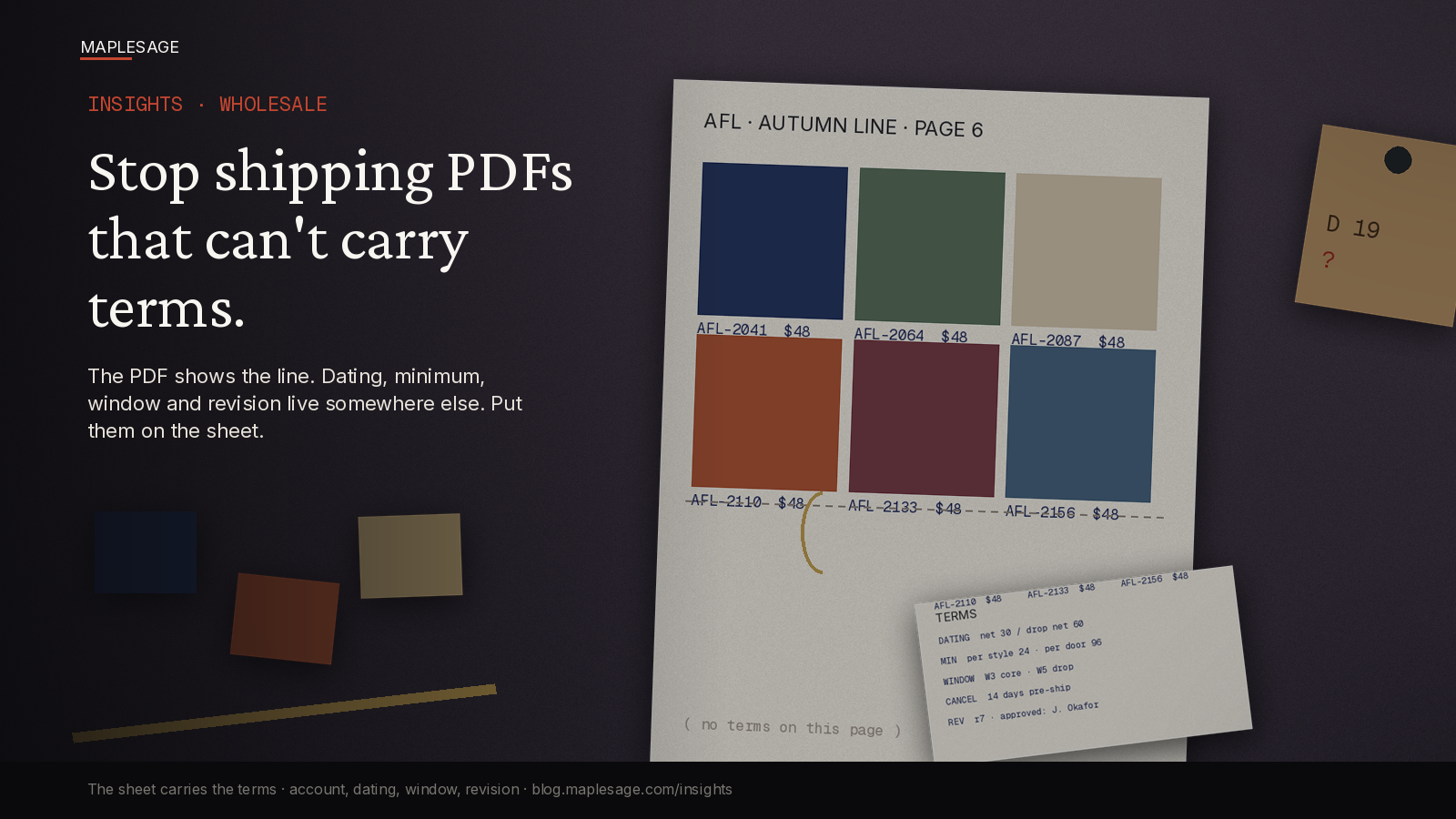
If the account does not carry its terms, the sheet cannot. Day 34 said the sheet has to carry them. This is where they come from.
Link two: the season
Not a PDF. A set of styles with a window, an availability position and a revision.
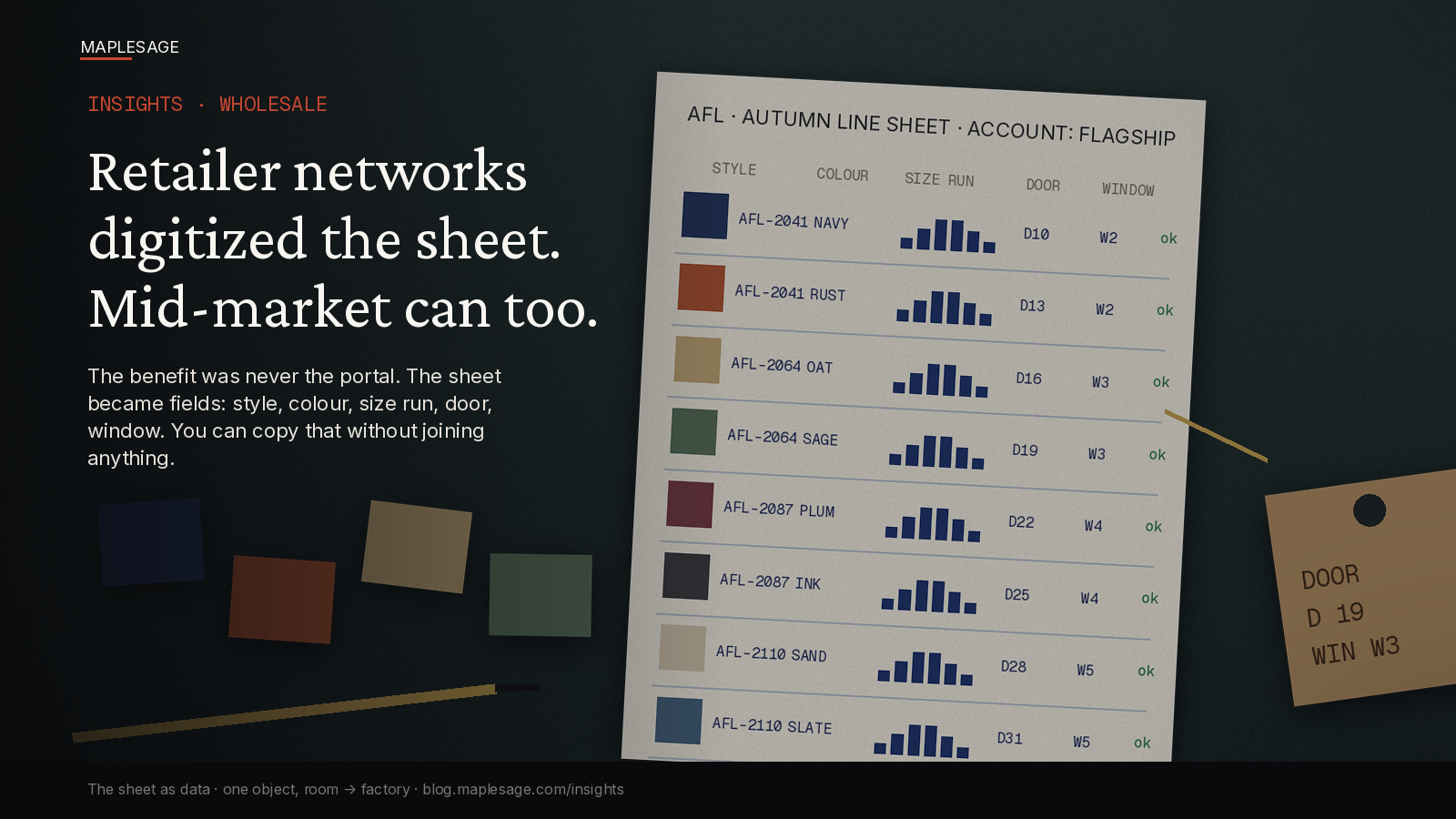
- Styles in the season, with colourways and size runs as units.
- Windows and cut dates attached to styles, not footnotes.
- Availability as of today, so “can we ship it” has an answer.
- A revision number so everyone can say which version they hold.
The season is only useful to a given buyer once it is joined to the account. A core style on a flagship door in window two is a fact. A core style is a catalogue entry.
Link three: the PO
Not an attachment. The commercial object the buyer commits to.
- Account and season, stated, not inferred from the subject line.
- Lines by style, colour and size, against the revision the buyer saw.
- Terms as accepted, not as the buyer assumed.
- Approver and date.
When the PO carries the account and season by reference, it can be checked against both. When it carries them as text in an email, it cannot.
Where the line breaks
Three common breaks:
- Account to season. The buyer gets the generic sheet. The special dating is agreed by email and never reaches the record.
- Season to PO. The buyer orders from last week’s PDF. The revision has moved. Nobody notices until the cut.
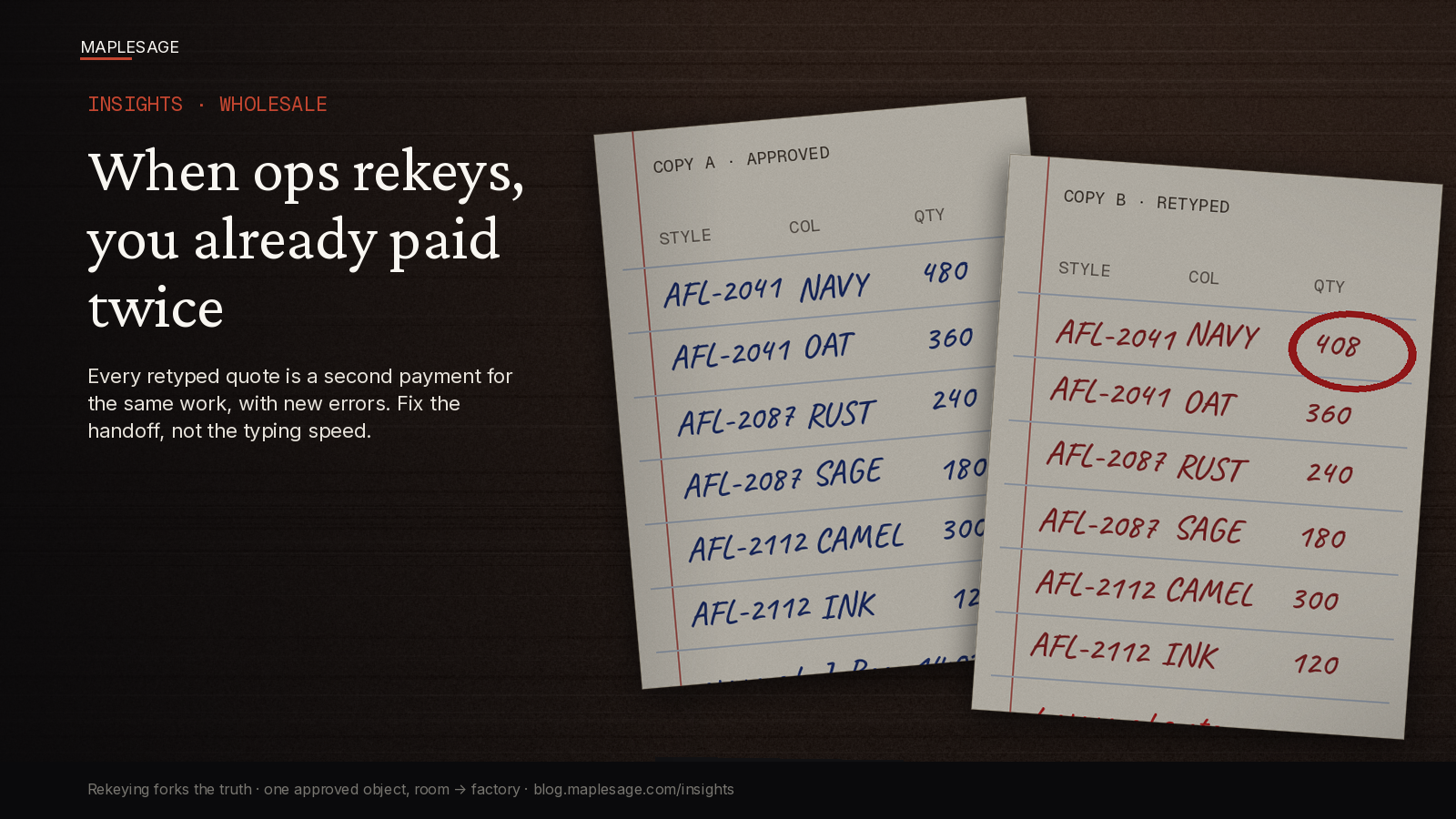
- PO to production. Ops re-keys the PO. A size run is rounded, a window is read from the wrong column.
None of these is a software failure. Each is a join nobody owns.
What the one line buys you
When the three are joined by reference, a lot of the daily work goes quiet:
- The quote is generated from account terms and the current season revision, not typed.
- The PO is checked on arrival: right account, right revision, terms match, quantities inside availability.
- Production receives a number with its context.
- A question like “what did this account buy against which version” has a one-query answer.
Where agents help, and where they should not
An agent can read an incoming PO, match it to the account and the season revision, and flag the mismatches: wrong revision, a minimum below the account’s agreement, a window the style does not have. That turns checking into review.
It should not decide which term wins when the PO and the record disagree. That is a commercial call. The agent shows the difference. A person with authority resolves it.
One-order trace
Pick one order from this season and trace it:
- Can you name the account record it was booked against, and show its terms?
- Can you name the season revision the buyer saw?
- Does the PO reference both, or only mention them?
- If the buyer asks what changed since they ordered, can you show it in under a minute?
If the answer to most is “it’s in an email”, the line is three separate places. The order still shipped. It just shipped on trust.
The close
Account → Season → PO. Three links, one line. Keep each as a record, join them by reference, and the sheet, the quote, the PO and the cut all read the same facts.
MapleSage Retail-OS is built around that spine: sheet → selection → quote → PO → production.