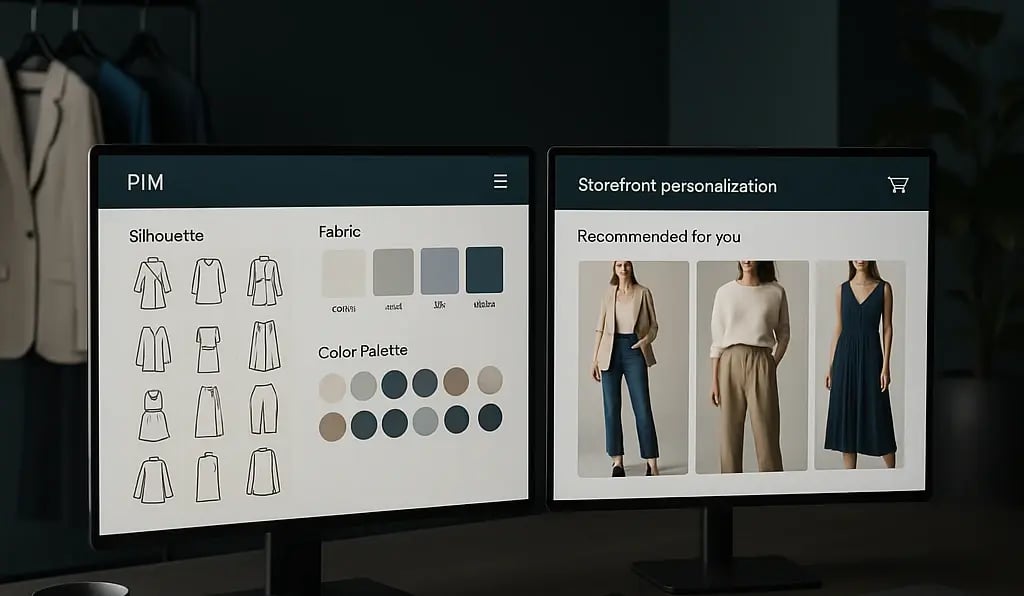
Why enriched PIM data is the hidden engine of style-led personalization.
Why PIM quality makes or breaks fashion personalization
Personalization in fashion fails more often because data, not algorithms. When product pages carry only category, color, and a vague fabric, even the smartest engine can’t recommend a coherent look or the right size-friendly alternative. The fix is upstream: a Product Information Management (PIM) layer that captures fashion-grade attributes—and keeps them consistent from studio to PDP. Think silhouettes (A-line, bias, bodycon), rises and lengths, necklines and sleeves, toe/heel shapes for footwear, fabric composition and stretch %, pattern families, palette, occasion, and care. With this vocabulary, style-led recommendations become explainable (“paired for column silhouette and satin finish”), search facets become intuitive, and fit intelligence has the signals it needs to reduce bracketing. This is where many headless or theme-led projects stumble. Brands decouple the storefront but leave data enrichment to spreadsheets and last-minute copy. Result: inconsistent filters, generic cross-sells, and SEO that ranks for “black dress” instead of “black satin midi slip dress with cowl neckline.”
Public primers reinforce the role of rich product data in commerce performance. For a clear explanation of how PIM differs from PLM and why both matter in fashion, see Centric: PIM vs PLM and the Centric PLM overview. Market outlooks underscore why this investment pays now: discovery is increasingly visual and attribute-driven, and mobile shoppers won’t type their way to taste. Shopify’s 2025 fashion brief summarizes the personalization mandate and social-to-shop shift at Shopify. A credible PIM doesn’t replace human taste; it gives merchandisers and stylists a shared language that machines can use.
The goal is a loop: merch teams author attributes that reflect the brand’s aesthetic; recommendation/search engines consume them to curate looks; and analytics return proof—attach rate, AOV, and return deltas—so teams see which attributes predict outcomes. As the State of Fashion 2025 highlights, volatility and value-seeking customers reward brands that move quickly with data-backed decisions; review the report at McKinsey x BoF 2025.
Designing a fashion attribute spine that powers CX and SEO
Start by defining a fashion attribute spine that merchandisers trust and machines can use. Minimum viable vocabulary: silhouettes (A-line, bias, bodycon; straight, wide-leg), lengths and rises, necklines/sleeves, closures, fabric composition and stretch %, pattern families, palette (with a mapping to color harmony), toe/heel shapes, last width for footwear, and occasion. Make these fields first-class in the PIM—not free text hidden in descriptions. Use controlled picklists with a few custom text fields where experimentation is needed.
Treat photography as data: tag finish (satin/matte), drape, and hardware tone to improve “shop the look” and visual search. Then align taxonomy to customer journeys and SEO. Facets and filters should mirror how fashion customers actually think: silhouette and length before technical fabric codes; rise before wash; heel height and toe shape for footwear. The same spine should power internal search boosts and external structured data (schema.org), creating consistency between on-site discovery and how search engines index the catalog. When vision models extract features (neckline, straps, palette) from images, map them back to the same vocabulary so camera-led discovery and text-led refinement speak one language.
Beyond PDPs, the spine fuels lifecycle personalization. Email and app feeds should reference the same attributes (“edit for cowl necklines you saved,” “wide-leg neutrals under $250”), and clienteling tablets should surface fit blocks and preferred silhouettes for VIPs. Shopify’s playbooks for personalization reinforce how first-party data and attribute depth improve conversion and loyalty; see their strategy primer at Shopify strategies and trend view at Shopify trends. The prize is a catalog that reads like a runway spec sheet to machines and a style magazine to humans.
Implementation playbook: PLM→PIM→storefront with KPIs
Implementation is a relay from PLM to PIM to storefront—backed by governance and a scoreboard. Blueprint: • Data flow: Make PLM the source of technical truth (materials, pattern blocks, approvals). On PLM milestones, create or update items in PIM automatically. Enrich PIM with customer-facing attributes and media (alt text, accessibility tags) and publish to the storefront and channels. For clear roles and handoffs, review PLM vs PIM distinctions at Centric: PIM vs PLM. • Contract tests: Version the product schema; add contract tests between PLM, PIM, and commerce APIs so attribute changes don’t break search or personalization. • Media pipeline: Automate variant image assignment and ensure images carry attribute tags used by visual retrieval. Keep accessibility first with accurate alt text. • Personalization/search: Expose the attribute spine to the recommendation and search layers on day one; do not postpone this until “phase two.” •
KPIs: Track attribute coverage (% of SKUs with complete spine), facet engagement, search success, attach rate of complementary items, AOV uplift, and return-rate deltas for SKUs with full attribute coverage vs. partial. Publish freshness SLAs for enrichment so new drops become discoverable within hours. • Governance: Treat taxonomy changes like deployable artifacts with rollback.
Maintain a changelog merchandisers can read. As McKinsey/BoF’s 2025 outlook notes, brands that operationalize data move faster through volatility; see BoF overview. Outcome: fewer dead-end grids and generic cross-sells; more coherent looks, better fit confidence, and measurable gains in conversion and margin—because the catalog finally speaks fashion fluently, at machine speed.