Translate trend signals into localized size curves and smarter allocation.
Why trend forecasting alone isn’t enough for buys
Traditional services and show coverage remain invaluable for context and taste. But buys fail when a promising silhouette isn’t translated into the right size mix, for the right markets, at the right time. The result is familiar: stockouts in core sizes, piles of odd sizes, and forced markdowns.
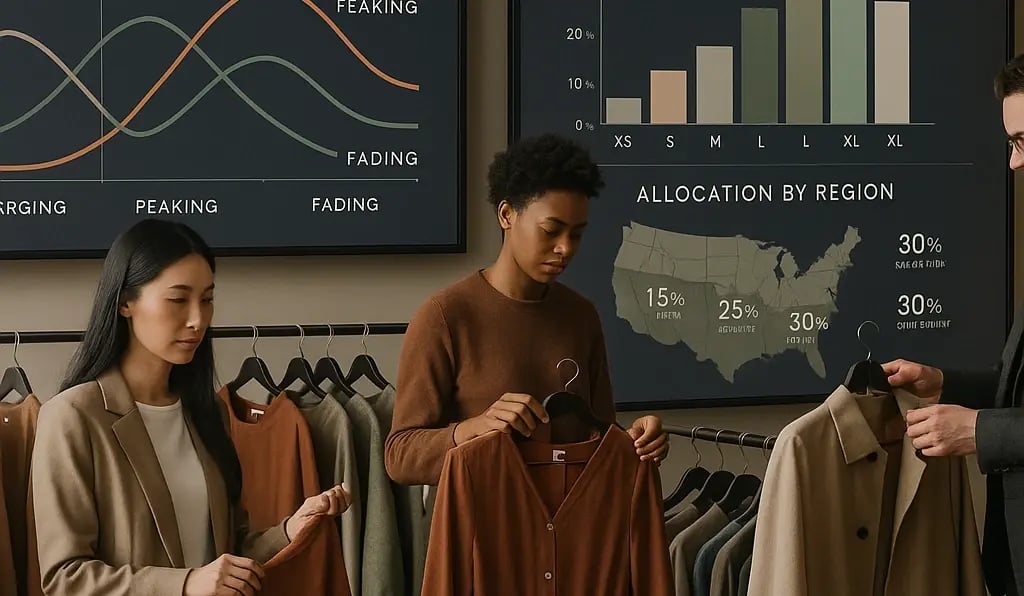
An AI‑augmented loop connects runway and social signals to localized size curves and allocation, so you commit smarter pre‑season and rebalance faster in‑season. Visual‑signal platforms quantify which silhouettes, palettes, and details are emerging, peaking, or fading; see how this works in practice via Heuritech and its explainer on runway‑to‑retail signal detection at Heuritech method.
Meanwhile, WGSN details how AI and expert review merge to produce product‑level forecasts across categories; their methodology outline is here: WGSN AI & Data. Macro outlooks (uneven demand, value focus) underline why precision in buys and allocation is a margin lever; see the industry’s backbone report at McKinsey 2025 and commerce context from Shopify.
Designing a signal‑to‑allocation loop merchandisers trust
Design the loop so merchandisers can explain every recommendation. Signals: availability‑aware sell‑through (corrected for stockouts), return‑reason feedback (fit/last issues), regional trend momentum, seasonality, channel mix (DTC/wholesale/marketplace), and launch calendars.
Modeling: 1) estimate censored demand to avoid reading stockouts as low appetite;
2) borrow learning from similar styles (same block, fabric, brand) for cold‑start SKUs;
3) localize curves by region and channel;
4) incorporate pre‑order, waitlist, and wishlist signals as demand with confidence bands.
Output: initial pre‑season size curves by style/region/channel with uncertainty bands; in‑season weekly refreshes that trigger reallocation where feasible.
Glue: a fashion attribute spine (silhouettes, rises/lengths, toe/heel shapes, fabric/stitch details) shared by PLM/PIM and decisioning, so trend attributes map cleanly to SKUs. UX: an allocation cockpit that answers “why this mix?” with reason codes—trend slope, historical adjusted demand, return feedback—so buyers can accept/override with confidence. For a luxury case featuring PLM’s role in speeding product decisions, see Centric × YNAP.
Operating cadence: KPIs, tests, and seasonal playbooks
Operate with a cadence that proves profit lift. KPIs: stockout reduction on top sizes, markdown rate on tail sizes, full‑price sell‑through, weeks of supply, and transfer efficiency (% of inventory reallocated pre‑markdown). Experiments: start with one category in two markets; run matched cohort or randomized store/site tests; publish stop‑loss thresholds (e.g., tail markdown depth).
Seasonal playbooks: pre‑season, convert signal trajectories into buy ranges by tier (core/fashion/test) and set uncertainty bands; in‑season, refresh weekly and coordinate creative so size‑rich stores and sessions get visibility; post‑season, attribute which attributes predicted stalls and fold them into next buys. For background on fashion’s evolving economics and why agility matters, refer to the BoF overview.
Commerce execution guides from Shopify remain useful context for discovery and conversion—the downstream effects of better allocation—see Shopify report. With a signal‑to‑allocation loop, “trend aware” finally becomes “inventory right”—and margin follows.