How shoppable video turns social inspiration into on-site conversion for fashion. Fashion inspiration increasingly begins in video—runway clips, creators’ styling tips, and micro‑trend edits that race across feeds.
Why shoppable video now dominates fashion discovery
The question for e‑commerce leaders isn’t whether to produce video; it’s how to make video shoppable in a way that respects brand aesthetics and actually lifts conversion, not just views. When built on a fashion-grade attribute spine and tied into your commerce stack, shoppable video compresses the journey from “I love this look” to “I bought the outfit,” especially on mobile where typing is friction.
The economics justify focus. Visual-first cohorts—particularly Gen Z—respond to swipeable, on‑model content with clear paths to purchase. Social commerce continues to expand, with platforms such as TikTok Shop leaning into on‑video transactions and affiliate ecosystems that move product in hours, not weeks; see the platform’s business overview at TikTok Shop.
Retail and fashion analyses throughout 2024 (BoF, WWD) emphasize that brands who translate social-native formats into on‑site shoppable video see higher engagement and better attribution than those who keep video siloed in social.
Shopify’s best-practice resources for shoppable video provide an implementation checklist—from tagging to analytics to conversion tracking—at Shopify. Design for the way people browse clothes, not gadgets.
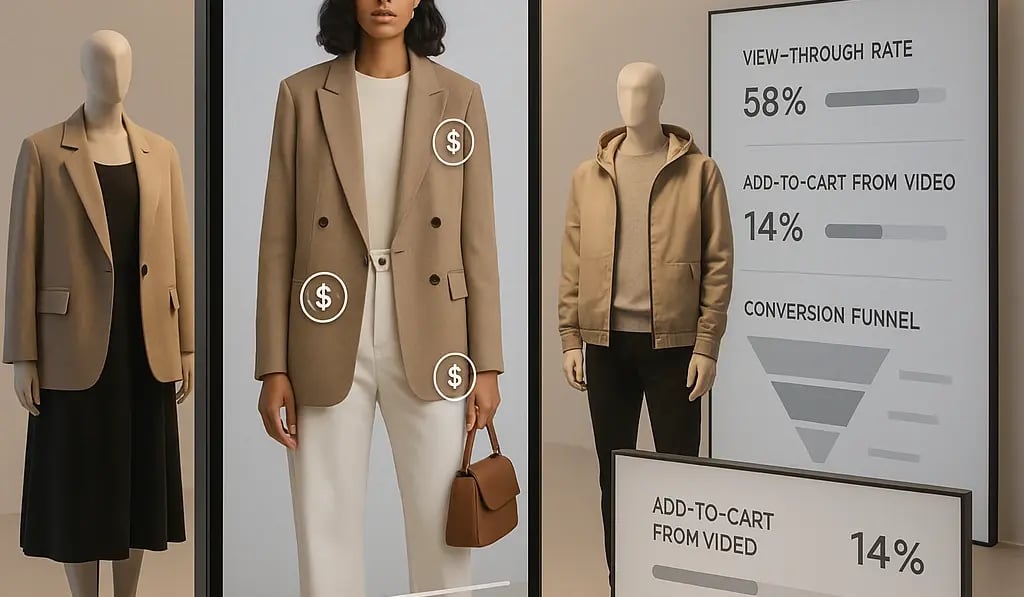
Lead with looks: show the hero piece styled in two or three contexts (office, night out, weekend). Make hotspots obvious but elegant, with quick-view cards that explain why the item fits the look (silhouette harmony, material finish) and show a recommended size.
Keep a carousel of alternates (“lower heel,” “warmer tone,” “longer hem”) so shoppers can make lateral moves without backing out. For performance, aim for sub‑100 ms interactions and lazy‑load variants so fabric detail isn’t lost.
Wire analytics to capture a full funnel—view → hotspot → cart → checkout—and benchmark against static PDPs to prove the delta. Finally, tie shoppable video to lifecycle.
Follow up with saved looks by email or in‑app messages, and track return-rate deltas. When size/fit is presented inline, bracketing drops; that’s conversion you keep. The end state is a studio that ships video as a product, measured weekly, and aligned to your fashion attribute spine and inventory realities.
Design shoppable video for fashion: data, UX, and tech stack
Great shoppable video in fashion is 80% data and 20% taste. Start with your fashion attribute spine—silhouettes, lengths, rises, necklines, sleeve types, palettes, fabrics and stretch, toe/heel shapes—so every tap target can carry a style reason (“paired for column silhouette and satin finish”).
Wire your PIM/PLM pipeline so videos are tagged as tightly as stills; this makes hotspots explainable and searchable.
Keep the experience mobile-first: vertical video, large touch targets, and one-hand controls.
Use a visible but light UI—subtle product pins, swipeable alternates, and a persistent add-to-bag.
Layer size/fit intelligence into the player so shoppers see a single recommended size with a short reason without leaving the video.
Choose your stack pragmatically. Platforms and apps now support in-video shopping and live commerce, but avoid siloed carts—route checkout through your core commerce so inventory, pricing, and loyalty stay coherent.
Ensure analytics capture view-through, product reveal, tap-to-PDP, add-to-cart, and purchases attributed to the video session.
This is especially important as TikTok Shop and other social commerce tools grow; see platform overviews such as TikTok Shop.
For a commerce lens on how visual discovery maps to purchase journeys, Shopify provides a useful overview at Shopify and broader fashion e‑commerce context at Shopify Enterprise.
Industry reporting continues to show that Gen Z’s visual-first behavior and social-to-shop patterns reward video-native discovery; coverage from Business of Fashion and WWD throughout 2024 reflects this trajectory.
Measurement, experiments, and governance for video commerce
Operate shoppable video with a scoreboard and guardrails.
KPIs:
• View-to-product reveal rate and reveal-to-add-to-cart rate
• Conversion rate from video sessions vs. traditional PDP paths
• AOV lift from outfit-linked videos and return rate delta when size/fit is inline
• Content velocity (time from shoot to shoppable), and video attribution share of revenue by category
Experiment design: start with canary cohorts on mobile and social referral traffic, where lift is usually highest. Use randomized control if feasible (split traffic to video vs. static content) or matched cohorts with pre-registered stop-loss thresholds (bounce spikes, watch-time drops).
Attribute at the node: video → product reveal → add-to-cart → purchase. Pair business KPIs with technical SLOs (player start under 100 ms, video rebuffer rate under a target, hotspot latency <200 ms). Governance and privacy: evaluate consent at activation for any personalization in the player, minimize PII in payloads, and keep retrieval boundaries tight.
Keep an immutable decision log for personalized elements (e.g., why a size badge appeared). As macro context for why visual-first commerce is rising in fashion, see the BoF x McKinsey overview. With disciplined measurement and tasteful UX, shoppable video becomes a conversion engine, not just content.