#Personalization
#fashiontrend
AthleticWear


Style and fit intelligence reduce fashion returns by resolving uncertainty at checkout.
Returns remain fashion e‑commerce’s profit killer because shoppers struggle with two anxieties at once: “Will this fit my body?” and “Is this my style?” When either doubt creeps in, customers hedge by buying multiple sizes, colors, or variants—or they bounce entirely.
Industry baselines show online fashion return rates in the 20–30% range, often higher for categories like denim and footwear; several analyses put e‑commerce fashion’s average around 22–30% depending on region and subcategory. The effects cascade: higher reverse‑logistics costs, markdowns on returned inventory, eroded contribution margins, and lower lifetime value as disappointed shoppers disengage. The fix isn’t more generic product detail; it’s decision support that resolves fit and style uncertainty at the exact moment of choice. Start with your foundation: accurate size charts are table stakes, but still leave interpretation to the shopper. A better approach uses body‑aware fit intelligence trained on your SKU patterns and historical returns (fit tags, fabric stretch, silhouettes) to recommend the most likely comfortable size for that shopper. Complement that with real style signals: silhouette preferences (wide‑leg vs. slim), color and palette affinity, neckline and rise choices, and occasion context. When a shopper sees “You’re a 28 in this cut; pairs with this cropped blazer based on your saved looks,” they feel understood—and order fewer safety sizes. Reliable sources reinforce the magnitude of the problem and the opportunity. For industry context and macro trends, see McKinsey State of Fashion and BoF x McKinsey. Benchmarks on apparel returns from research firms cite mid‑20s averages for online apparel; see Coresight Research. For an overview of fashion e‑commerce realities, Shopify’s enterprise brief summarizes current dynamics: Shopify: Fashion e‑commerce. While vendor blogs abound, the pattern is consistent across sources: size/fit and style mismatch drive most fashion returns—and both are solvable with better data and on‑page guidance.
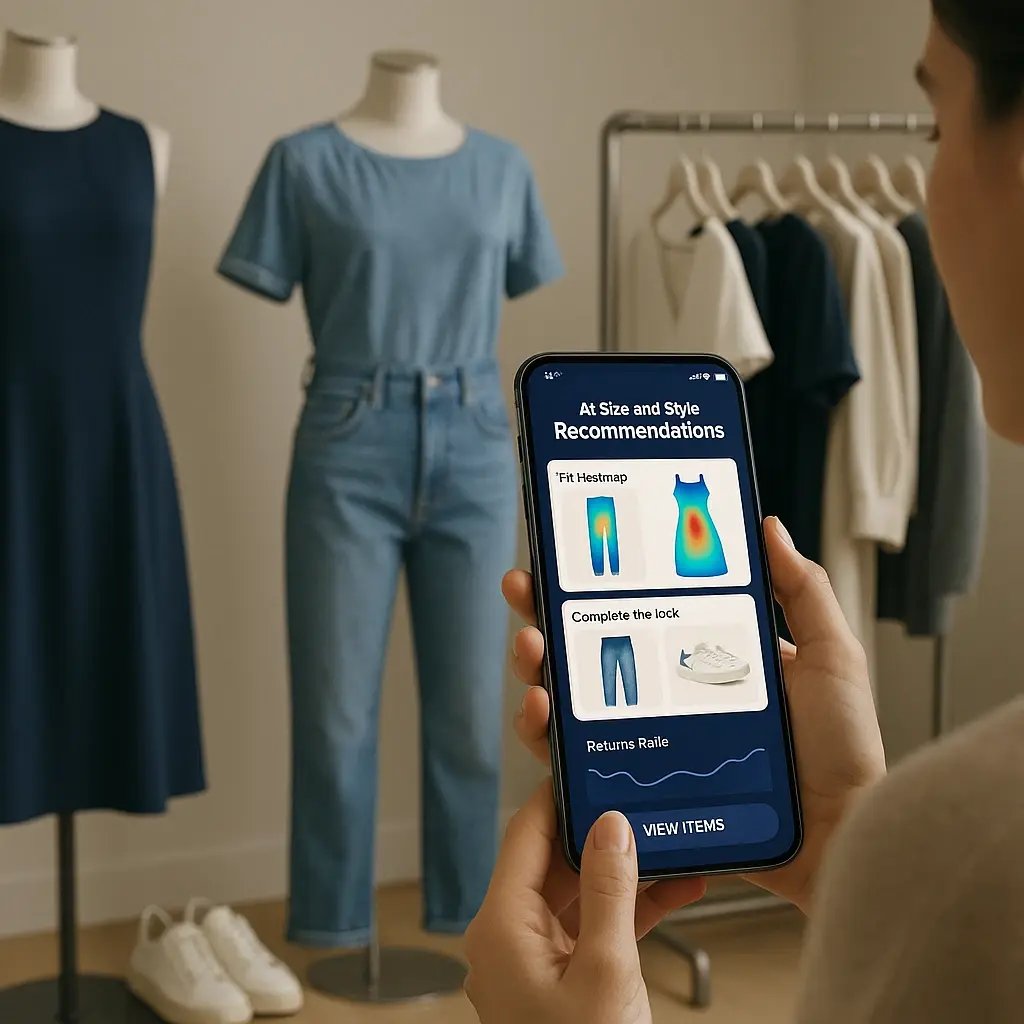
Style profiling and fit intelligence are complementary—one reduces aesthetic mismatch, the other reduces size errors. Treat them as a single experience. • Style profiling: Build a lightweight style graph for each shopper from declared preferences (quick quiz, saved items), behavioral signals (what they click, dwell on, or hide), and visual features extracted from images they engage with. Translate the graph into fashion attributes your team uses: silhouettes, lengths, rises, fabrics, palettes, and occasions. Use this to power “complete the look,” “similar in your style,” and “swap suggestions” when an item is out of stock. • Fit and size intelligence: Move beyond static size charts. Train a model that maps SKU‑level attributes (pattern blocks, stretch %, material composition, rise, inseam, last shape) to observed return reasons. Footwear returns often hinge on last/width nuance; denim on rise and stretch. The recommendation should output a single clear suggestion (“Most comfortable: 28”) with a short reason (“This cut runs roomy; your past purchases suggest 28”). • Evidence on impact: Independent syntheses cite that a large share of fashion returns are size/fit related. For a concise summary, see survey‑based indicators that online apparel returns outpace stores and skew toward fit issues, such as ICSC’s 2024 report: ICSC apparel return stats (summary). Practical vendor case writeups echo 10–20% reductions in returns with fit tech; while specific outcomes vary, the mechanism is clear: fewer multi‑size orders and higher first‑try fit confidence. Academic and trade literature continue to explore AI for fit and returns reduction; see a 2025 supply‑chain review framing returns as a strategic cost center: ScienceDirect: fashion returns review. Blend the two into your PDP, cart, and email flows. On PDPs, show size plus a minimal style rationale. In cart, flag redundant sizes and suggest the most probable fit. In post‑purchase, offer styling tips that reduce “change of mind” returns by showing how to wear the item with pieces the shopper already owns or has saved.
To prove ROI, plan, test, and instrument the experience end‑to‑end. • Define the scoreboard: Track return rate deltas by category, multi‑size order share, exchange vs. refund mix, average order value, and second‑purchase rate. Attribute effects to shoppers who saw size+style guidance vs. matched controls. • Run disciplined experiments: Ship the new guidance behind flags. Use randomized cohorts on key categories (denim, dresses, sneakers) where size/fit pain is high. Monitor uplift weekly; keep stop‑loss thresholds to protect margin while you tune. • Integrate into operations: Ensure reverse‑logistics and customer care codes capture granular reasons (“too big in waist,” “style not as pictured”) so models keep learning. Merchandisers can use aggregated fit/style feedback to adjust buys and product copy. • Sustainability and CX dividends: Lower return miles and fewer re‑pack cycles reduce environmental impact and improve brand sentiment—valuable for luxury and contemporary segments that court discerning shoppers. Helpful context and primers: McKinsey’s State of Fashion remains the industry’s backbone report (McKinsey). For practical commerce context, see Shopify’s overview of fashion e‑commerce dynamics (Shopify). For additional data points and perspective on fit‑led returns, see Coresight’s analysis (Coresight). With style profiling and fit intelligence working together—and measured with experimental rigor—fashion brands consistently see fewer returns, higher net revenue, and a calmer CX inbox. That’s profitability you can scale, not just a prettier PDP.