AI size curves for smarter buys and fewer markdowns in apparel. Size risk is one of apparel’s silent margin killers. When the size mix is wrong, you get “sold out in my size” moments on core SKUs and a tail of odd sizes that head to markdown.
Why static size curves fail modern apparel
Traditional curves built from last season’s sales miss censored demand (stockouts), ignore return reasons, and gloss over regional and channel differences.
AI changes the math by fusing cleaned sales, availability, returns, and trend signals into dynamic size curves—and by wiring those curves into pre-season buys and in-season allocation.
The result: fewer stockouts on top sizes, lower markdowns on tails, and a better customer experience.
Start with signals that reflect how people actually wear clothes. Correct sales for stockouts so demand isn’t undercounted. Ingest returns reasons with fit detail (e.g., “too tight in thigh,” “heel slips”) to detect misfit by block/last.
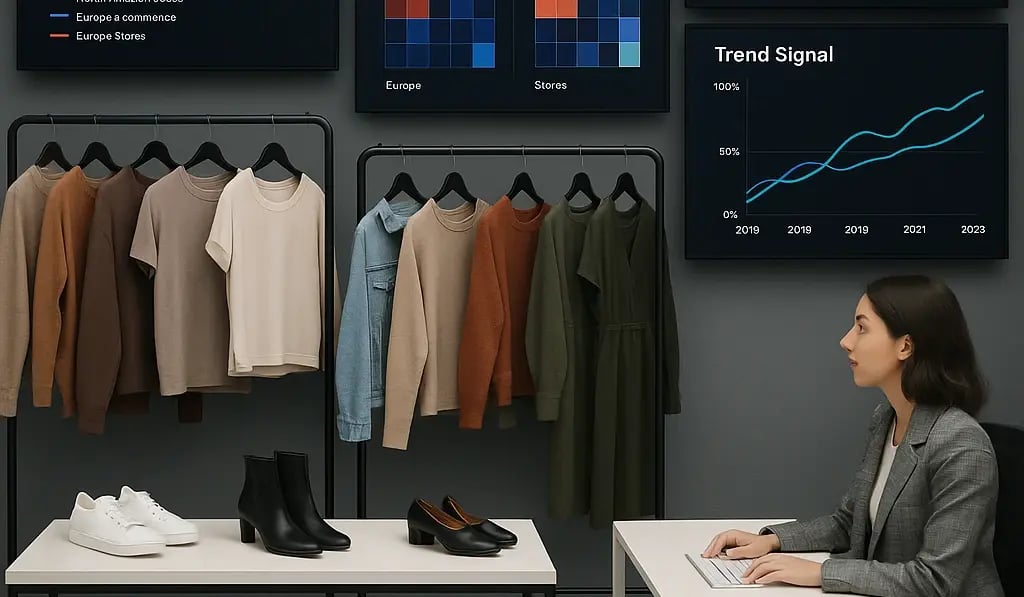
Add localized trend momentum and channel behavior; a silhouette that peaks on social in Paris may not crest in Dubai until weeks later. The output shouldn’t be a black box—it should be a mix and a rationale per style/region/channel.
Close the loop to decisions. Pre-season, translate curves into buy ranges with confidence bands; in-season, refresh weekly and trigger reallocation where it can prevent markdowns.
Coordinate merchandising so size-rich assortments get visibility in the right markets and cohorts. Over time, the telemetry teaches which attributes predict stalls, improving both curves and buys.
For industry grounding, see trend-signal explainers from Heuritech and commerce context at Shopify.
Design dynamic size curves and buy-to-allocate loops
Design the intelligence with transparency merchandisers trust. Data model: move beyond last season’s sell-through. Tag transactions with true availability (so stockouts aren’t misread as low demand).
Capture returns reasons and map them to fit blocks (e.g., denim rise/inseam + stretch %, footwear last/width) to detect misfit that distorts demand. Add regional and channel context—DTC, wholesale, marketplace—because curves differ across surfaces.
Modeling: estimate censored demand to correct for stockouts, segment curves by region and channel, and borrow learning from similar silhouettes and fabrics to handle new styles.
Blend early signals (pre-orders, waitlists, wishlists) as demand with confidence bands. Translate curves into pre-season buy ranges and in-season reallocation triggers with explainable reason codes: “top sizes stockout risk; trend slowing in EU; transfer to US West.” Loop to operations: expose curves and reason codes in a cockpit buyers actually use. Localize by market; feed allocation with store/DC constraints and shipping windows.
Coordinate creative and site merchandising so size-rich assortments get visibility where they can sell. For market context on visual signals that affect demand timing, see Heuritech. For a commerce baseline on fashion e‑commerce dynamics, review Shopify.
Operate: KPIs, experiments, and allocation guardrails
Run it like a product with CFO-ready proof.
• Outcome KPIs: stockout reduction on top sizes, markdown rate and depth on tail sizes, full‑price sell‑through, GMROI, weeks of supply, and transfer efficiency (% reallocated pre‑markdown).
• Experiment design: start with one category (denim or dresses) in two regions. Use randomized store/site cohorts or matched tests with pre-registered stop-loss thresholds.
• Technical SLOs: weekly curve refresh (faster for fast fashion), inventory sync freshness, and low forecast drift. Risk and governance: version the curve model, store rationales, and keep override logs.
Publish a change log so planners trust updates. Align with privacy minimization and retrieval boundaries; sizing intelligence shouldn’t shuttle full profiles around. For macro volatility and why agility wins, see McKinsey 2025.