
#FutureTech
#FashionAI
#Personalization
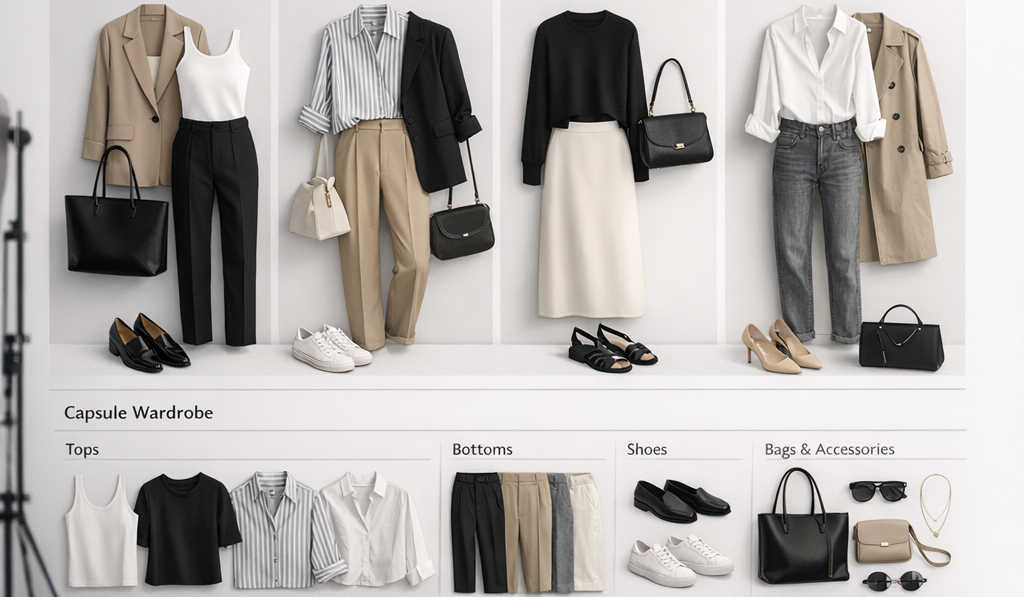

How AI-powered capsule wardrobes help DTC fashion brands increase outfit sell-through, loyalty, and sustainability.
“Too many clothes, nothing to wear” has become a cliché for a reason. For many fashion shoppers—especially in DTC-heavy segments like contemporary womenswear and athleisure—the problem is not lack of product, but lack of structure. They own plenty, but few pieces work together; new purchases are often impulse-driven; and the gap between their aspirational Pinterest board and their actual wardrobe keeps widening. Capsule wardrobes offer an antidote: a curated set of versatile pieces designed to mix and match into many outfits. Apps like Cladwell have popularized the concept, showing that when people organize their closets into capsules, they wear a higher share of what they own and spend more intentionally; Cladwell reports that its users wear around 65% of their closet (vs. the typical ~20%), take only five minutes to get dressed, and save hundreds of dollars per year by buying less but better Cladwell. The next evolution is the AI-powered capsule wardrobe embedded directly into DTC fashion experiences. Instead of static checklists, AI can actively build, test, and adjust capsules for each shopper, taking into account region, lifestyle, climate, fit history, and style cues. Recent work in the fashion tech space, such as Tryfits AI’s focus on using AI and virtual try-on to build 10 outfits from just five pieces, shows how generative and predictive models can help customers visualize and optimize capsules before they buy Tryfits AI. Academic research is moving in the same direction: a 2025 IEEE conference paper explores interactive systems for constructing personalized fashion capsules with alternative recommendations as constraints change, reinforcing the viability of this approach at scale IEEE. For MapleSage’s AFL ICPs—Fashion CMOs, E-commerce Directors, Merchandising VPs, CTOs, and CX leaders—this is a high-leverage opportunity: • Commercially, capsules drive basket size and full-look sell-through while reducing random, low-coherence purchases. • From a loyalty standpoint, they help the brand act like a stylist rather than just a catalog—strengthening trust and habit. • Sustainability-wise, capsules shift customers toward better utilization and fewer, more thoughtful purchases, aligning with circular fashion goals. This post lays out how DTC fashion brands can design AI-first capsule experiences across site, app, email, and even resale; what data and tech stack patterns are required; and how to measure the impact on AOV, margin, and wardrobe utilization. Even though keyword tools don’t yet show huge search volume for phrases like “AI capsule wardrobe,” interest in “capsule wardrobe” and “AI stylist” is rising in fashion and consumer tech circles. For MapleSage, that’s exactly the kind of strategic, slightly-ahead-of-the-curve topic that builds thought leadership with Fashion CMOs and digital leaders before the SEO wave crests.
Turning capsule philosophy into a scalable DTC experience requires more than a static blog post and a few lookbooks. Done well, it becomes a living product in your stack: AI continuously re-assembles outfits as inventory, climate, and shopper behavior change. The starting point is a product model that understands which pieces play well together. Capsule-focused apps like Cladwell model closets around mix-and-matchability, encouraging users to identify versatile staples and track usage; Cladwell cites users wearing 65% of their closet (vs. the typical ~20%) and saving money as they shift away from impulse buys Cladwell. Academic and industry work on capsule wardrobe construction is now catching up: recent IEEE research explores interactive systems that help users build personalized capsules with alternative recommendations as constraints change (weather, occasion, preferences) IEEE. For MapleSage’s AFL brands, SageRetail can unlock similar logic within their own ecosystems by: • Tagging each product with silhouettes, fabrics, palette families, and occasions, using PLM/PIM and visual AI. • Defining “anchor pieces” (e.g., blazers, jeans, sneakers, day-to-night dresses) and rules for how many tops, bottoms, layers, and shoes constitute a coherent capsule by climate and persona. • Using shopper data—region, lifestyle, fit history, style signals—to propose capsules that match real lives, not generic archetypes. In the experience layer, capsules can appear as: • Onboarding flows: new subscribers answer a short, image-led quiz and receive a proposed 8–15 piece capsule, with clear visuals of how many outfits those pieces unlock. • Category and campaign pages: “Build your spring capsule” experiences that let shoppers drag-and-drop pieces into a virtual rail and see outfit counts and gaps update in real time. • In-app “closet” views: for logged-in customers, AI can use order history plus declared items to suggest how to evolve their capsule—what to add, what to retire, and what to resell. AI adds value by simulating outcomes at speed. Tryfits AI, for example, shows how virtual try-on and AI outfit generation can help users test capsule combinations before purchasing, illustrating how five carefully chosen pieces can generate ten or more distinct looks Tryfits AI. For MapleSage’s clients, similar logic can run behind the scenes: SageRetail scores capsules on diversity (number of usable outfits), climate robustness, and margin mix, and then surfaces only those options that clear minimum thresholds. Critically, capsule experiences must feel distinct by segment: • Contemporary: emphasize versatility, desk-to-dinner transitions, and seasonless layering. • Luxury: focus on longevity and craftsmanship, showing how a few investment pieces ground multiple seasons’ worth of looks; integrate repair and care messaging. • Athletic: frame capsules around training cycles and recovery, mixing performance and lifestyle wear into coherent weekly wardrobes. Throughout, copy and creative should foreground how capsules solve real problems—decision fatigue, overstuffed closets, packing for travel—rather than pushing minimalism for its own sake. Gen Z and younger millennials care about sustainability, but they also care about self-expression and fun; capsule journeys that feel punitive or austere will miss the mark.
To move AI-powered capsule wardrobes from “nice content idea” to “measurable growth lever,” AFL leaders need a scoreboard that ties capsule behavior to conversion, margin, and sustainability outcomes. At the conversion layer, track: • Capsule vs. non-capsule conversion: how often shoppers who engage with capsule builders complete purchases compared with baseline visitors. • Outfit bundle attach rate: percentage of orders that include two or more items from the same AI-proposed capsule. • Time-to-first-add and checkout completion rates from capsule flows vs. traditional PLPs or lookbooks. At the margin and sustainability layer, monitor: • Full-price sell-through of capsule components vs. comparable items sold outside capsule journeys. • Repeat purchase rates and wardrobe penetration: how many categories a capsule shopper buys across over 6–12 months. • Returns and exchanges: whether capsule-guided orders show lower size- and style-related return rates, thanks to clearer styling context and fit guidance. • Closet utilization and resale participation, where measurable (e.g., uptake of trade-in programs or resale partnerships tied to capsule items). External signals suggest there is value to capture. Capsule-focused apps like Cladwell report users saving money and wearing a higher share of their wardrobe by concentrating on versatile pieces, while sustainability analysts tie “buy less, buy better” behaviors to reduced fashion waste and emissions Cladwell. Tryfits AI’s analysis of AI-assisted capsule building highlights how virtual try-on reduces regret and returns by letting users preview multiple outfit permutations before committing Tryfits AI. For MapleSage’s AFL clients, a staircase rollout might look like this: Phase 1 – Static capsules, AI-informed • Use SageRetail offline to identify which existing products form high-performant mini-wardrobes by cluster (region, persona). • Launch editorial capsules on site and email, measuring engagement and basket metrics. Phase 2 – Interactive capsule builders • Embed AI-backed capsule builders on key category and campaign pages, allowing shoppers to adjust inputs (climate, number of looks, budget) and see capsules update. • Introduce capsule-based bundles and pricing mechanics (e.g., tiered incentives for completing a capsule) without eroding margin. Phase 3 – Personalized, lifecycle-aware capsules • Tie capsules into onboarding, loyalty, and resale programs; let high-value customers “lock in” seasonal capsules that the brand pre-curates and ships on a cadence. • Use capsule data to inform merchandising and design: which silhouettes consistently anchor capsules; which fabrics underperform in real wardrobes; which gaps keep appearing in planning flows. From a stack perspective, SageRetail acts as the capsule brain atop PLM, PIM, and commerce. It doesn’t replace stylistic judgment; designers and merchandisers still define what “on brand” looks like. But it does provide the combinatorial intelligence and behavioral feedback loop that humans can’t scale on their own. Strategically, this topic supports Campaign 1 (AI Personalization for Fashion Customer Loyalty), Campaign 3 (Fashion Merchandising Automation & Trend Intelligence), and MapleSage’s sustainability narrative. By helping shoppers build smarter wardrobes, AFL brands can deepen loyalty, protect margin, and credibly claim progress on circularity—not as a side project, but as a core part of the DTC experience. You can create and publish this post directly via your HubSpot blog suggestions UI, then use it as a cornerstone asset for capsule-focused campaigns, sustainability storytelling, and DTC merchandising strategy sessions.