#FashionInnovation
#DigitalFashion
#FashionEcommerce

How AI-powered fitting rooms and try-on data help AFL brands cut returns, lift conversion, and improve e-commerce personalization.
Online fashion has struggled for years with a simple truth: people buy with their bodies, but most data comes from screens. Return rates of 25–40% in apparel and footwear are now common, with fit and size uncertainty driving a huge share of bracketing and send-backs.
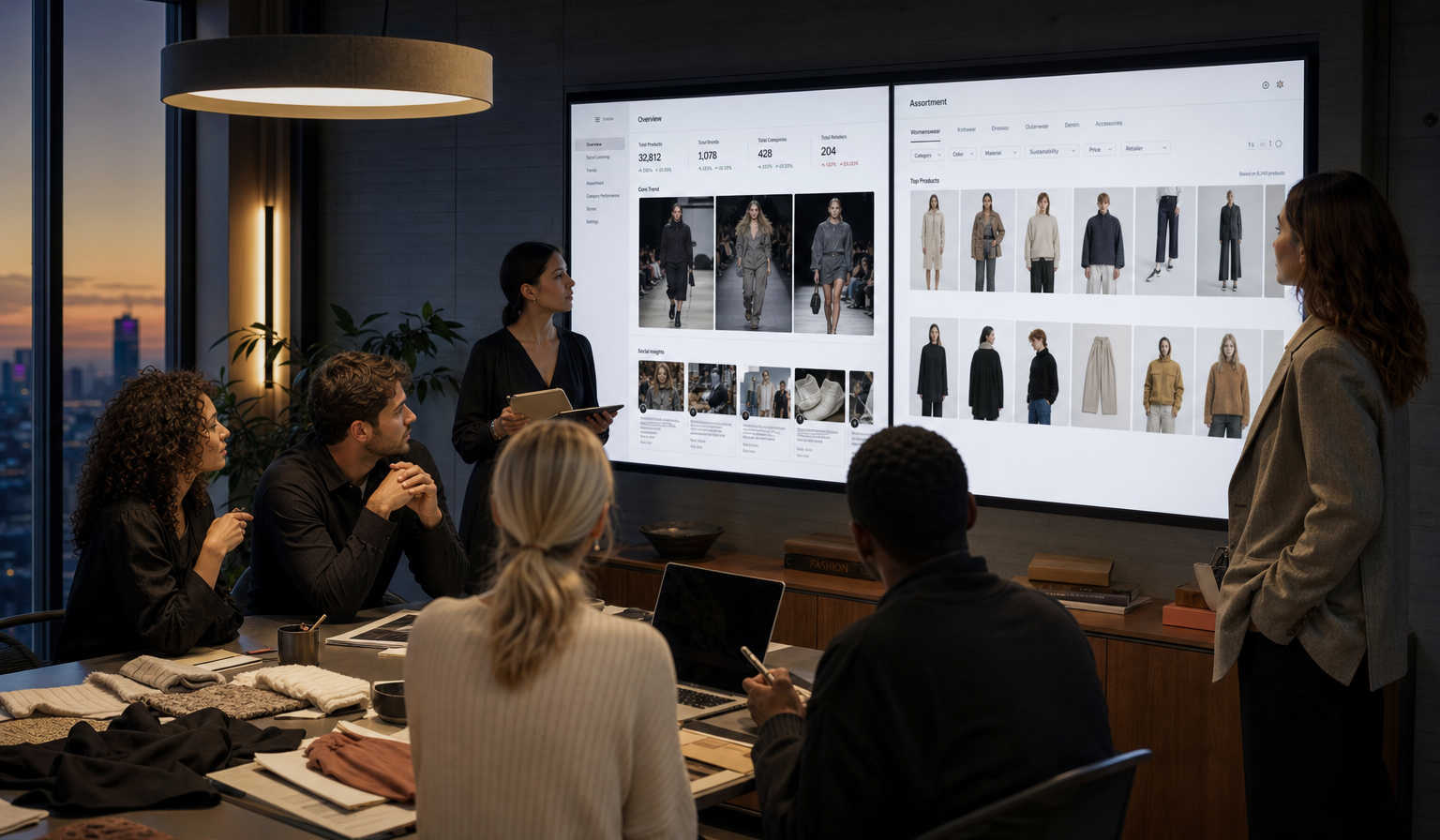
At the same time, brick-and-mortar stores still host the richest fit and styling moments—shoppers trying multiple sizes, asking associates for honest feedback, and reacting in real time to how clothes feel, move, and look. AI-powered fitting rooms, or “AI fit rooms”, are emerging as the bridge between those worlds. Instead of treating in-store try-on as a black box, smart fitting rooms capture anonymised signals about which sizes and silhouettes work for which bodies, which combinations convert, and where friction remains.
A 2026 PYMNTS analysis notes that retailers are increasingly betting on AI fitting rooms and virtual try-on to slash costly returns, particularly as online shopping makes buying and returning seamless but expensive for brands.PYMNTS For MapleSage’s Apparel, Footwear & Luxury ICPs—Fashion CMOs, E-commerce and Retail Directors, Merchandising VPs, CX Directors, and Fashion CTOs—the question is how to use AI fit rooms as part of an integrated strategy, not just a hardware showpiece. That means:
• Designing fitting-room experiences that genuinely help shoppers choose the right size and style, without feeling surveilled.
• Turning in-store try-on data into better e-commerce personalization, size curves, and merchandising decisions through SageRetail.
• Measuring impact across both store and online metrics: returns, conversion, AOV, and loyalty.
Virtual fitting room case studies already point to the opportunity. Inuberry reports that a mid-sized fashion retailer lifted conversion and reduced returns after implementing AI- and AR-powered virtual fitting rooms that let shoppers “try before they buy” digitally, improving size confidence and styling choices.
Inuberry ZegaSoftware’s AI try-on work shows similar results: more confident purchases and fewer size-related returns when shoppers see garments on realistic avatars rather than generic models.ZegaSoftware Veesual’s Eileen Fisher deployment illustrates how AI styling plus fit visualisation boosts conversion and AOV in fashion e-commerce.Veesual
This post focuses on the in-store side of that story. It explores how AFL brands can design AI fit rooms that respect shopper comfort and brand codes, capture high-quality fit and style data, and then feed that intelligence back into SageRetail to power better PDPs, recommendations, and merchandising. In short: how to turn every fitting-room session into an asset that improves both store and e-commerce performance.
Technology alone does not make a fitting room “smart.” Many early experiments failed because they treated the fitting room as a billboard for upsell rather than a safe, helpful space. For MapleSage’s AFL clients, designing AI fit rooms means putting comfort, clarity, and cultural nuance first—and then layering AI where it genuinely reduces friction. The starting point is the physical experience.
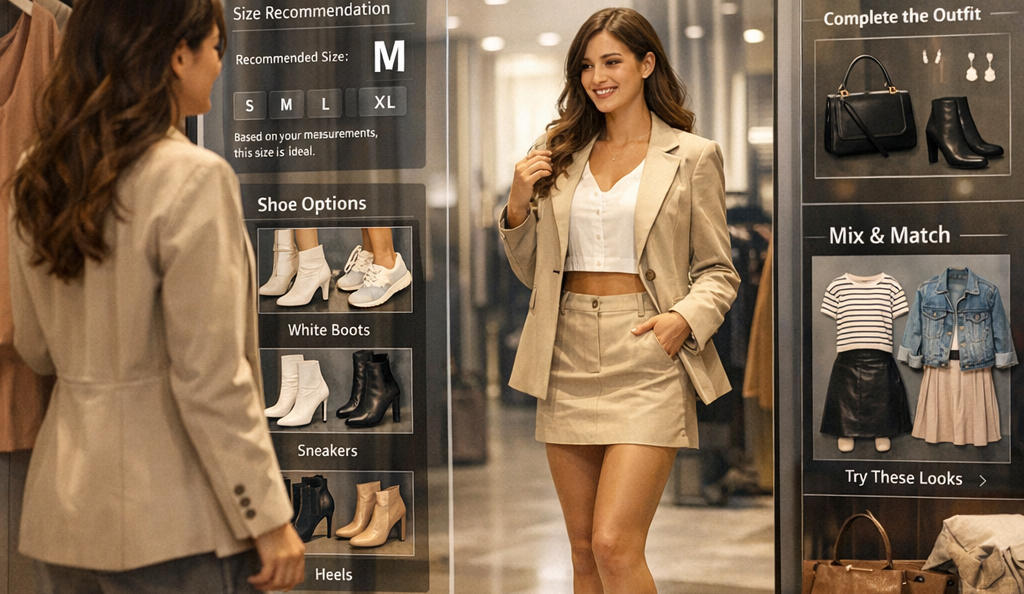
A well-designed AI fit room feels like an upgraded version of a great boutique fitting room: flattering lighting, privacy controls, simple gestures. Interactive mirrors and touchscreens should answer the questions shoppers already ask: “How does this come up in the waist?”, “Do you have this in a different size or colour?”, “What would you style this with?” Case studies from virtual fitting room vendors and retailers highlight that when shoppers are forced to fight with complicated interfaces or feel watched, adoption drops and staff end up bypassing the tech.
Inuberry AI fit rooms should therefore focus on three core workflows:
• Size and fit guidance: using SageRetail’s fit graphs, garment measurements, and returns data to suggest better sizes and alternative blocks that match how the shopper tends to keep or return pieces. Interactive mirrors can summarise fit feedback from similar shoppers in plain language (“runs narrow at the toe for wide feet”, “generous at the hip, consider a size down if in between”).
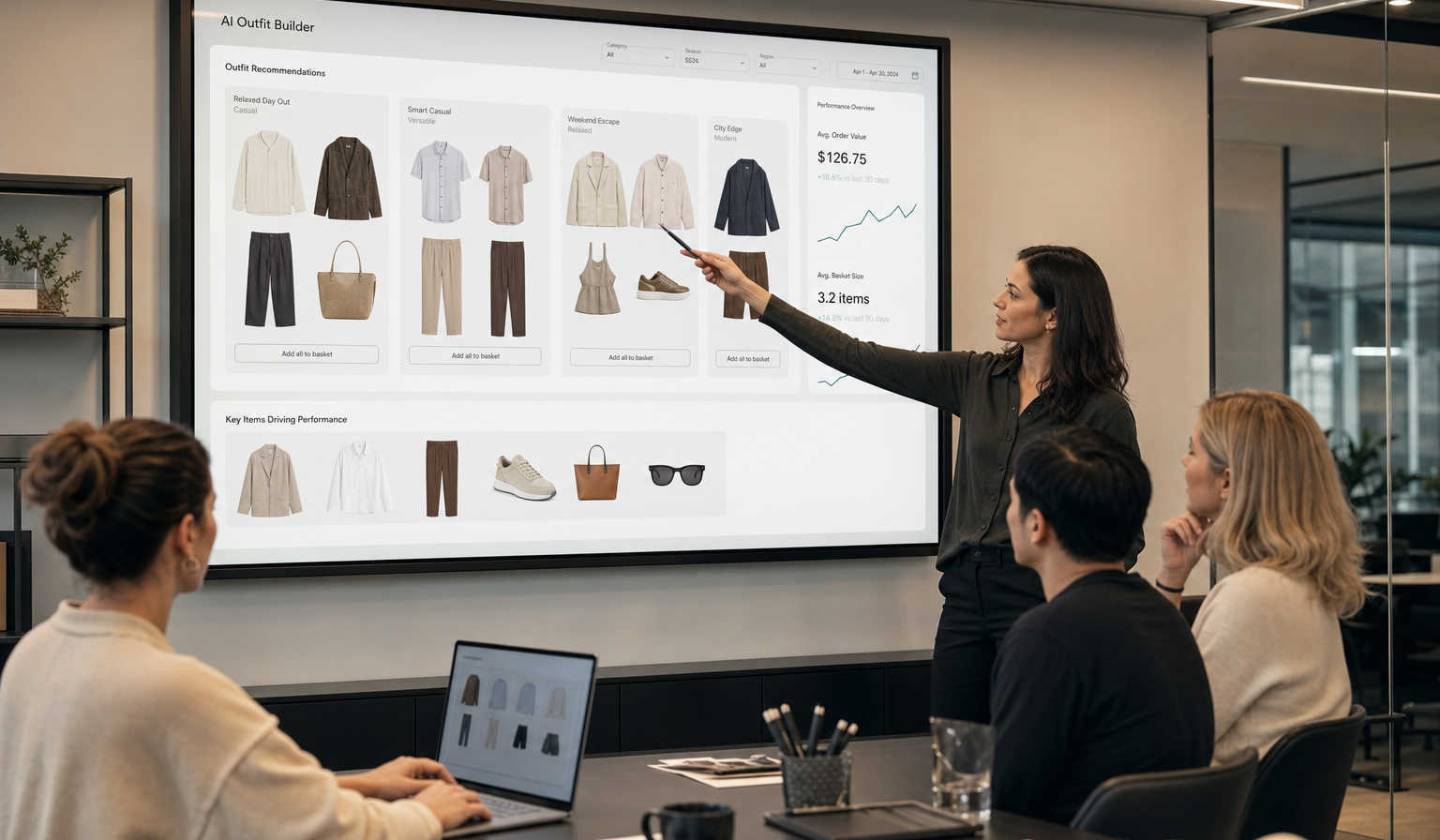
• Styling and outfit building: pulling from style graphs and PLM attributes to propose complementary items—shoes, outerwear, accessories—that respect the brand’s aesthetics and the shopper’s known preferences. Veesual’s work with Eileen Fisher, for example, shows how interactive, AI-powered outfit builders increase conversion and AOV by letting shoppers mix and match pieces in real time.Veesual
• Assistance and privacy controls: making it easy for shoppers to request a different size or item without stepping out, and to control what data (photos, measurements, past sessions) is stored. A “privacy mode” that turns off cameras when not in use and clear opt-ins for saving profiles build trust. Operationally, AI fit rooms must fit into store rhythms. Associates need quick views of which rooms need attention, what items are being tried, and which suggested alternates are in stock.
Fitting-room dashboards should be lightweight enough to glance at between tasks and should avoid over-instrumentation that makes staff feel surveilled rather than supported. Finally, cultural and segment nuances matter. In modestwear and luxury segments, mirrors and cameras may need different defaults; in some markets, shoppers prefer stylists to initiate suggestions, while in others self-service is welcome. MapleSage recommends running focus groups and pilots in diverse markets to tune UX and guardrails before scaling.
To make AI fit rooms a durable advantage, not a one-season gimmick, AFL brands need clear KPIs, disciplined experiments, and tight data integrations between store and digital. On the KPI side, Fashion CMOs, E-commerce Directors, and Merchandising VPs should monitor:
• Conversion lift for shoppers who use AI fit rooms versus those who do not
• Fit- and size-related return rates for items tried in AI-enabled rooms versus standard rooms • Attach rate and AOV for outfits built or adjusted via fit-room recommendations
• Fitting-room utilisation and satisfaction scores across segments and markets Virtual try-on and fitting-room case studies point to realistic upside. Inuberry’s AI-powered virtual fitting room project for a mid-sized fashion retailer reports higher conversion and lower returns once shoppers could “try before buy” virtually, with AR-assisted sizing and styling improving confidence.
Inuberry Veesual’s deployment for Eileen Fisher shows that combining AI styling and fitting experiences can increase conversion by 272%, boost average order value by 11%, and extend session duration by 258% when integrated thoughtfully into the journey, both on web and in-store touchpoints.Veesual
A 2026 PYMNTS report notes that retailers are betting on AI-powered fitting and virtual try-on as one of the most commercially viable ways to curb costly returns, given the logistics burden of bracketing and size-related send-backs. PYMNTS Experimentation should be staircase-based.
Phase 1: instrument current fitting rooms in a few pilot stores to capture baseline metrics—try-on to purchase conversion, time in room, return reasons for items tried on.
Phase 2: deploy AI fit capabilities in a subset of rooms and categories (for example, denim and dresses in women’s, sneakers in footwear), with clear messaging and staff training, and A/B test against traditional rooms.
Phase 3: expand capabilities (styling suggestions, appointment-based fitting, loyalty integration) and connect fit-room insights to SageRetail so that online PDPs and recommendations reflect what happens in-store.
Data integration is where MapleSage’s Campaign 2 comes in. PLM and PIM must supply accurate garment attributes; POS and store systems must stream fitting-room events; the fashion CDP must unify in-store and online profiles; and SageRetail must turn those signals into actionable style and fit graphs. With that spine, AI fit rooms stop being a standalone hardware play and become part of a broader omnichannel fit-intelligence strategy.
Governance and ethics complete the picture. Shoppers need crystal-clear information about how images, measurements, and session data are used, with options to delete or anonymise. Bias testing is essential: AI fit and styling recommendations must work equally well for all body types, sizes, and skin tones.
Cultural norms around undress, modesty, and gendered spaces must guide where and how cameras and mirrors operate. Done right, AI fit rooms do more than reduce returns. They turn trying on clothes—a deeply personal, sometimes stressful act—into a supported, intelligent experience that bridges store and screen.
For MapleSage’s AFL ICPs, that means fewer costly returns, higher conversion, richer data for buying and design, and a tangible expression of the brand’s commitment to both innovation and human-centric fashion.