How resort capsule personalization drives conversion and margin.
Why resort capsules need style-led, size‑confident journeys
Resort and cruise collections should convert like a stylist’s edit—not a generic grid. Shoppers arrive with a vibe in mind—linen sets that breathe on the plane, satin slips for sunset dinners, block-heel sandals that behave on boardwalks—and on mobile, they won’t type their way to taste. The brands that outperform turn “vibe” into a data-backed experience: a resort capsule that feels curated, explains itself, and stays size‑confident from discovery to checkout. That means style-led discovery, fit intelligence inline, and inventory-aware merchandising that respects seasonality and travel timing. Begin with product truth expressed in a fashion-grade vocabulary. In PIM, go beyond “dress, blue, polyester.”
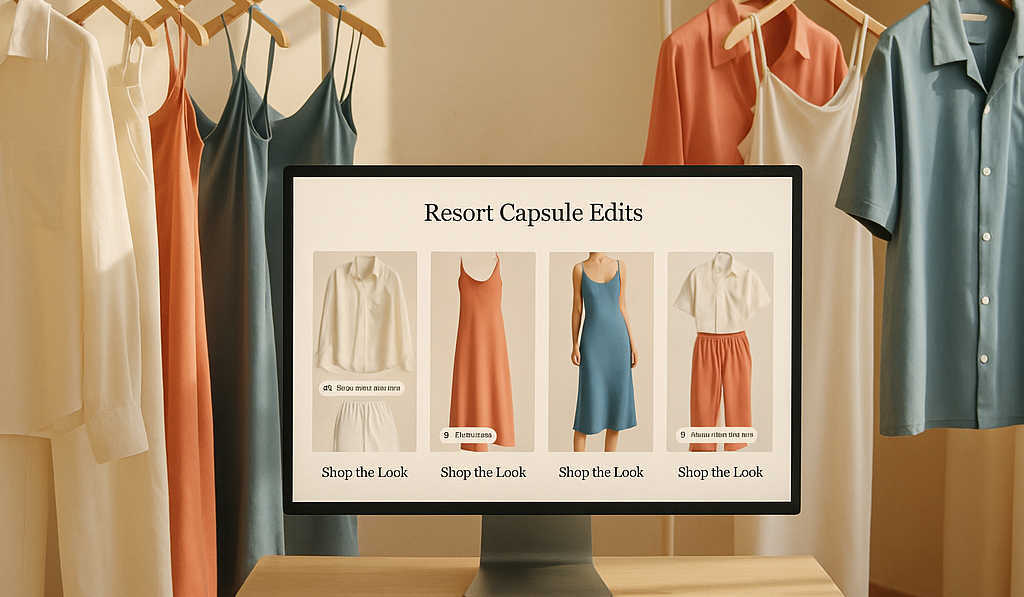
Capture silhouettes (slip, column, wrap), lengths and rises (midi/maxi; mid/high-rise), necklines/sleeves (halter, cowl, sleeveless), fabric composition and stretch % (linen blends, viscose satin), footwear toe/heel shapes, hardware tones, and palette families (off‑white, coral, ocean blue). Map PLM’s technical truth (pattern blocks, fabric codes) into that spine so search facets, “Shop the Look,” and emails speak one language. With this foundation, your engine can justify every suggestion: “paired for column silhouette and satin finish,” “lower heel for inseam balance,” “warmer tone to match saved looks.” Make discovery visual and mobile-first. Replace blank boxes with a personalized style feed that opens on resort edits. Present complete looks—hero garment plus sandals, bag, and light layer—so AOV climbs through outfit completion, not generic cross-sells. Carry a single, confident size badge into the card and PDP to curb bracketing. Evidence consistently shows that mobile and visual discovery dominate fashion e‑commerce journeys; for a commerce baseline, see Shopify.
On PDP, use on‑model images across sizes and short video to show drape, especially for satin and linen where movement sells. Baymard’s research summarizes the PDP patterns that raise confidence at the moment of choice: Baymard. Resort economics reward precision. Demand is spiky, travel windows are fixed, and margin evaporates with late markdowns. Macro outlooks underline uneven demand and value-seeking behavior; see the BoF x McKinsey State of Fashion overview at Business of Fashion and the full collection at McKinsey. Translate that into rails: pre‑orders and waitlists to capture intent before buy plans lock; localized assortments for resort hubs; and post‑purchase styling (“wear it three ways”) to reduce change‑of‑mind returns. Done tastefully—editorial restraint for luxury, energetic clarity for contemporary—resort capsules convert without racing to discounts.
Design resort capsules: data spine, UX, and lifecycle moments
Personalization that sells resort capsules starts upstream with fashion-grade data and travels through every touchpoint. Treat the capsule like a coherent world—silhouettes, palettes, fabrics, and occasions that make sense together—and wire your stack so it can explain why each suggestion belongs. In practice, that means a product attribute spine beyond category and color: silhouettes (slip, column, wide-leg, tie-waist), lengths and rises (midi, maxi; mid-rise, high-rise), necklines and sleeves (halter, cowl, sleeveless), fabric composition and stretch %, palette with beach-forward tones (off-white, coral, ocean blue), and accessories with toe/heel shapes and hardware tones. Make these first-class fields in PIM, not prose.
Map PLM truth (pattern blocks, fabric codes) into the same vocabulary so studio, search, email, and clienteling speak one language. With that foundation, every recommendation can carry a simple reason code: “paired for column silhouette and satin finish,” “lower heel for boardwalk comfort,” “warmer tone for your saved looks.” Render the experience where resort intent lives: mobile, social-to-shop, and email. Replace blank search with a visual style feed that opens with resort edits—“Sunset Dinner Capsule,” “Seaside Morning,” “Travel Day Layers.” Each card should preview a complete look and carry a single size recommendation for the hero piece to curb bracketing. Outfit completion should be palette- and fabric-aware so sandals echo metallics and straps, and clutches match hardware tones. For industry baselines on why visual discovery and mobile-first UI win in fashion e‑commerce, review Shopify. For evidence-based PDP patterns that raise confidence at the point of decision, see Baymard. Lifecycle moments matter for capsules that sell out quickly.
Use style-led welcome flows to introduce seasonal edits; send back‑in‑stock alerts that are style‑aware and size‑confident when a sought-after slip returns; and follow purchase with “wear it three ways” content tuned to the buyer’s style profile (e.g., dinner, poolside cover-up, day trip). Keep luxury and contemporary tones distinct—editorial restraint for luxury with concierge options (reserve in boutique, alterations), energetic clarity for contemporary with price bands. Macro volatility and value-seeking behavior make precision in CX and merchandising a profit lever in 2025; see the BoF x McKinsey overview at Business of Fashion and the full collection at McKinsey.
Operate playbooks: KPIs, tests, and inventory guardrails
Operate the resort program like a product with evidence and guardrails. Define outcome KPIs that tie to journey nodes and P&L: style-feed → PDP → add-to-cart rate, AOV and units-per-transaction from outfit completion, multi-size order share, return-rate delta on orders influenced by size badges, and sell-through velocity by capsule. Segment by segment (luxury vs. contemporary) and geography (sun-belt vs. temperate markets) because economics and climate differ.
Attribute lift only to shoppers who actually saw personalized blocks—not to channel averages. Design disciplined experiments. Start with two capsules in two regions. Use randomized control at the session/user level where feasible; otherwise run matched cohorts with pre‑registered stop‑loss thresholds (unsubscribe spikes, save‑rate dips). Test levers that reflect resort realities: palette emphasis (off-white vs. ocean blue), footwear heel height guidance, and packable fabric cues. Publish weekly readouts reconciling incremental revenue and returns reduction with creative and integration costs. Pair outcome KPIs with technical SLOs: P95 <300 ms for personalization blocks and outfit retrieval; near‑real‑time inventory sync so “in stock” is true; low error rates.
Treat privacy as a performance feature—evaluate consent at activation and minimize PII in payloads. Keep inventory discipline. Prefer in‑stock complements and avoid suggesting scarce sizes in core resort items. Use pre‑orders and waitlists to capture demand for replenishments without over‑buying; practical guidance on waitlists and back‑in‑stock programs is available via Shopify Help. For trend signals on silhouettes and palettes that calibrate capsules, see Heuritech. When style and fit reassurance travel together from grid to PDP to post‑purchase, resort capsules sell at full price—and the returns truck comes less often.