A practical blueprint to wire PLM→PIM→PDP so style feeds are fast, explainable, and profitable.
Why data pipelines make or break style feeds
Style feeds win or lose on data, not just design. If your catalog only knows “dress, black, polyester,” no engine can assemble a coherent look, explain why items pair, or recommend a confident size alternate. Fashion brands need a data spine that merchandisers trust and machines can use—then a clean pipeline that moves that truth from design to PDP without getting lost. This post is a blueprint to wire PLM→PIM→PDP so personalized discovery feels like a stylist, not a search box.
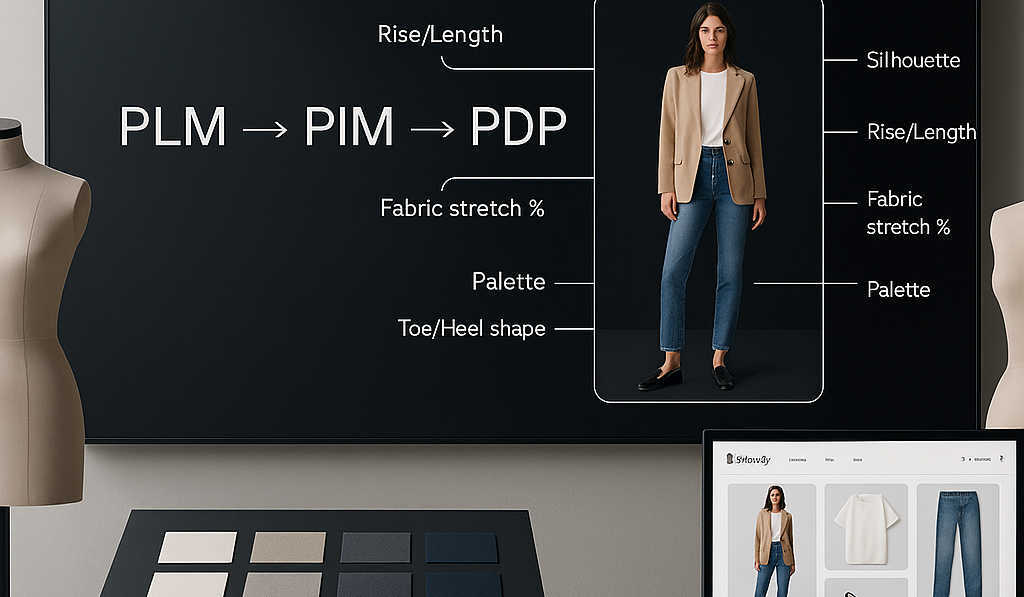
Start with business stakes. Visual‑first, mobile‑led journeys dominate fashion today; shoppers expect to land on a feed that reflects their taste and size—not a blank search box. The economics are real: better discovery and fit clarity raise conversion and AOV while reducing returns. Industry reports synthesize the pressure to get this right in 2025; see State of Fashion 2025. The most common failure mode we see is a decoupled front end without an attribute spine. Beautiful screens, generic data. Design the spine first. In PIM, make silhouettes (A‑line, bias, bodycon; wide‑leg vs. straight), rises and lengths, necklines and sleeves, toe/heel shapes, fabric composition and stretch %, palette families, and occasion first‑class fields. Map PLM’s technical truth—pattern blocks, materials, approvals—into those fields so the vocabulary is shared from studio to storefront.
Treat photography as data: tag finish (satin/matte), drape, strap width, hardware tone so visual search and “shop the look” can match taste. With this in place, recommendations can carry simple reason codes (“paired for column silhouette and satin finish”) that build trust and reduce “change‑of‑mind” returns. For platform context on headless and why it’s popular in fashion, review Shopify and a representative case at TASCHEN.
Design PLM–PIM–storefront integration for fashion
Treat integration as a relay, not a hail‑Mary. PLM is the technical source of truth (pattern blocks, materials, approvals). On key milestones, PLM emits an event that creates/updates items in PIM. PIM is where consumer‑facing attributes live: silhouettes (A‑line, bias, wide‑leg), rises and lengths, necklines and sleeves, toe/heel shapes, fabric composition and stretch %, palette families, occasion, and care. Photography is data too: tag finish (satin/matte), drape, strap width, and hardware tone so visual retrieval and “shop the look” can match taste. Keep these fields structured, controlled, and multilingual where needed.
For clear roles and handoffs, review Centric and PLM scope at Centric PLM. Expose this spine to personalization/search on day one. Don’t ship a headless front end without the data layer it needs. Whether you run native themes or Hydrogen/Next.js, the service that ranks cards in the style feed must consume the same vocabulary your merch team uses. Every recommendation should carry a reason code aligned to brand voice—“paired for column silhouette and satin finish,” “similar wide‑leg with 2% stretch.” For a pragmatic headless context and why brands decouple UI from commerce while keeping checkout coherent, see Shopify’s primers: Shopify headless and a representative case study at TASCHEN. Performance is product.
Target P95 <300 ms for style‑feed updates and recommendation blocks, aggressive image budgets that preserve fabric detail on mobile, and freshness SLAs so new drops are fully enriched within hours, not days. Publish contract tests between PLM→PIM and PIM→storefront APIs so schema changes don’t silently break search or personalization. Keep privacy a performance feature: evaluate consent at activation for any personalized block, minimize PII in payloads, and constrain retrieval to minimal context (style cluster, size band, budget).
Operate with KPIs, SLOs, and governance
Operate the pipeline with a scoreboard and governance that merchandisers trust. Outcome KPIs: search/feed→PDP rate; time‑to‑first‑add on mobile; attach rate from outfit completion; AOV and units per transaction; and return‑rate delta where size/fit badges appear.
Data KPIs: attribute coverage across the spine (% SKUs with silhouettes, rises/lengths, necklines/sleeves, fabric stretch %, palette, toe/heel shapes); time‑to‑enrichment for new SKUs; and error rates in attribute extraction (esp. for computer‑vision‑assisted tagging). Technical SLOs: P95 latency for results, job runtimes for enrichment, and freshness SLAs (e.g., “new drop enriched in ≤4 hours”). Run staircase rollouts and publish a changelog. Start with two categories (dresses and sneakers) in two markets. Prefer randomized control at session/user level; otherwise matched cohorts with stop‑loss thresholds (bounce spikes, save‑rate dips). Attribute lift at the node, not channel.
Maintain an immutable decision log for personalized elements (inputs, reason codes, outcome) so tuning and audits are straightforward. Use macro context in leadership decks to keep urgency: the State of Fashion 2025 underscores uneven demand and value‑seeking; brands that connect PLM, PIM, and storefront data move faster and discount less. Tie results to merchandising calendars and content shoots so the spine steers creative, not just filters. When your data pipes and product truth travel intact to the PDP and the style feed, personalization stops guessing—and starts styling.