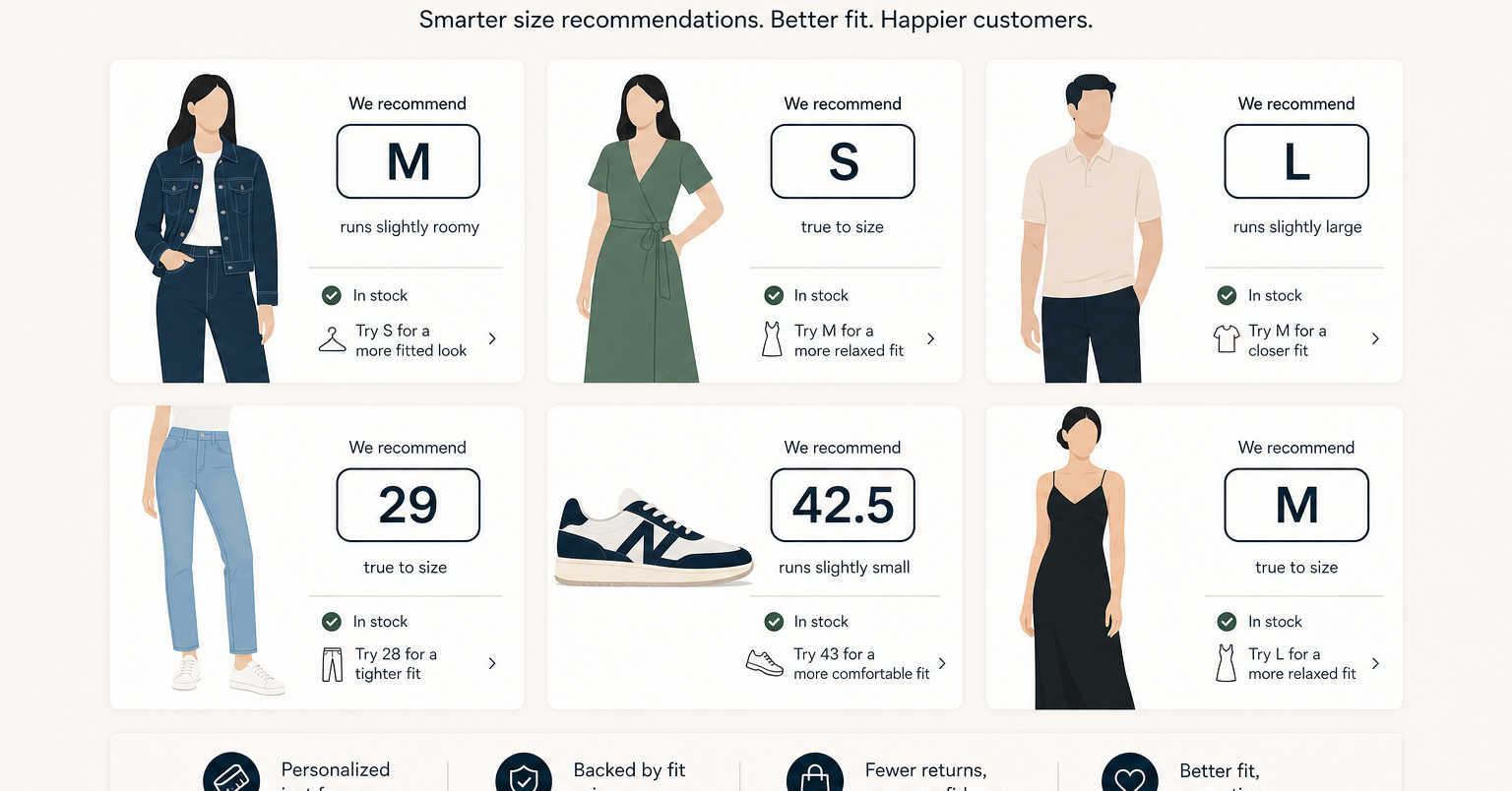
Inline size badges on listing pages cut bracketing and returns while lifting conversion.
Why inline size guidance on grids cuts returns
Fashion returns are expensive not only in reverse logistics but in loyalty. The fastest way to shrink them is to stop “just in case” multi‑size orders—bracketing—before they start. Inline size guidance on listing pages and collection grids does exactly that. When every card calmly carries one recommended size, shoppers move forward with confidence, not duplication. Conversion rises on mobile where typing and tabbing are frictions, and return rates fall because uncertainty is addressed at first glance. Begin with the shopper’s reality. On social‑led, mobile journeys, customers arrive with a vibe—silhouette, palette, occasion—not a SKU. They scan grids, not spec tables. A size badge on the card eliminates the “I’ll add three sizes and decide later” reflex, especially in high‑return categories like denim, dresses, and sneakers. The badge should be a single, confident suggestion (“We recommend 28/30,” “Try 42.5”) in a tone that matches the brand—editorial restraint for luxury, energetic clarity for contemporary and athletic. For macro context on how uneven demand and cost pressure make returns reduction a priority, see the industry backbone report State of Fashion 2025. Carry confidence through the journey. When a shopper taps a card, the PDP should reaffirm the same recommendation above the fold and provide a short rationale (“this cut runs slightly roomy; 2% stretch”). Pair it with on‑model images across sizes and a short video to show drape—Baymard’s research outlines why these patterns raise conversion and reduce returns: Baymard. On the grid and PDP, add a small, tasteful outfit strip so baskets grow via coherent accessories rather than random cross‑sells. For a commerce baseline on why visual discovery dominates and why performance matters, review Shopify. Inventory reality must be explicit. If the recommended size is constrained, show truthful availability and propose one nearby alternate (“similar block, slightly more stretch”). For footwear, include last shape and width in the reasoning (“runs narrow at forefoot”). When confidence is low, route to elegant fallbacks: boutique appointment for luxury, try‑on kits for premium segments, or lightweight virtual try‑on for silhouette assessment. The aim is a journey that feels like a stylist—fast, visual, and calm—so customers order one size the first time.
Design size badges for fashion: data and UX
Great size guidance is won upstream, rendered in milliseconds, and measured like a product. Start with product truth a stylist would trust, not generic tables. Encode SKU‑level attributes that actually change comfort and silhouette: pattern block IDs, rise and inseam pairs, fabric composition and stretch percentage (e.g., 2% elastane vs. rigid satin), garment ease at bust/waist/hip, and for footwear, last shape and width. Treat these as first‑class fields in your PIM so they flow cleanly to search, recommendations, and the UI. Map PLM’s technical truth (materials, blocks, approvals) into the same vocabulary so studio, PDP copy, and sizing intelligence speak one language. A quick primer on why PLM and PIM need to work together in fashion is here: Centric and Centric PLM. Badge design should feel like a stylist, not a calculator. Place a single, confident recommendation on each product card—“We recommend M” or “Try 42.5”—with a short reason code where space allows (“runs slightly roomy”). Keep it calm and premium; avoid neon urgency. When the shopper opens the PDP, show the same recommendation above the fold with a slightly longer rationale and a link to sizing notes. Carry the badge into cart and quietly flag duplicate sizes to curb bracketing. Evidence keeps piling up that resolving fit and expectation gaps at the moment of choice reduces returns and raises conversion; for apparel macro context and the cost of returns, see McKinsey’s industry work: State of Fashion 2025. For evidence‑based PDP patterns that pair well with size guidance (on‑model images, fit subscores), review Baymard. The model should prefer clarity over false precision. Borrow learning from siblings (same block, brand, fabric) to handle cold‑start SKUs, correct historical sales for stockouts so empty shelves aren’t read as “low demand,” and ingest returns reasons with granular tags (“too tight in thigh,” “heel slips”) to avoid repeating mistakes. Emit one recommended size with a confidence band; when confidence is low, offer a dignified step‑down: virtual try‑on for silhouette, boutique appointment, or a home try kit for premium tiers. Finally, keep latency sub‑300 ms for recommendations and outfit retrieval—on mobile, performance is product. Platform primers on fashion discovery and mobile reality are here: Shopify.
Operate with KPIs, tests, and guardrails
Treat grid size badges like any revenue feature: prove the lift and publish the limits. Define outcome KPIs that tie directly to the behaviors you’re trying to change: multi‑size order share (should fall), PDP view‑to‑add rate (should rise), return‑rate delta on influenced orders (should fall), and exchange vs. refund mix (exchanges should increase where fit guidance is visible). Attribute at the node, not the channel—“grid badge viewed → fewer duplicate sizes in cart”—so you don’t over‑credit. Run staircase rollouts. Start with two high‑return categories (denim and sneakers) and social‑led mobile traffic where hesitation is highest. Prefer randomized control at session or user level; otherwise, use matched cohorts with pre‑registered stop‑loss thresholds (bounce spikes, save‑rate dips). Pair outcome KPIs with technical SLOs: P95 <300 ms for badge rendering, near‑real‑time inventory sync so availability labels are true, and low error budgets. Publish weekly readouts that reconcile incremental revenue and reduced reverse‑logistics costs with creative and integration spend. Keep guardrails for brand and privacy. Luxury needs editorial restraint and concierge options (“reserve in boutique,” “alterations”), while contemporary can use energetic clarity with price bands. Evaluate consent at activation for any personalized block; minimize PII in payloads; and keep retrieval boundaries tight (style cluster, size band, budget) to lower latency and risk. Maintain an immutable decision log (inputs, reason codes, outcome) so merchandising, data science, and care can audit and tune. For macro context on why precision CX matters now, see State of Fashion 2025, and for PDP dependencies that often ride with size badges, Baymard’s patterns at Baymard. With tasteful, explainable badges on the grid, you reduce bracketing at the source—and keep revenue you used to refund.