#FashionInnovation
#DigitalFashion
#FashionEcommerce

How Gen Z fashion trends and AI style feeds reshape mobile discovery, conversion, and loyalty for AFL brands.
Gen Z is the primary growth engine of the global fashion market, and their shopping behaviors are forcing Apparel, Footwear & Luxury (AFL) brands to rethink mobile commerce from the ground up. Where older cohorts still tolerate keyword search bars, static grids, and generic email blasts, Gen Z expects personalized feeds, creator-led storytelling, and AI assistance that feels as natural and intuitive as scrolling TikTok or Instagram Reels.
For MapleSage’s AFL clients, this shift is a fundamental commercial reality. It directly dictates mobile conversion rates, Customer Acquisition Cost (CAC) payback periods, and long-term Customer Lifetime Value (CLV).
Recent empirical research paints an unambiguous picture of this landscape:
For MapleSage’s Ideal Customer Profiles (ICPs)—Fashion CMOs, E-commerce Directors, CX Directors, and Fashion CTOs—the mandate is clear: owned mobile experiences cannot simply shrink desktop product listing pages (PLPs) onto a 6-inch screen. They must behave like intelligent, AI-powered style feeds that natively understand Gen Z missions (e.g., festival weekends, Ramadan Iftars, campus life, hybrid work) and style tribes (e.g., quiet luxury, streetwear, Y2K revival, modestwear, gorpcore).
The following chart illustrates the behavioral divide driving the adoption of AI style feeds in 2026–2027:.webp?width=1408&height=768&name=Gemini_Generated_Image_p6pyqvp6pyqvp6py%20(1).webp)
| Architectural Dimension | Legacy Mobile E-Commerce (PLPs & Grids) | AI-Powered Style Feeds (SageRetail) |
| Primary Discovery Interface | Keyword search bar, hierarchical navigation menus, static 2x2 grids. | Algorithmic, vertical-scroll infinite feeds, swipeable outfit cards, and video rails. |
| Data Ingestion Engine | Basic SKU metadata, manual tagging, and historical category browsing. | PLM (silhouettes, blocks, fabrics), PIM, CDP, live intent, and returns telemetry. |
| Personalization Logic | "Collaborative filtering" ("People who bought X also bought Y"). | Per-shopper Style Graphs mapping missions, micro-moods, price bands, and fit realities. |
| Search Modality | Exact-match text queries; high friction for complex aesthetic intent. | Multimodal: Visual search ("Shop the screenshot"), natural language chat, and aesthetic tagging. |
| Fit & Return Mitigation | Static size charts and post-purchase review text. | Predictive size-confidence badges ("90% of shoppers with your profile kept this size"). |
| Brand Relationship | Transactional; high churn and one-off discount-driven purchases. | Continuous, highly associative loyalty loop built on cultural relevance and curation. |
Gen Z does not browse fashion systematically; they experience it algorithmically. Having grown up with TikTok’s For You Page and Spotify’s personalized mixes, their baseline expectation for digital discovery is visual, frictionless, and acutely tuned to micro-moods. Typing complex queries into a mobile search bar feels obsolete to a cohort accustomed to zero-click discovery.
To capture this audience without sacrificing margin, AFL brands must orchestrate a seamless loop between social inspiration and owned-channel conversion. This is where SageRetail, MapleSage’s decisioning layer, bridges the gap.
Rather than relying solely on superficial clickstream data, SageRetail constructs a multi-dimensional Style Graph for every individual user by unifying siloed enterprise data:
For example, SageRetail recognizes that a GCC modestwear shopper consistently keeps wide-leg trousers and midi dresses with specific necklines, while a US Gen Z festival shopper frequently interacts with distressed denim, mesh layering, and bold color blocking. The feed dynamically re-sorts itself in milliseconds to prioritize outfits that match both the aesthetic mission and the shopper's historical keep-rate silhouette.
To match the fluidity of social platforms, SageRetail replaces static UX with intuitive, modern entry points:
Treating AI style feeds as a superficial frontend gimmick leaves massive commercial value on the table. For Fashion CMOs and E-commerce Directors, the goal is to operate these feeds as a closed-loop loyalty and merchandising engine that directly impacts P&L and Customer Lifetime Value.
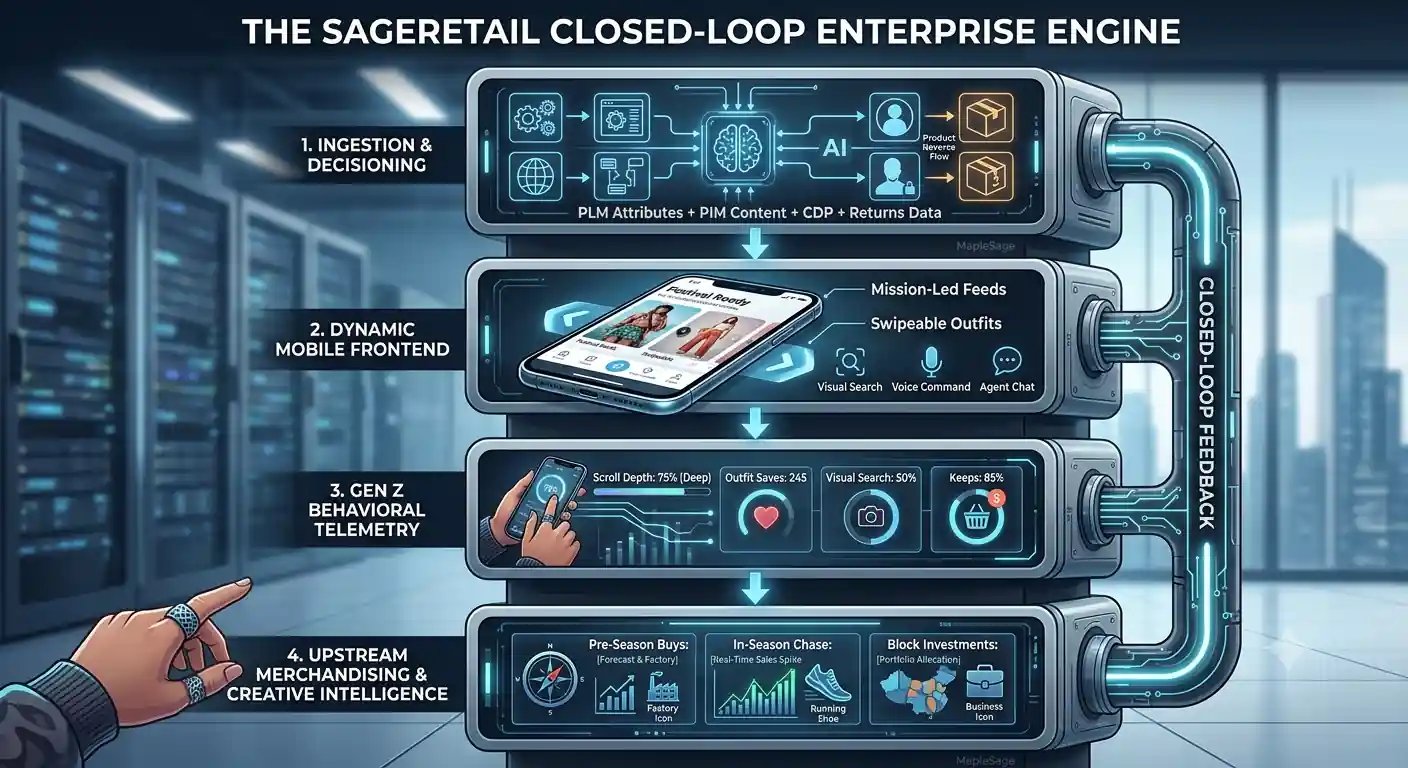
To accurately measure the ROI of SageRetail style feeds, AFL brands must track post-return metrics segmented by age band and style tribe:
Every swipe, save, and return decision within a SageRetail feed acts as a real-time focus group. Merchandising and planning teams can extract these behavioral telemetry logs to answer critical supply chain questions:
To maintain brand equity and governance over algorithmic outputs, forward-thinking AFL enterprises are establishing cross-functional Next-Gen Councils spanning Brand, Digital, Merchandising, Data, and Legal.
This council sets the guardrails for SageRetail’s decisioning logic. It dictates where the algorithm should enjoy creative freedom (e.g., fast-cycling streetwear or seasonal festival edits) versus where strict editorial curation is required (e.g., heritage luxury lines or formal occasionwear). Furthermore, because SageRetail operates on an explainable AI framework—telling shoppers why a look was served ("Curated because you kept similar relaxed-fit silhouettes last season"—the council can easily audit algorithmic recommendations to ensure alignment with brand diversity, inclusivity, and sustainability commitments.
For MapleSage’s active enterprise campaigns, this operational shift sits at the convergence of AI Personalization for Fashion Customer Loyalty and Fashion E-commerce Conversion Through AI.
With search interest in terms like "Gen Z fashion trends" and "AI fashion shopping" surging across enterprise retail sectors, brands that continue to rely on static, desktop-first mobile architectures will face rising customer acquisition costs and eroding margins. By deploying SageRetail to transform owned mobile channels into intelligent, mission-driven style feeds, AFL leaders turn the fragmented, fast-moving expectations of Gen Z into a structured, compounding competitive advantage.