FashionForward
#FashionAI
LuxuryFashion
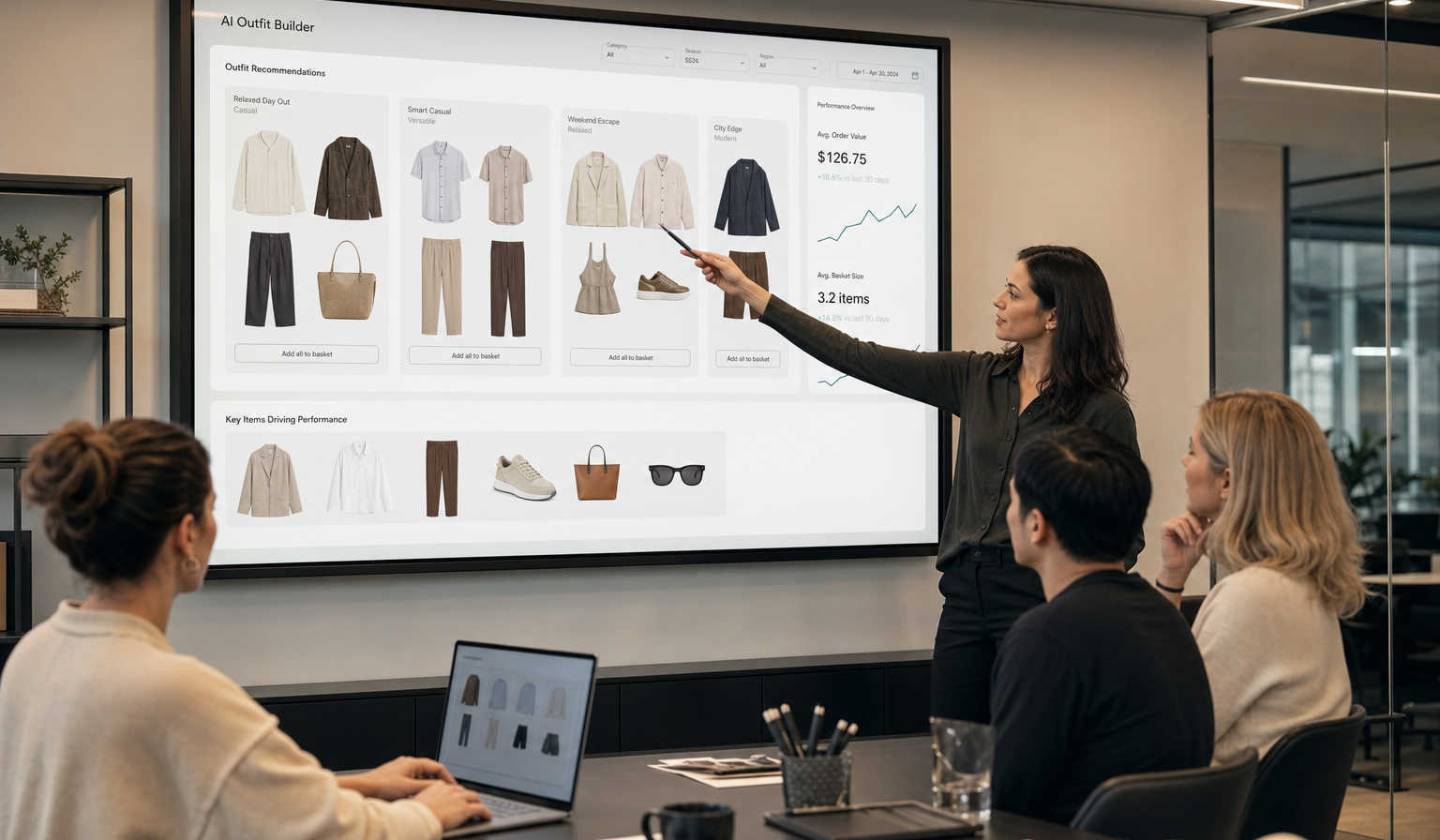

How AFL brands use AI outfit builders to grow AOV, units per transaction, and loyalty through mission-led, style- and fit-aware outfits.
Apparel, Footwear & Luxury ecommerce has spent a decade optimising individual product pages, but most shoppers don’t wake up wanting a single SKU—they want an outfit that solves a mission. The brands winning share are those that help customers go from vague intent (“I need something for a Ramadan iftar,” “I want a new trail running kit”) to a complete look, fast. AI outfit builders—engines that assemble full looks across categories in response to context and conversation—are emerging as one of the most powerful tools to close that gap. Search and market signals show why this is a high-ROI opportunity. While standalone terms like “fashion outfit builder” have modest direct volume, broader queries around “ai fashion stylist” carry measurable interest, and related queries show rising curiosity about personalised shopping and styling apps. Semrush data points to hundreds of monthly US searches across “ai fashion stylist,” “ai stylist app,” and “personalized shopping,” with keyword difficulty in a range that is achievable for a focused AFL thought-leadership strategy. Semrush – AI Fashion Stylist & Personalized Shopping Keywords Combined with evergreen demand for “what to wear” and “complete the look” searches, this suggests a growing pool of shoppers—and digital leaders—looking for AI support that thinks in outfits, not SKUs. Ecommerce case studies hint at the upside when discovery becomes outfit-led. Stylitics, a leader in outfitting, has documented how outfitting and bundling across the journey—Shop the Look, Complete the Look, and Styled for You—drive higher units per transaction and bigger baskets as customers add full outfits rather than single items. Stylitics – DTLR Outfit-Based Discovery Case Study Rappit’s 2026 case study on Dutch fashion retailer Omoda shows how launching a GenAI-powered “AI stylist” lifted conversion by 2.5x, increased revenue by over 30% without adding headcount, and cut mispicked orders by 40%, illustrating how conversational styling and outfit guidance can reshape the P&L. Rappit – Omoda GenAI Stylist Case Study For MapleSage’s AFL ICPs—E-commerce Directors, Fashion CMOs, Merchandising VPs, CX leaders and Fashion CTOs—this creates a clear Campaign 4 opportunity: use MapleSage’s SageRetail platform to make AI outfit builders the default way shoppers interact with your assortment. Instead of scrolling endless grids, visitors should see mission-led rails—Ramadan iftar, quiet-luxury officewear, on-the-go athleisure, performance running kits—filled with complete outfits that balance style, fit confidence and commercial goals like sell-through and margin. In that world, outfit builders are not a side feature; they are the front door to a more profitable, style-led ecommerce model.
Designing an AI outfit builder that actually works for Apparel, Footwear & Luxury means going beyond generic “you might also like” carousels. The experience has to feel like a stylist building a rail for a specific mission, not an algorithm dumping loosely related products onto a page. That starts with fashion-literate data, continues with UX that respects how people put looks together, and ends with merchandising rules that protect brand codes and margins. On the data side, PLM and PIM are your raw materials. Most AFL brands already encode silhouettes, rises and inseams, lasts, fabrics, palettes, dress codes, sustainability flags, and capsule structures. When those attributes are cleaned and mapped to orders, returns, and engagement signals, they become the vocabulary of an outfit graph: which tops pair with which bottoms, which sneakers or heels fit the vibe, which outerwear and accessories complete a look for a given climate and occasion. SageRetail sits on top of that graph, learning not only what sells, but what gets bought together and kept together. Case studies from across retail show what happens when AI recommends outfits, not one-offs. Stylitics’ 2026 case study with sneaker and streetwear retailer DTLR describes how rolling out outfit-based discovery across the journey—shop the look, complete the look, and styled-for-you modules—drove higher engagement and bigger baskets as shoppers added full outfits rather than single SKUs. Stylitics – DTLR Outfit-Based Discovery Case Study GoML’s 2025 case study on Modamia, a modern fashion retailer, explains how implementing an AI fashion personalization engine that lets shoppers design outfits to suit their body type and occasion transformed engagement and conversions by making it easier to visualise complete looks instead of isolated garments. GoML – Modamia AI Fashion Personalization Case Study Rappit’s 2026 write-up on Dutch fashion retailer Omoda shows how launching a GenAI-powered AI stylist increased conversion by 2.5x, grew revenue more than 30% without adding headcount, and cut mispicked orders by 40% by recommending cohesive, head-to-toe looks rather than single SKUs. Rappit – Omoda GenAI Stylist Case Study For MapleSage’s AFL ICPs—E-commerce Directors, Fashion CMOs, CX leads and Fashion CTOs—the implication is clear: the most powerful AI outfit builders won’t live in a single widget. They will be threaded through PDPs, PLPs, carts, and apps as style feeds, mission-based bundles and conversational stylists. UX patterns should feel as natural as scrolling a TikTok feed: swipeable outfit cards with inline size-confidence hints, quick toggles for dress code or weather, and “shop your closet” options that let shoppers anchor outfits around pieces they already own. MapleSage’s SageRetail can power this by reading PLM attributes and behaviour to propose looks that reflect brand codes, local climate, cultural moments such as Ramadan and Eid, and each shopper’s evolving style tribe. Critically, fit can’t be an afterthought. An outfit builder that proposes wide-leg trousers to someone who keeps returning that block will drive returns and erode trust. By joining outfit intelligence with fit graphs—what keeps and what comes back by size, silhouette, and tribe—SageRetail can quietly steer shoppers toward silhouettes and combinations with higher keep rates. Over time, the system learns which looks deliver both delight and low return risk for each profile and surface, letting merchandisers prioritise bundles and campaigns that create profitable, long-term relationships, not just big one-off baskets.
Treating AI outfit builders as a growth engine rather than an isolated UX experiment requires disciplined KPIs, governance, and a roadmap that ties styling decisions to P&L outcomes. Without that structure, even the best AI-powered experiences risk turning into expensive novelties. On the KPI side, E-commerce Directors, Fashion CMOs, Merchandising VPs, and CFOs should measure more than just click-through. At minimum, they should track: • Average order value and units per transaction for sessions exposed to outfit builders versus control journeys. • Attach rates for key categories (denim with tops, dresses with footwear, activewear with outerwear) where outfit-based merchandising should move the needle. • Net revenue after returns, with a specific lens on size- and fit-related returns for multi-item baskets coming from outfit builders. • Category breadth and CLV for customers who frequently buy via outfits compared with single-SKU shoppers. External benchmarks help set ambition. Agentmelt’s 2026 case study of a mid-size fashion brand using an AI ecommerce agent—combining product recommendations with size guidance—reports a 22% increase in average order value and a 35% reduction in returns, showing how powerful combined styling and fit intelligence can be. Agentmelt – AI Ecommerce Agent Fashion Case Study Wizzy.ai’s 2026 article on mobile product discovery trends reports that Gen Z now drives around 40% of global ecommerce traffic and that clients who master mobile-first, visual discovery journeys can recover 25–30% of otherwise lost carts, underscoring the importance of outfit-led mobile shopping experiences. Wizzy.ai – Mobile Product Discovery Trends for Gen Z Stylitics’ DTLR case study similarly shows that outfit-based discovery drives higher engagement and basket size compared with single-SKU merchandising across the shopping journey. Stylitics – DTLR Outfit-Based Discovery Case Study For MapleSage’s Campaign 4 (“Fashion E-commerce Conversion Through AI”), the roadmap typically unfolds in three phases. Phase 1 adds simple “complete the look” recommendations on PDPs and in carts, driven by SageRetail’s product graph and filtered by PLM attributes, with A/B tests focused on AOV and net revenue after returns. Phase 2 launches richer experiences—feed-like outfit discovery on home and PLP, mission-based bundles for events like Ramadan, Eid, weddings and back-to-office, and conversational AI that builds outfits from natural-language prompts. Phase 3 closes the loop by feeding outfit performance back into merchandising and design: silhouettes and bundles with high keep rates and CLV influence capsule planning, size curves and marketing storytelling. Governance should sit with an “outfitting council” that includes Merchandising, CX, E-commerce and Brand. This group owns rules around on-brand looks, margin thresholds for bundles, and guardrails for when AI can flex beyond default merchandising (for example, more experimentation in contemporary and athleisure, tighter controls in luxury). With this structure, AI outfit builders stop being a nice-to-have widget and become a disciplined lever for AOV, CLV and differentiated CX in AFL.