Build an exchanges‑first flow that preserves revenue and loyalty.
Why exchanges‑first beats refunds in fashion
Refunds end relationships; exchanges preserve them. In fashion e‑commerce, a well‑designed exchanges‑first flow can turn disappointment into delight—keeping revenue in‑house, reducing reverse‑logistics losses, and maintaining brand equity.
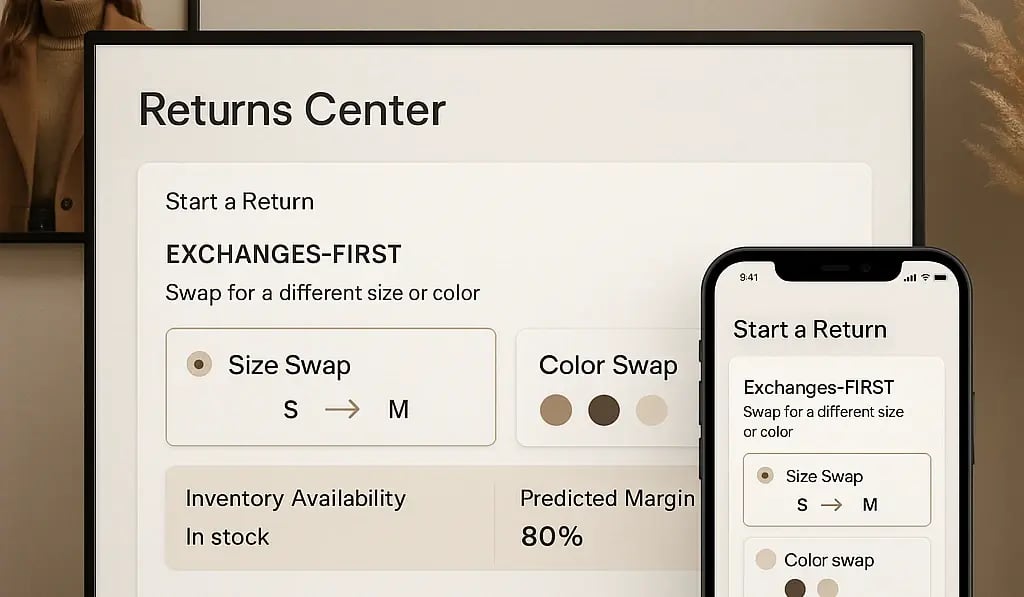
The key is to resolve the reason behind the return with minimal friction: if it’s fit, offer the most likely comfortable size with a short reason (“this cut runs slightly roomy; we suggest M”); if it’s style, propose a colorway or adjacent silhouette validated by the shopper’s style profile. Make the exchange path faster and more generous than a refund, and most customers will choose it—particularly when inventory is visible and shipping timelines are clear. The economics are compelling.
Apparel returns are persistently high online, driven primarily by fit and expectation gaps. Coresight summarizes online apparel return rates and their cost gravity at Coresight.
Broader 2024 return surveys show the pressure on margins and the opportunity to earn loyalty via better experiences; see Narvar’s summary at Narvar 2024. Exchanges preserve contribution margin, reduce restock write‑downs, and lower refund‑related churn. They also create a second chance to style—attach complementary items when the shopper picks the replacement.
Designing the flow: size, color, and look‑aligned swaps
Design the exchanges journey around three pillars: fit certainty, style alignment, and speed. • Fit certainty: expose SKU‑level attributes (pattern block, rise/length, stretch %, last/width for footwear) to a size/fit service that outputs a single confident recommendation with a short reason.
Carry this badge from the return portal to cart.
• Style alignment: show one or two close alternates tied to the shopper’s style profile and to the original item’s attribute spine—e.g., “same column silhouette, warmer tone,” “lower heel for better inseam balance.” Offer tap‑to‑swap chips like “longer hem,” “wider strap.”
• Speed: show real‑time availability by size/color, preprint labels or mobile QR, and set expectations (dispatch of replacement before receiving return for VIPs; standard otherwise).
Keep the path fewer clicks than a refund. Guardrails protect brand and P&L. Cap exchange loops to prevent abuse; steer to store credit where inventory is constrained; and keep messaging premium, not punitive. Instrument reason codes carefully (“too tight in thigh,” “color off from expectation”) to improve future recommendations and product copy.
Practical guidance on returns reduction emphasizes post‑purchase communication and better product info; a 2024 retailer guide is at Radial. For macro demand volatility and why agility matters, see the BoF x McKinsey State of Fashion 2025 overview at BoF x McKinsey and the full PDF at McKinsey.
Run it like a product: KPIs, experiments, governance
Run the program with a scoreboard and disciplined tests.
Outcome KPIs:
• Exchange rate vs. refund rate by category and segment
• Recovered revenue and margin retention
• Time‑to‑resolution and CX (NPS/CSAT)
• Repeat purchase rate for exchange cohorts
• Return‑rate delta in categories where size badges appear.
Operational KPIs:
• Portal latency and error budgets
• Label issue→drop‑off rate
• Inventory mis‑pick rate for exchanges.
Experiment design: start with denim, dresses, and sneakers—high‑return, high‑impact categories. Launch behind a feature flag; favor randomized control or matched cohorts with stop‑loss thresholds (refund spikes, CX dips).
Test incentives (free fast shipping on exchanges), “ship replacement now” rules for VIPs, and the copy framing that drives exchange selection.
Attribute lift at the node: “exchange portal viewed → exchange selected → shipped → retained revenue.” Privacy and governance are features. Evaluate consent at activation for any personalized elements; minimize PII in payloads; log each decision with inputs and rationale for audit and tuning.
Maintain a weekly readout that reconciles recovered revenue with costs (shipping delta, restock, service time). Treat exchanges‑first as part of customer experience—not a policy trick—and the P&L will follow.