Localize fashion assortments with climate-aware personalization.
Why climate-aware localization lifts conversion and margin
A summer dress that sells out in Miami can stall in Munich—and the reverse is true for knit layers in September. Fashion demand is seasonal, regional, and comfort‑driven, yet most storefronts treat every visitor the same.
Climate‑aware personalization fixes that. By combining local climate signals with trend momentum, inventory, and fit intelligence, you surface looks that feel right for the weather your customer actually lives in—without turning your site into a weather app. The outcome is simple: faster discovery, higher conversion, fewer returns, and better full‑price sell‑through.
Start with business stakes and brand voice. Mobile and social‑led journeys mean shoppers arrive with a vibe, not a SKU; they want “my style, my size, for today’s weather.” On mobile feeds, show breathable fabrics and open silhouettes in hot/humid regions and layered looks in cool/dry ones.
Keep tone premium and on‑brand: editorial restraint for luxury, energetic clarity for contemporary, capsule‑led for athletic. Ground the approach with fashion-grade data so personalization reads like a stylist. That means a product attribute spine that merchandisers trust: silhouettes, lengths and rises, necklines and sleeves, fabric composition and stretch %, palette, toe/heel shapes—and for footwear, last width and heel height.
Treat photography as data (finish, drape), so visual search and outfitting remain coherent. Translate climate into taste, not gimmicks. Instead of “It’s 86°F—buy sandals,” let the system boost breathable linens, open necklines, and strap sandals in hot/humid zones, and favor mid‑weights and closed‑toe options where evenings cool.
Carry a single size recommendation for hero items to curb bracketing and align expectation to comfort. For background on e‑commerce realities you’re optimizing for, see Shopify. For how visual signals inform timing across regions, review Heuritech.
Macro outlooks emphasize that precision merchandising is a margin lever in 2025; consult the BoF x McKinsey overview at Business of Fashion and the report collection at McKinsey.
Design climate-aware data, models, and UX for fashion
A credible design has three layers: better signals, an explainable model, and a calm
UX. Signals:
1) corrected sell‑through (so stockouts don’t masquerade as “low demand”),
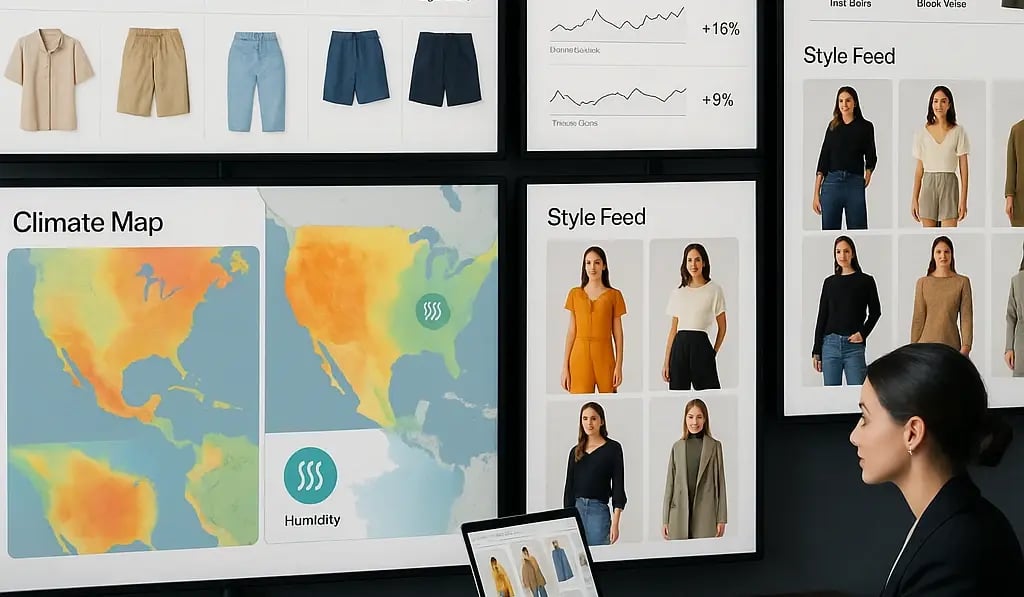
2) local climate features (temperature, humidity, heat index; precipitation patterns; UV) and seasonality,
3) regional trend momentum (visual/search signals),
4) returns reasons with fit/style context, and
5) channel mix (DTC, wholesale, marketplace).
Map these to a fashion attribute spine—silhouettes, lengths/rises, necklines/sleeves, fabrics and stretch %, palette, toe/heel shapes—so outputs talk like merchandisers. Trend-signal providers outline how visual data predicts timing across regions; see Heuritech. For a commerce baseline on discovery behaviors you’ll influence with localization, review Shopify.
Modeling: estimate censored demand (to correct for stockouts), segment by geography and channel, and include climate features as covariates rather than crude rules. Borrow learning from similar silhouettes and fabrics to handle cold‑start SKUs. Output localized size curves, price elasticity hints, and exposure weights per region (“boost breathable linen sets; downweight heavy knits until evening temps drop”).
Attach reason codes to every recommendation so buyers can accept/override with confidence: “heat index rising; linen and short sleeves peaking; strap sandal inventory rich.” UX: surface localization as taste and comfort, not weather alerts. In hot/humid regions, open with light fabrics, open necklines, and strap sandals; in cool/dry, show layers and closed-toe options first.
Keep a single size recommendation inline for hero items to reduce bracketing. Use palette pivots that match local light—whites and sea tones often lead in coastal sun; deeper neutrals and espresso expand as light cools. In luxury, maintain editorial restraint and concierge touches (reserve in boutique); in contemporary, provide price bands and quick “swap chips” like “cooler fabric,” “longer hem,” or “lower heel.”
Operate with KPIs, tests, and reliability SLOs
Operate the program like a product with CFO‑ready proof and guardrails.
KPIs: conversion and PDP view‑to‑add rate by region, AOV and units‑per‑transaction from outfit completion, full‑price sell‑through, weeks of supply and markdown rate for climate‑sensitive categories, and return‑rate deltas where size badges are visible. Segment by geography and by climate cohort to prove the thesis.
Attribute lift at journey nodes—“localized feed → PDP → add‑to‑cart”—not just channel totals. Pair outcome KPIs with technical SLOs: P95 <300 ms for results, data freshness SLAs for inventory and climate signals, and low error budgets.
Experiment design: start with two categories (dresses and sandals; denim and outerwear) across two climates. Prefer randomized control at session/user level; if not feasible, use matched cohorts with pre‑registered stop‑loss thresholds (bounce spikes, save‑rate dips).
Test levers: fabric weight emphasis, open vs. closed shoes, sleeve and neckline variants, and palette shifts. Publish weekly readouts reconciling incremental revenue and markdown avoidance with creative and integration costs.
Governance and privacy are performance features. Evaluate consent at activation for any personalized block; minimize PII in decision payloads; and keep retrieval boundaries tight (style cluster, size band, budget, local climate state).
Maintain an immutable decision log (inputs, reason codes, outcomes) for audit. For macro fashion context on uneven demand and the need for precision, see the BoF x McKinsey State of Fashion overview at Business of Fashion and the full collection at McKinsey.