#FashionInnovation
#DigitalFashion
#FashionEcommerce


How AFL merchandisers use AI trend forecasting to build profitable, low-markdown collections from runway to retail.
Every season, AFL merchandisers and planners replay the same high-stakes game: commit open-to-buy months ahead, place bets on silhouettes and colour stories, then hope that reality lines up with the deck. When it doesn’t, the cost is brutal—markdown racks full of the wrong dresses, empty shelves where the right sneakers should have been and write-offs that quietly erode margin. Climate volatility, TikTok-driven micro-trends and ever-more-fragmented channels are only amplifying this tension. Traditional tools aren’t built for this world.
Most planning systems lean heavily on last year’s sales curves and static assumptions. They treat SKUs as anonymous items in a hierarchy instead of looks, capsules and tribes. They also struggle to ingest the signals that now shape demand: search interest around a specific silhouette on marketplaces, localised climate anomalies that change outerwear needs, or how aggressively competitors are promoting a particular category.
That’s why AI fashion trend forecasting is starting to move from “innovation project” to core capability for leading Apparel, Footwear & Luxury brands. Instead of relying only on historical sales and gut feel, AFL merchandisers can now tap models that combine PLM and PIM attributes, multi-channel sell-through, returns and markdowns, external signals and climate data to forecast demand at style–colour–size and regional-cluster level. Search behaviour supports this shift.
Semrush shows meaningful but still under-served interest around phrases such as “ai fashion trend forecasting”, “trend forecasting fashion” and “ai in fashion”, with hundreds of monthly searches in the US and moderate keyword difficulty—an indicator that merchandisers and Fashion CTOs are starting to look for answers, but that few content pieces speak to them in fashion-specific language.
Semrush – AI Fashion Trend Forecasting Keywords Industry examples underline the upside when AI is built and deployed thoughtfully. A 2025 case study from Infopine describes a fashion retailer that used AI-powered forecasting on a unified data stack to achieve 40% more accurate demand forecasts, a 32% reduction in overproduction and a 27% decline in unsold inventory. Infopine – Predicting Fashion Trends with AI SIS AI’s work with a global fast-fashion player shows how a neural network trained on real-time social listening, internal sales and macro signals helped reduce markdown losses and improve seasonal forecasting across thousands of stores worldwide.
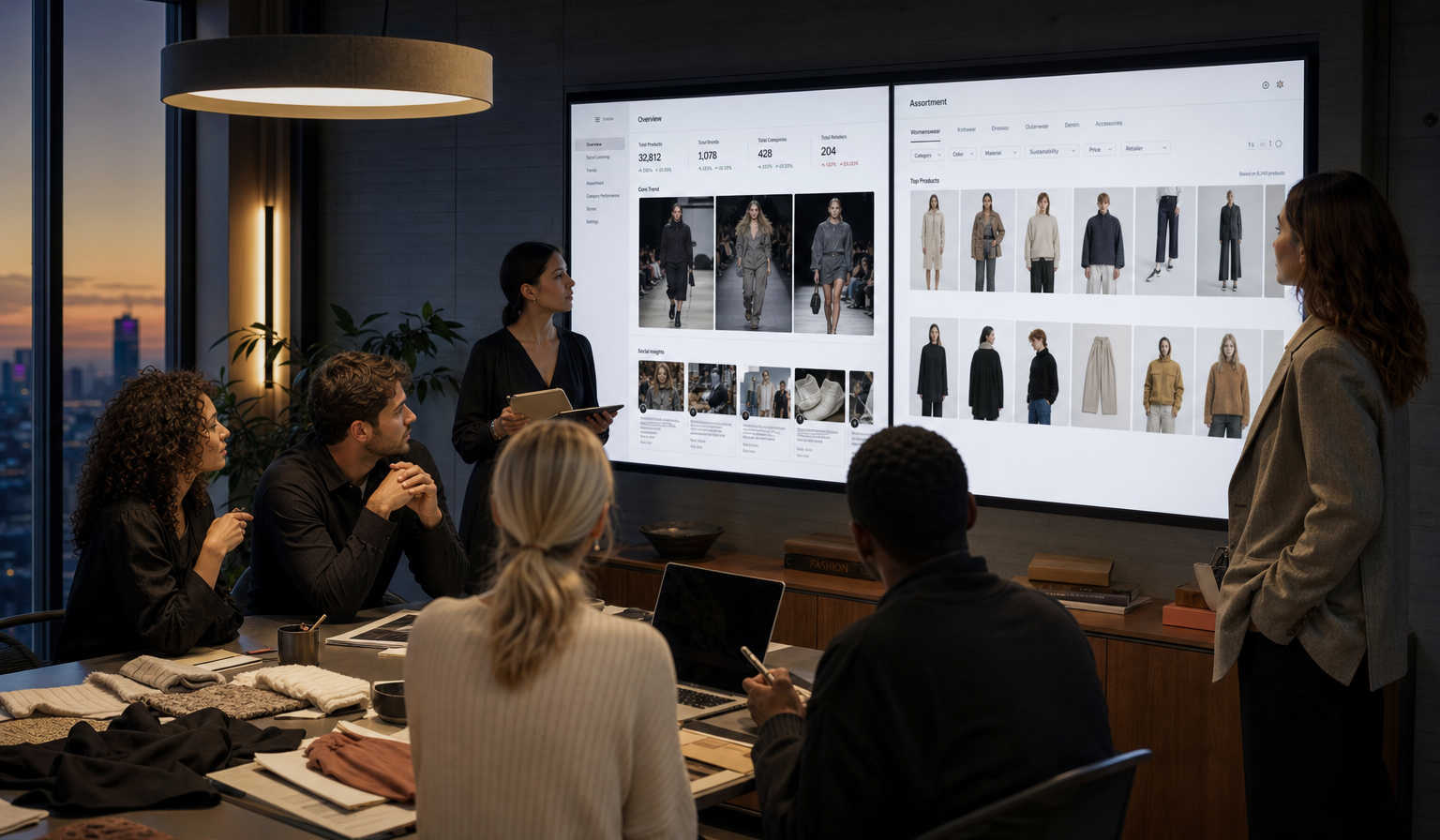
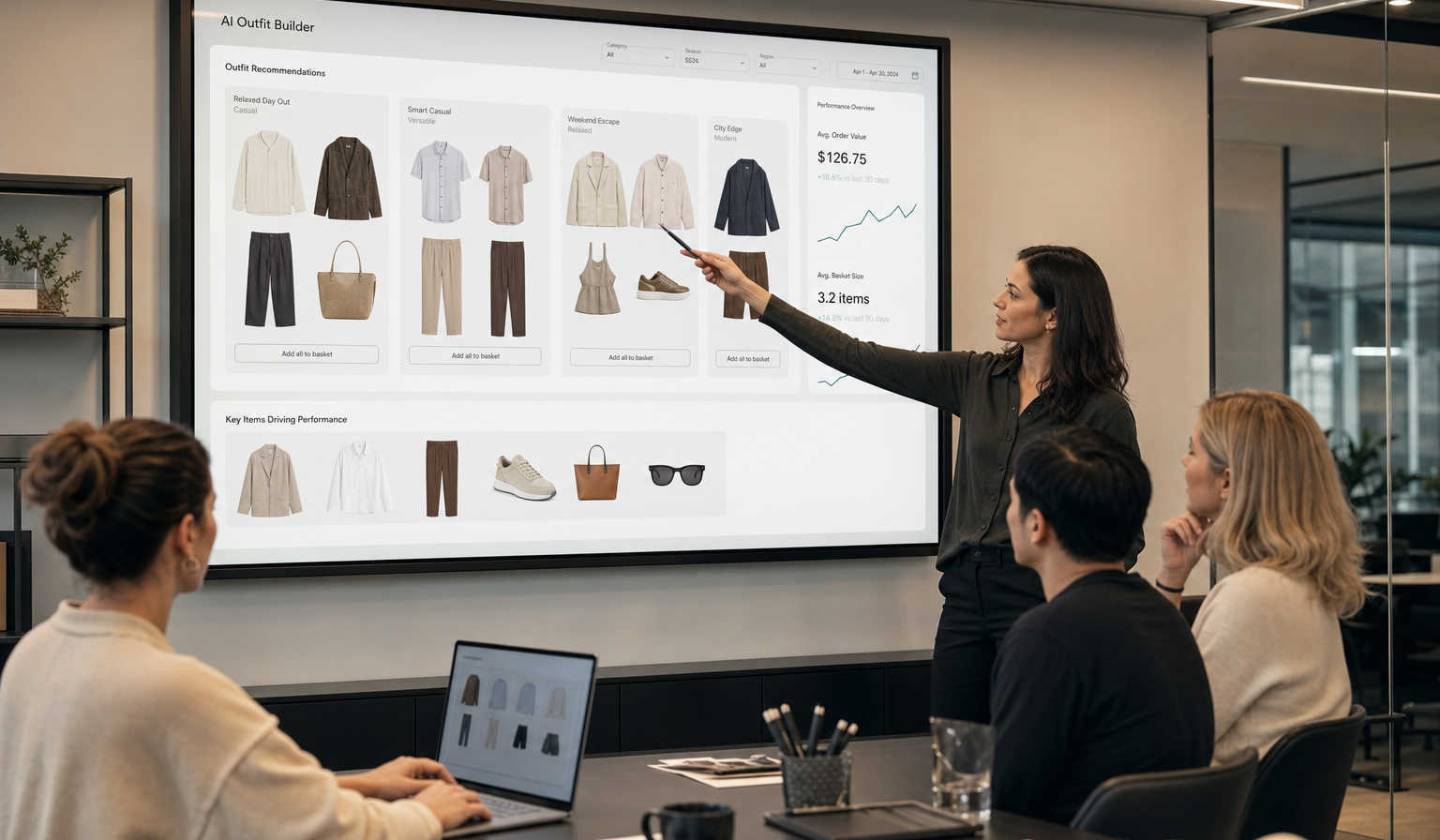
SIS AI – AI-Powered Inventory Optimization For MapleSage’s AFL ICPs—VP Merchandising, Buying Directors, Fashion CMOs and Fashion CTOs—this is exactly where Campaign 3 (Fashion Merchandising Automation & Trend Intelligence) comes to life. SageRetail, MapleSage’s merchandising and personalization engine, is built to sit on top of PLM, PIM and commerce platforms such as Shopify Plus, turning messy sales and product data into a living demand graph. Instead of generic “Q4 forecast” curves, merchandisers get scenario views by capsule, tribe, price band and region—and a way to tie creative bets on trend to the hard numbers that protect margin.
Building AI fashion trend forecasts that merchandisers actually trust starts with respecting how AFL teams already think about product. Buyers and planners don’t start with abstract SKUs; they start with stories and capsules:
Ramadan occasionwear for GCC malls, festival denim for Europe, quiet-luxury tailoring for finance hubs, back-to-school sneakers across North America. Any credible AI system has to understand those constructs and work with a product spine rooted in PLM and PIM, not just a flat hierarchy of style codes.
That means treating PLM as the source of design truth and PIM as the layer that turns that truth into consumer-ready storytelling. In PLM you already carry silhouettes, blocks, fabric weights, palettes, dress codes, climate tags, modesty flags and sustainability indicators. When this data is joined to three to five years of sell-through, returns and markdowns at style–colour–size by channel and market, you get an attribute-rich demand history that machine learning can work with.
Leading case studies show why this matters. Infopine’s 2025 write-up on a growing fashion retailer describes how unifying ERP, POS and ecommerce data into a cloud forecasting stack drove 40% more accurate demand forecasts, a 32% reduction in overproduction and a 27% drop in unsold inventory. Infopine – Predicting Fashion Trends with AI SIS AI’s work with a global fast-fashion chain highlights how combining social listening, macro signals and internal data into a neural network reduced markdown waste from $152 million annually by improving seasonal forecasting and rebalancing stock across 2,400 stores in 45 countries. SIS AI – Global Fast Fashion Inventory Optimization
MapleSage’s SageRetail merchandising intelligence layer follows a fashion-literate version of this blueprint. It ingests PLM attributes, PIM content and multi-channel performance data, then trains hierarchical models that forecast demand at style–colour–size and store or regional-cluster level. Because related items share information, a new blazer that reuses a proven block can “borrow” demand shape from previous seasons, while a new sneaker colourway can be anchored to performance on the same last and price band.
External signals—search trends, social buzz, marketplace performance, even climate anomalies—can be layered on where data access allows. For AFL merchandisers and Buying Directors, the output only becomes actionable when it is translated back into their language. Instead of opaque forecast curves, SageRetail surfaces recommended buy windows and depth ranges by capsule and region, suggested size curves by channel, and risk bands for each bet. A VP Merchandising can compare AI’s guidance for a Ramadan partywear capsule in KSA versus UAE, or for a festival denim story in Germany versus the UK, and still bring creative and competitive context into the final call. AI does the heavy lifting across millions of data points; humans still decide which stories deserve the boldest bets.
Designing strong models is only half the job; the other half is running AI fashion trend forecasting as a disciplined capability across seasons. That requires shared KPIs, a phased rollout and clear governance so merchandisers feel that AI is a partner, not a black box second-guessing their judgment. On the KPI side, VP Merchandising, Buying Directors, Finance and Supply Chain leaders should look beyond generic accuracy metrics and ask how AI forecasting is changing commercial outcomes.
Core measures include: • Forecast accuracy (MAPE or similar) at style–colour–size and cluster level, benchmarked against planner baselines. • Full-price sell-through by capsule, category and market where AI forecasts materially influenced buys. • Markdown depth and timing needed to clear seasonal inventory, especially in high-risk trend stories. • Stockout rates on hero styles and core sizes, plus lost sales estimates during key periods like holiday or festival season. • Working capital indicators: weeks of cover, inventory turns and the value of unsold or heavily marked-down stock.
Third-party case studies underline what’s possible when these KPIs are managed well. Infopine’s apparel client achieved 40% more accurate forecasts and cut unsold inventory by 27% after adopting AI trend forecasting built on unified data. Infopine – AI Fashion Trend Forecasting SIS AI reports that its inventory-optimisation engine helped a global fast-fashion chain reduce markdown waste by tens of millions while improving seasonal forecasting accuracy from 31% to much higher levels, shrinking the gap between top and bottom stores by using real-time signals.
SIS AI – AI Inventory Optimization MapleSage typically recommends a three-phase roadmap for SageRetail-led AI trend forecasting.
Phase 1 is “shadow mode”: run AI forecasts alongside planner forecasts on a handful of critical categories—denim, outerwear, sneakers, occasionwear—for one or two seasons, without changing buys. Use this to benchmark accuracy, test attribute choices and build trust.
Phase 2 moves to “bounded influence”: allow AI to guide a defined share of open-to-buy, such as 20–30% in selected markets or capsules, with explicit guardrails on minimum and maximum variance from human plans.
Phase 3 is “embedded ritual”: make SageRetail forecasts a standard input into range reviews, OTB sign-offs, in-season reforecasts and end-of-season retros, and extend coverage into allocation and replenishment.
Governance sits with a cross-functional forecasting council that spans Merchandising, Planning, Finance, Supply Chain and Data. This group defines risk appetite by segment (for example, more experimentation for fast fashion, tighter constraints in luxury), decides how sustainability targets like overproduction and textile waste feed into optimisation, and documents when human overrides are allowed—and why.
For MapleSage’s AFL clients, that structure turns AI trend forecasting from a one-off experiment into a durable lever for Campaign 3, protecting margins and helping brands put the right stories, in the right sizes, into the right markets season after season.