
#FashionInnovation
#DigitalFashion
#FashionEcommerce
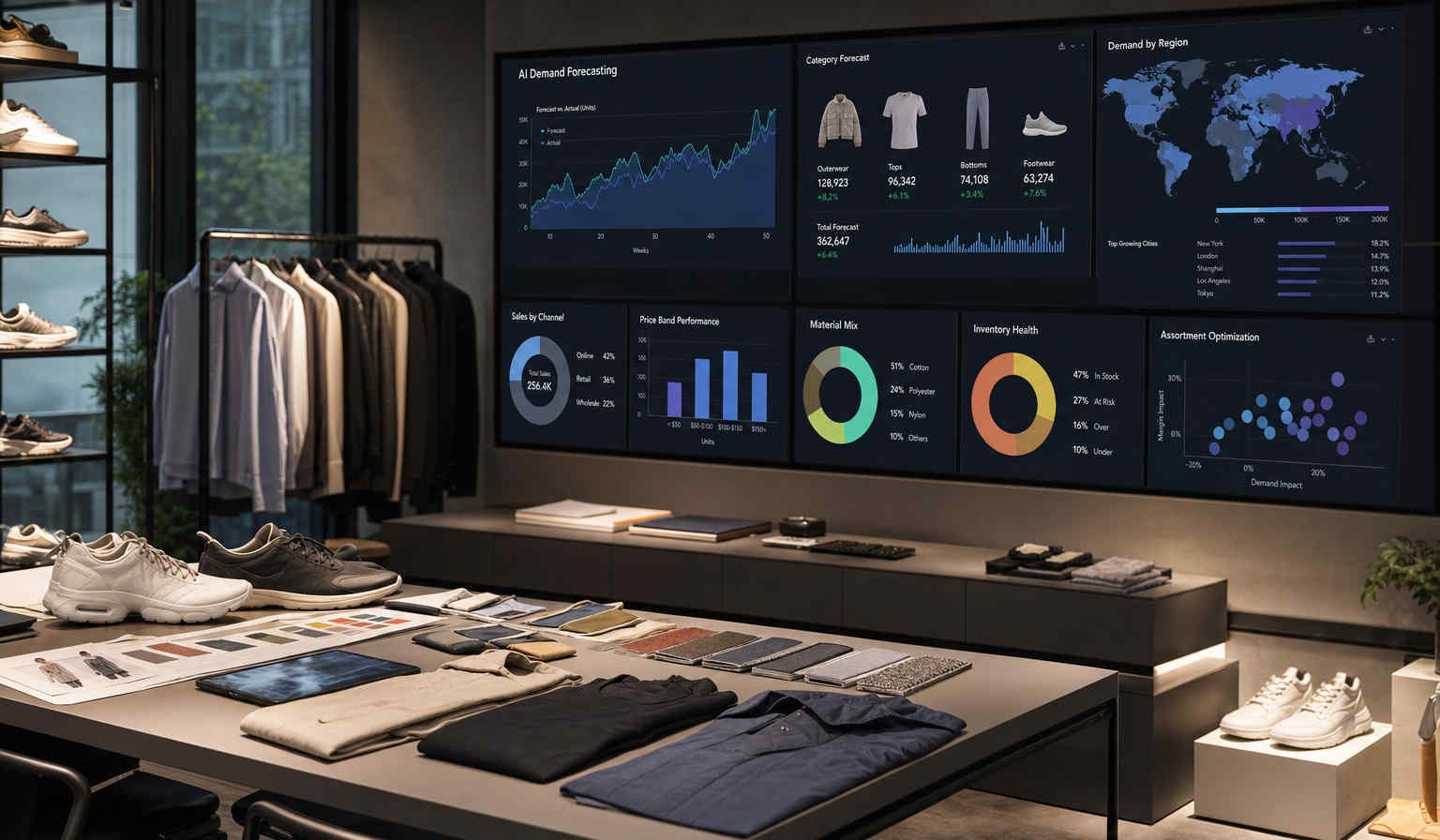

How AFL merchandisers use AI demand forecasting to cut markdowns, reduce stockouts, and protect margins across collections.
Every season, AFL merchandisers and planners replay the same balancing act: commit buys months in advance, hope the trends land, then scramble when reality doesn’t match the plan. Climate volatility, TikTok-fuelled micro-trends, and fragmented channels make it harder than ever to predict which stories will sell through at full price and which will end up on the markdown rack.
Traditional forecasting tools lean too heavily on last year’s sales and static assumptions. They treat SKUs as anonymous items in a hierarchy instead of looks, capsules, and tribes. They also struggle to incorporate the real-world signals that now shape fashion demand: social buzz around specific silhouettes, marketplace performance, localised climate anomalies, and competitor activity.
AI-powered demand forecasting is emerging as a way to bridge that gap, especially in fashion. Search and vendor data support this shift. Semrush shows modest but growing US search volume around “fashion demand forecasting” (around 20 monthly searches) and broader interest in AI forecasting topics, with relatively low keyword difficulty—signalling that the space is still under-served from an SEO perspective, but highly relevant for merchandisers and fashion tech leaders.
Semrush – Fashion Demand Forecasting Keywords Recent case studies illustrate the upside. Adyantrix details how a fashion retailer reduced markdown waste by 33% using a tailored demand forecasting ML model trained on historical sales, trend signals, and seasonal patterns. Adyantrix – Demand Forecasting ML Model Invent.ai’s 2024 case study on a European apparel retailer shows that AI-powered markdown optimisation can boost revenue by 2.4%, lift sell-through by 6.9%, and reduce markdown loss by 2% across 400+ stores by aligning discounts and inventory moves with true demand curves. Invent.ai – Markdown Optimisation Case Study
For MapleSage’s AFL ICPs—VP Merchandising, Buying Directors, Fashion CMOs, and Fashion CTOs—this is directly aligned with Campaign 3 (“Fashion Merchandising Automation & Trend Intelligence”). Instead of treating forecasting as a static report or a black box in the ERP, SageRetail connects PLM, PIM, ecommerce, and external signals into a living demand graph. That graph helps answer the questions merchandisers really ask: How deep should we go on this new suiting block in the GCC versus Northern Europe? Which size curves should we run for a holiday partywear capsule in MENA versus North America? Where should we lean into bold sneakers versus classic silhouettes for back-to-school?
Once AFL brands accept that traditional tools can’t keep up with volatility, the next question is how to design AI demand forecasting that actually fits fashion reality. That means models and workflows that understand categories, capsules, channels, and climate—not just aggregate “Q4 demand” curves. Specialist providers offer a clear blueprint.
Adyantrix’s 2026 case study describes an online fashion retailer struggling with chronic overproduction and markdown waste during seasonal peaks. By implementing a machine learning demand forecasting model tuned to historical sales, trend signals, and seasonal patterns, the retailer reduced markdown waste by 33% while maintaining product availability.
Adyantrix – Markdown Waste Reduction Other vendors show similar gains. 42Signals’ 2026 case study on fashion retailer StyleSphere highlights how integrating marketplace data, digital shelf analytics, and hyper-local dark-store signals into an AI forecast solution improved demand accuracy by 32%, reduced stockouts by 40%, and cut markdowns by 25%. 42Signals – AI Forecast in Fashion Retail Affine documents a global sportswear and footwear brand that improved forecast accuracy from 60% to 90% and cut forecast generation time from seven days to three hours by deploying an AI-powered forecasting engine across categories and channels.
Affine – AI Demand Forecasting MapleSage’s SageRetail merchandising intelligence layer follows a fashion-literate version of this pattern. It starts by ingesting PLM and PIM attributes—silhouettes, fabrics, palettes, dress codes, sustainability flags—alongside multi-channel sell-through, returns, and markdowns at style–colour–size level. It then layers in promotion calendars (Ramadan and Eid, festival season, BFCM, Singles’ Day, holiday), regional climate and event data, and, where available, external signals such as search trends and marketplace performance.
On this foundation, SageRetail trains hierarchical models that forecast demand at style–colour–size and store or regional-cluster level, sharing information across related items so that new colourways or silhouettes can “borrow” shape from similar past products. Crucially, outputs are translated back into the language merchandisers actually use. Instead of opaque model scores, SageRetail surfaces recommended buy windows and volumes by capsule and market (“buy deeper into wide-leg suiting in GCC and MENA, hold back in Northern Europe”), suggested size curves by region and channel, and risk flags where exposure is high or data is sparse. For MapleSage’s VP Merchandising,
Buying Directors, Fashion CMOs, and Fashion CTOs, this makes AI demand forecasting a practical decision tool they can bring into OTB and line-review meetings—not just a dashboard that sits on the side.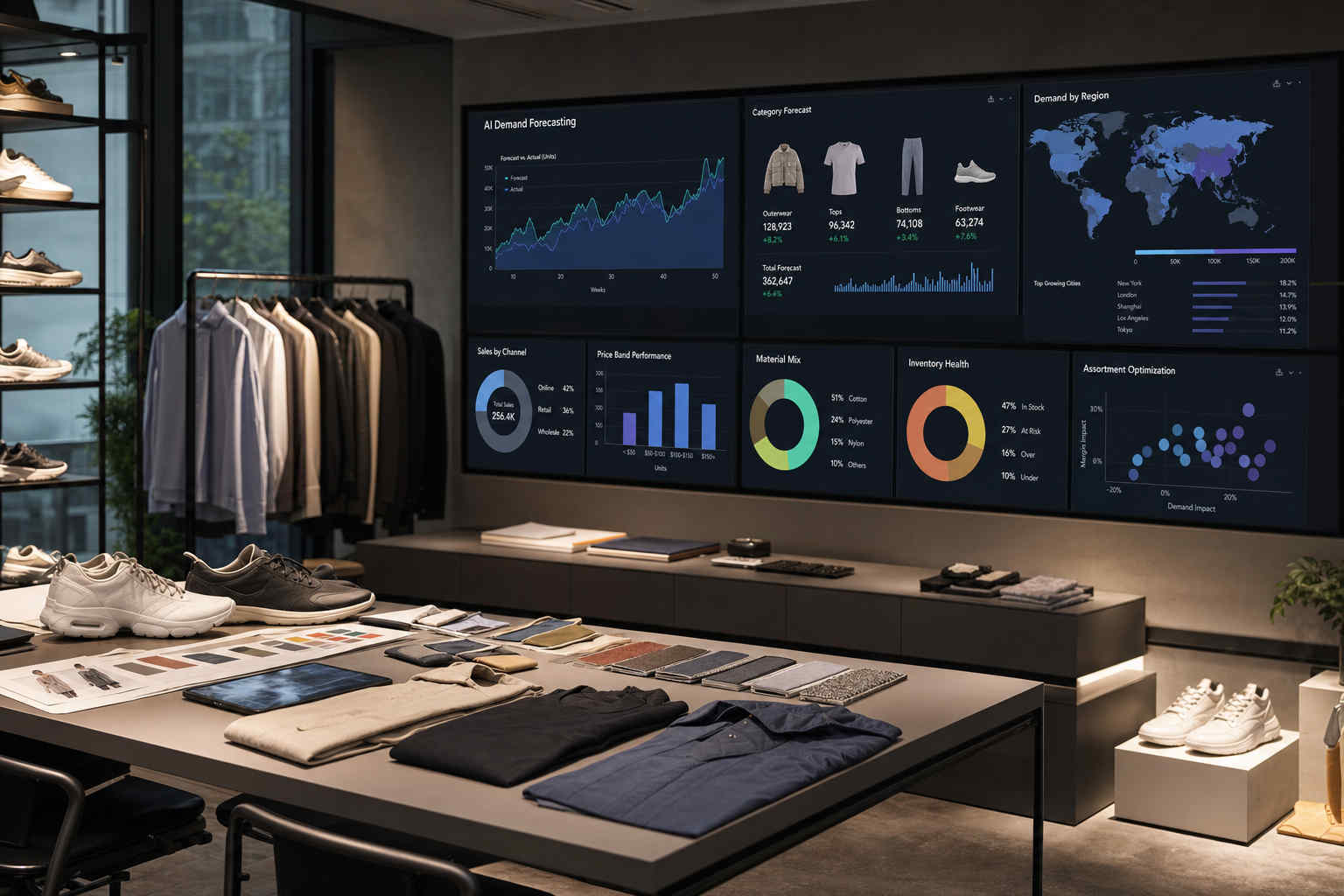
Designing strong models is only half of the work; the other half is running AI demand forecasting as a disciplined merchandising capability across seasons. That requires shared KPIs, experimentation, and governance. On the metrics side, VP Merchandising, Planning, Finance, and Supply Chain leaders should move beyond generic forecast error and track how forecasting influences commercial outcomes.
Key measures include:
• Forecast accuracy (MAPE or similar) at style–colour–size and cluster level, benchmarked against planner baselines.
• Full-price sell-through by capsule, category, and region, especially where AI forecasts materially influenced buys.
• Markdown depth and timing required to clear seasonal inventory, including how much volume moves below your target margin.
• Stockouts and lost sales on hero styles and core sizes during key periods.
• Working-capital metrics: inventory turns, weeks of cover, and the value of unsold or heavily marked-down stock.
Case studies from the field show how quickly these metrics can shift. 42Signals’ AI forecast implementation delivered a 32% improvement in forecast accuracy, a 40% reduction in stockouts, and a 25% cut in markdowns by combining internal sales data with external context from marketplaces and dark stores. 42Signals – 32% Better Demand Accuracy SIS AI’s work with a global fast-fashion chain reports that AI-powered inventory optimisation helped tackle an annual $152 million drag from markdowns and dead stock by using neural networks, social listening, and real-time signals to predict trends and rebalance stock across 2,400 stores in 45 countries.
SIS AI – Global Fast Fashion Inventory Optimisation MapleSage typically proposes a three-phase roadmap for SageRetail-led demand forecasting.
Phase 1 is “shadow mode”: run AI forecasts alongside planner forecasts on a few high-impact categories—denim, outerwear, sneakers, dresses—for one or two seasons without changing buys, then compare performance in accuracy, sell-through, markdowns, and stockouts.
Phase 2 is “bounded influence”: allow AI to influence a defined share of open-to-buy (for example, 20–30% of budget for selected regions or capsules), with explicit guardrails on maximum variance from planner plans and structured tests across markets.
Phase 3 is “embedded ritual”: make AI forecasts a standard input into range reviews, OTB sign-offs, in-season reforecasts, and markdown-planning meetings, and extend coverage into allocation and replenishment so that insights from one season feed directly into the next. Governance should sit with a cross-functional “forecasting council” that includes Merchandising,
Planning, Finance, Supply Chain, and Data. This group sets risk appetite by segment (fast fashion versus luxury), agrees how sustainability targets (overproduction, textile waste) factor into optimisation, and defines clear rules for when human judgment can overrule the model—and how those overrides are documented to improve future learning. With that structure in place, AI demand forecasting becomes a core lever for Campaign 3 (“Fashion Merchandising Automation & Trend Intelligence”): a practical, measurable way for MapleSage clients to cut markdowns, protect margins, and keep shelves aligned with what fashion shoppers actually want.