#FashionInnovation
#DigitalFashion
#FashionEcommerce
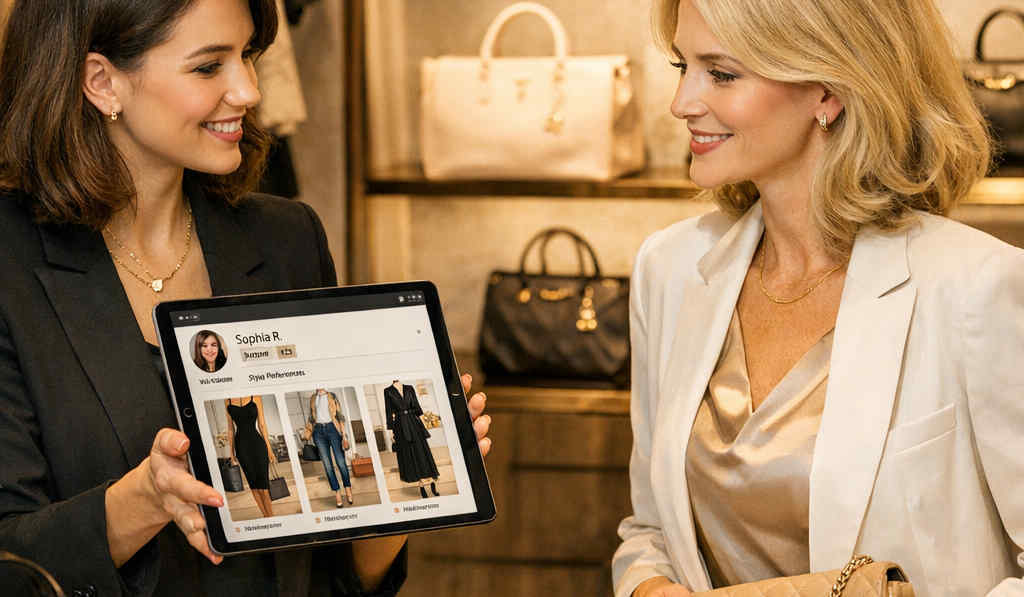

How luxury and premium AFL brands use AI clienteling to connect boutiques and ecommerce into one continuous, style-led experience.
Luxury and premium fashion have always been defined by what happens in the boutique: the way a trusted associate remembers your size, how a blazer sat on your shoulders last season, or which palette you gravitate towards when dressing for Ramadan dinners or art openings. Yet as digital accelerates, many high-value clients move fluidly between channels – discovering looks on their phones, checking store availability online, then shopping in boutiques or outlets. Too often, the experience breaks in between. A VIP who spends thousands each year in-store may receive generic ecommerce emails and no recognition when they log into the website.
A new digital client who has carefully built a capsule online walks into a flagship and is treated like a first-time visitor. For MapleSage’s AFL ICPs – CX Directors, Fashion CMOs, Retail Operations heads, and Fashion CTOs – this disconnect is both a risk and an opportunity.
Search interest around clienteling is growing beyond pure buzzword status. Semrush data indicates around 90 monthly US searches for “clienteling software”, with commercial intent and relatively low keyword difficulty, showing that retailers and brands are actively researching tools to modernise their approach. Semrush – Clienteling Software Keyword Data At the same time, press coverage of early adopters highlights how AI is reshaping luxury clienteling.
Zegna’s ZEGNA X system, built with Microsoft, uses AI-powered recommendations and a 360° configurator to help style consultants curate outfits from tens of billions of possible combinations. Associates use the ZEGNA X app to send highly personalised product suggestions and lookbooks via text, email, and messaging apps, effectively extending boutique-level service into clients’ everyday digital lives. Vogue Business – Zegna AI ClientelingMicrosoft – Working with Microsoft, Zegna Adds AI Brunello Cucinelli’s Solomeo AI platform similarly demonstrates how high-end fashion can use AI to interpret natural-language requests and propose outfits for specific contexts via its new ecommerce site.
Customers can type prompts about occasions and preferences and receive suggestions consistent with the brand’s refined aesthetic. Digital Commerce 360 – Brunello Cucinelli AI Ecommerce MapleSage’s SageRetail platform sits at the crossroads of these developments. It is designed to give fashion associates, AI stylists, and digital journeys a shared understanding of each client’s style and fit. By connecting PLM data (silhouettes, fabrics, palettes, dress codes) with orders, returns, appointments, and engagement, SageRetail powers clienteling that feels as considered as a one-on-one salon appointment – whether it happens in a Montenapoleone flagship, a Dubai mall boutique, or a mobile app. This post lays out how AFL brands can design, implement, and operate AI clienteling that truly connects boutique and browser.
Designing AI-augmented clienteling journeys starts with a unified, fashion-literate client profile. For Apparel, Footwear & Luxury (AFL), that profile has to carry more than recency and spend; it must capture silhouettes, fabrics, palettes, and occasions, as well as fit nuances and service preferences. MapleSage’s SageRetail platform builds this by ingesting PLM and PIM attributes, ecommerce and POS data, clienteling notes, and digital engagement into style and fit graphs that associates and AI stylists can actually use. Luxury leaders provide blueprints. Zegna’s ZEGNA X system, developed with Microsoft, connects style consultants to clients using a 360° configurator capable of generating up to 49 billion outfit combinations. The app aggregates client data, past purchases, and preferences so associates can send curated looks and product suggestions through channels like WhatsApp and email. Microsoft – ZEGNA X Clienteling Vogue Business notes that these AI-powered recommendations sit inside an outreach app that began as a US pilot and now supports stores globally, underscoring the importance of tying AI into day-to-day clienteling rather than isolating it in a lab. Vogue Business – Zegna AI Clienteling
Brunello Cucinelli’s Solomeo AI initiative offers another vantage point. The brand’s new AI-powered ecommerce site, built on its proprietary Callimacus platform, includes a prompt field where customers can ask natural-language questions about products suited to particular contexts – for example, what to wear to a specific event or setting. Digital Commerce 360 – Brunello Cucinelli AI Site While the initial focus is digital, the long-term direction is clear: align AI intent understanding and styling with the brand’s boutique-level service, creating a continuous conversation across channels. In MapleSage’s model,
SageRetail provides the same connective tissue for AFL clients. It fuses: • Style intelligence – silhouettes, dress codes, capsules and tribes that resonate with each client, derived from PLM and past behaviour. • Fit intelligence – blocks, lasts, rises, and fabrics that historically work for the client, plus return and alteration history. • Mission context – inferred from appointments, events, geography, and interactions with AI stylists or campaign content.
Associates see this context inside clienteling tools; AI experiences on web and app use the same graph. That allows journeys such as: • Store to screen: after a boutique appointment, clients receive interactive lookbooks and saved carts that reflect the actual rail they tried, including alternates for unavailable sizes or colours. • Screen to store: when a VIP interacts heavily with a new capsule online – exploring looks for a gala, Ramadan iftar, or resort trip – their preferred associate is notified and can prepare a rack of pieces in the right sizes and palettes for the next visit. Because SageRetail is fashion-literate, these journeys respect brand codes and local norms while still using AI to scale memory and creativity beyond what any individual associate could manage alone.
To make AI clienteling a durable growth and loyalty engine, AFL brands need to run it with a clear operating model that links boutiques, ecommerce, marketing, and technology.
Without shared KPIs and guardrails, AI risks becoming a novelty feature rather than the backbone of VIP experience. For CX leaders, Retail Operations, and Finance, the KPI stack should cover:
• Clienteling-influenced revenue – online and in-store sales attributable to associate outreach and AI-assisted styling across channels.
• VIP metrics – retention, frequency, average order value, and cross-category penetration for top clients exposed to AI-augmented journeys.
• Productivity – changes in associate prep time for appointments, response times to client queries, and the number of personalised recommendations delivered per stylist.
• Experience quality – post-visit NPS, satisfaction scores for AI and human-assisted styling, and qualitative feedback on tone and relevance.
Zegna’s collaboration with Microsoft reports that its ZEGNA X clienteling programme already accounts for a substantial share of the brand’s revenues, with AI-powered outfit configuration giving associates more options while keeping them in control of final curation.
Microsoft – ZEGNA X Business Impact Coverage of Brunello Cucinelli’s Solomeo AI project indicates that the brand expects its AI-powered ecommerce site to play a “decisive role” in both brand image and revenue, highlighting how seriously luxury leaders are treating AI-guided experiences. Digital Commerce 360 – Solomeo AI Growth Ambitions MapleSage recommends introducing SageRetail-powered clienteling in phases.
Phase 1: pilot with a small set of boutiques and stylists who already have strong client books, and introduce an AI stylist on web for logged-in VIP segments. Focus on simple, high-value use cases – personalised lookbooks after appointments, pre-visit rails based on online behaviour, and AI styling suggestions for specific events.
Phase 2: expand to broader client segments and regions, integrate with CDPs and loyalty programmes, and connect store activity to ecommerce retargeting and live-shopping.
Phase 3: embed AI clienteling in seasonal planning – using client feedback and wardrobe gaps to influence capsule design, buys, and invite lists for exclusive events.
Governance must be tight in luxury and premium fashion. A cross-functional council covering Brand, CX, Retail, Tech, and Legal should define which experiences are AI-led versus human-led, set tone and representation guidelines, and control how client data is captured and used. AI should support, not overshadow, human stylists: proposals from SageRetail are suggestions that associates adapt, not scripts they must follow. With this framework, AI clienteling becomes MapleSage’s signature bridge between boutique and browser – amplifying human service while delivering measurable lifts in conversion, AOV, and lifetime value.