How AI trend forecasting helps AFL merchandisers turn social, search and sales signals into better buys and fewer markdowns.
Why AFL merchandisers need AI trend forecasting beyond static reports
Season after season, AFL merchandisers face the same tension: they need to place bold creative bets on what shoppers will want 6–12 months from now, but they are judged ruthlessly on missed demand, overstock and markdowns. In an era of TikTok micro-trends, climate volatility and cross-border assortments, relying solely on static WGSN-style reports and last-year line sheets is no longer enough. McKinsey and BoF’s State of Fashion 2026 sets the context: margin pressure is intensifying, consumer demand is fragmenting across tribes and regions, and AI is moving from experimentation into the core of fashion operations (McKinsey). K3 Fashion Solutions’ commentary on that report goes further, arguing that brands must strengthen their operational backbones – especially data and planning – if they want AI to deliver real savings rather than isolated pilots (K3 Fashion Solutions). AI trend forecasting promises to give merchandisers something they’ve never really had before: quantified, up-to-date views of how specific silhouettes, palettes, fabrics and categories are moving across markets and style tribes. Platforms like Heuritech, Trendalytics, Enstyle and Couture.ai ingest millions of social images, search queries and commerce signals to predict which ideas are emerging, peaking or fading long before those patterns are obvious in POS (Heuritech, Trendalytics, Enstyle, Couture AI). For MapleSage’s AFL ICPs – VP Merchandising, Buying Directors, Fashion CTOs and E-commerce leaders – the challenge is not whether AI can see patterns, but how to plug those signals into real workflows without overwhelming teams or eroding creative control. This post frames AI trend forecasting as a practical merchandising tool rather than a black box: where it fits in the calendar, how it should connect to PLM, PIM, POS and ecommerce, and how to measure its impact on buys, markdowns and inventory risk. It also connects directly to MapleSage’s Campaign 3 (Fashion Merchandising Automation & Trend Intelligence) and Campaign 4 (Fashion E-commerce Conversion Through AI), showing how better pre-season decisions ripple all the way through to in-season performance, personalised assortments and margin protection.
Designing AI trend forecasting workflows for buys, assortments and in-season moves
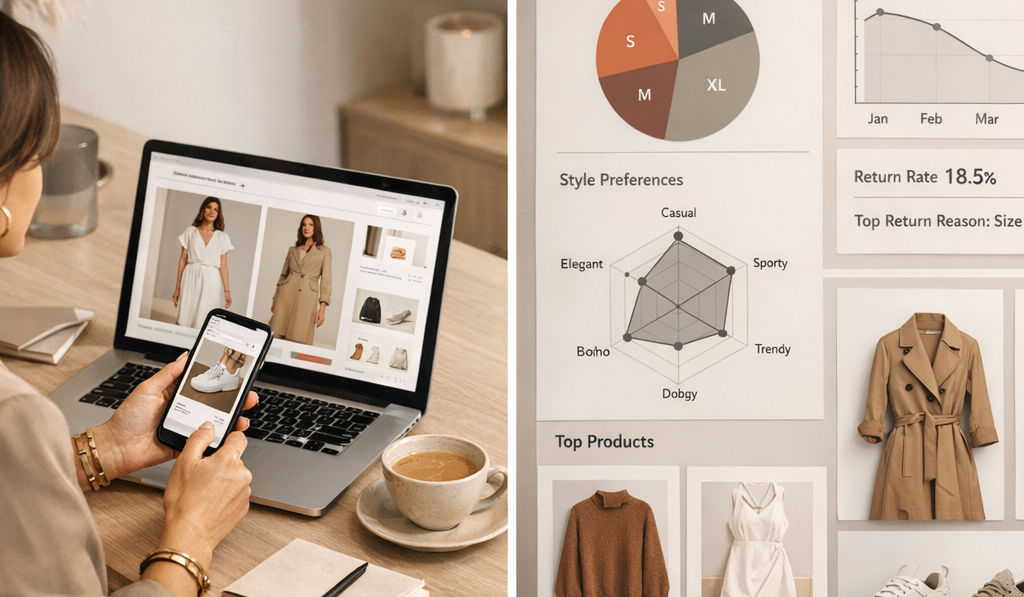
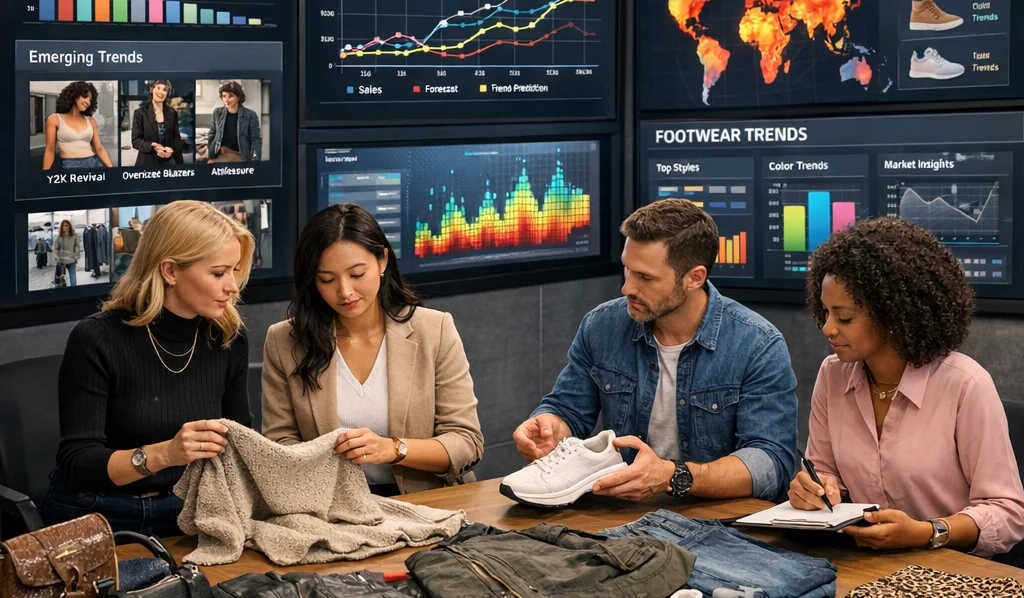
Designing AI trend forecasting workflows means translating dashboards into specific, routine decisions across the merchandising calendar. Start by mapping your existing process: inspiration and concepting, line planning, buys and size curves, allocation, in-season replenishment, and markdowns. At each stage, identify which inputs are currently used (WGSN reports, designer mood boards, last-year sales, buyer gut) and where signals arrive too late or too coarse to be useful. AI platforms like Heuritech, Trendalytics and Enstyle capture social, search and market data to predict how specific silhouettes, colors and categories are likely to move months ahead (Heuritech, Trendalytics, Enstyle). The job of SageRetail is to fuse those external signals with your PLM, PIM, POS, ecommerce and returns data so that recommendations respect your brand, supply chain and customer base. In pre-season, this might look like quantified briefs: for each segment and region, AI surfaces trend families (“wide-leg tailored trousers in cool neutrals”, “mesh-paneled performance tops”, “chunky-soled loafers”) with projected growth curves and overlap with your existing audience. Merchandisers and designers still choose where to lean in creatively, but they do so with a quantified sense of upside and risk. During line planning and buys, SageRetail overlays projected demand on historic size-curve and regional performance to flag over- and under-exposure: “you are over-indexed on skinny fits for Tribe A in Market 1 given expected shift to relaxed cuts” or “this sneaker last is projected to grow in GCC but flatten in Northern Europe.” Reports from K3 Fashion Solutions synthesising McKinsey’s State of Fashion work emphasise this kind of signal-led planning as a key lever for protecting margin in a slower-growth, higher-volatility fashion market (K3 Fashion Solutions). In-season, AI models track deviations from expected demand: silhouettes or colors that are overperforming in specific clusters, or slow movers that risk heavy markdowns. Partner research from SuperAGI and Solvoyo on AI inventory and size optimisation shows that even modest improvements in forecast accuracy at style × store level can deliver double-digit reductions in stockouts and excess stock (SuperAGI, Solvoyo). SageRetail can convert those deviations into concrete actions for merchandisers: deepen buys on a winning block, re-phase delivery of a color story, accelerate markdowns in one cluster while holding price in another. The key is workflow fit: outputs must show up inside existing planning and allocation tools, not as yet another PDF in someone’s inbox.
KPIs, experiments, and roadmap for AI trend forecasting in AFL
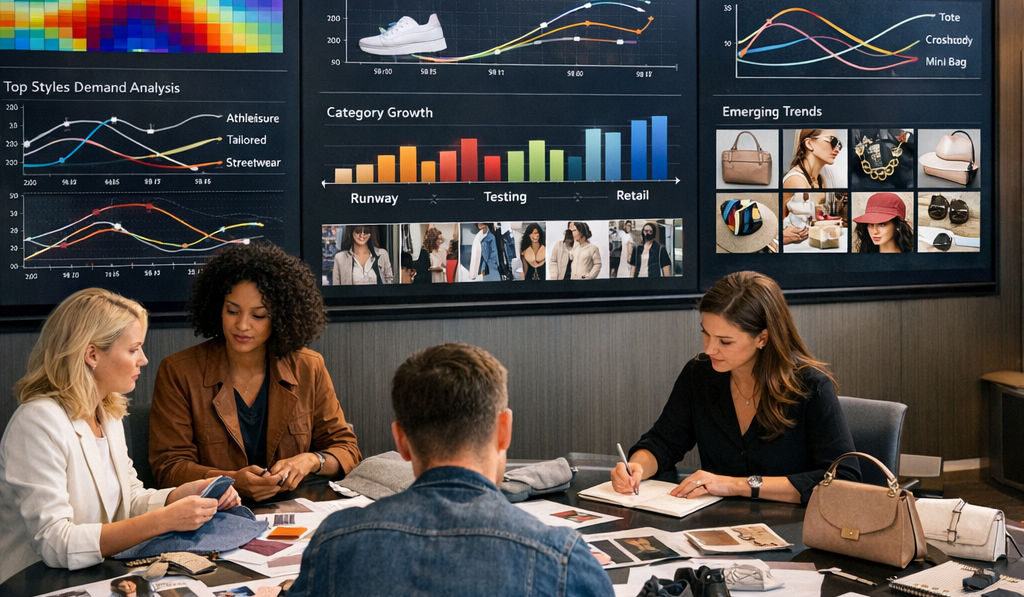
To make AI trend forecasting a durable capability rather than a one-season pilot, AFL leaders need a clear scoreboard and change plan. On the KPI side, focus on forecast accuracy (by category, cluster and time horizon), full-price sell-through, markdown rate and depth, inventory turns, and stockouts on hero styles and sizes. Academic work on AI-enhanced demand forecasting across retail sectors suggests that, when models are trained on high-quality data and integrated into decisions, forecast errors can shrink by 20–50%, with corresponding drops in overstock and lost sales (WJARR). Fashion-specific work on size-curve optimisation in luxury illustrates similar upside when decisions move from one-size-fits-all curves to store- and tribe-specific models (Politecnico di Torino). Experimentation should follow a phased approach. Phase one: run AI in shadow mode for a handful of categories (denim, dresses, sneakers) and markets, comparing its forecasts and recommended buys against human decisions without changing orders. Phase two: move to assisted mode for specific levers – for example, use AI recommendations to adjust color depth or store allocations on 20–30% of the buy while keeping the rest in the traditional process. Phase three: embed AI into formal S&OP and Open-to-Buy processes with clear thresholds for when to follow or override its guidance. Case studies like Miroglio Fashion’s collaboration with Evo Pricing (“AI with a human touch”) show that blended human–AI decisioning, with clear reason codes and feedback loops, is what produces sustained performance gains (Springer / RePEc). Change management is as critical as the models. Merchandisers and planners must see AI as a co-pilot, not a verdict. Recommendations need transparent drivers: “acceleration in social and search signals for this silhouette,” “early sell-through above plan in these markets,” “returns risk elevated for this fabric in hot climates.” Governance should cover data contracts between PLM, PIM, POS, ecommerce and SageRetail; if product attributes are messy or late, even the best algorithms will misfire. Strategically, this topic scores strongly against MapleSage’s framework: niche but growing search interest (~20 searches/month for “fashion trend forecasting AI”), very high commercial intent, tight alignment with Campaign 3 (Fashion Merchandising Automation & Trend Intelligence), and clear ICP fit for VP Merchandising, Buying Directors, Fashion CTOs and E-commerce leaders. It also differentiates MapleSage by emphasising real-world implementation and workflow integration, not just abstract AI potential.